
Editorial voice: Monem · Published 2026-10-11 · Article resources updated November 18, 2026
Key takeaways
- Assign each deposit to expenses due before the next payday.
- Reserve money for later bills and unexpected expenses.
- Check the payment calendar and revise the plan when income changes.
General educational information, not personalized financial advice. Read our Financial Disclaimer.
Source note: Some pre-existing anecdotal references could not be verified. Those statements are marked accordingly and should not be relied upon as evidence.
To budget by paycheck, decide what each deposit must cover before the next one arrives, including money you need to hold for bills further ahead. That last part matters. A paycheck can look comfortably large on Friday and still have very little available for the weekend.
Nick Vega, an IT manager on Long Island, described learning that lesson in a published interview with Money Management International. While enrolled in its debt management program, he had to make sure his paycheck could cover the program’s monthly payment. That repeated task helped him get more deliberate about his other bills, too. His experience involved a structured debt repayment program, so it wasn’t simply a matter of finding the right budget template. [source]
Still, there’s a useful place to begin in his story: identify an obligation, protect the money for it, and repeat the process when you get paid.
You don’t have to map out a flawless financial year today. You need a workable answer to a smaller question: What does this paycheck need to do before I can safely spend any of it?
Why a monthly budget can still leave you short
Related reading: Explore our monthly budget guide for a complementary approach.
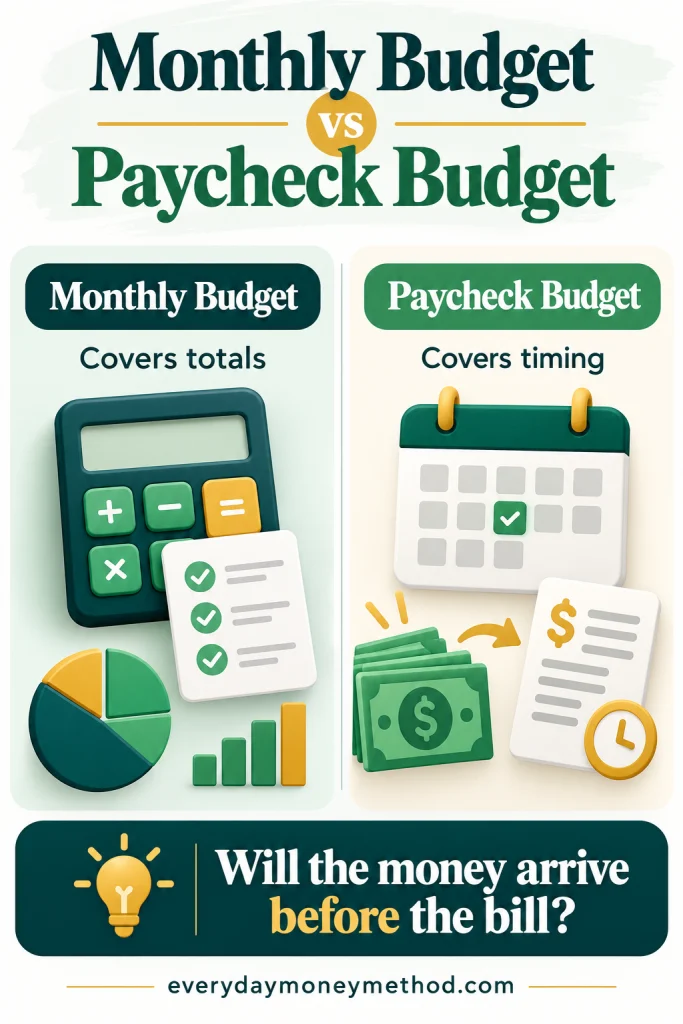
A monthly budget tells you whether your income can cover your overall spending. A paycheck budget adds the calendar: will the money be available when each expense hits?
The Consumer Financial Protection Bureau’s cash flow worksheet follows money through individual weeks, carrying each ending balance into the next week. That makes a shortage visible even when the month’s totals seem manageable. [source]
Imagine that rent is due on Tuesday and your next paycheck arrives Friday. Money arriving Friday cannot pay Tuesday’s bill on time unless you already have enough set aside or have arranged a different payment date.
There are two problems to look for:
- A timing problem: You can afford your expenses overall, but income and due dates don’t line up.
- An income gap: Your essential expenses and required payments exceed the money you bring home.
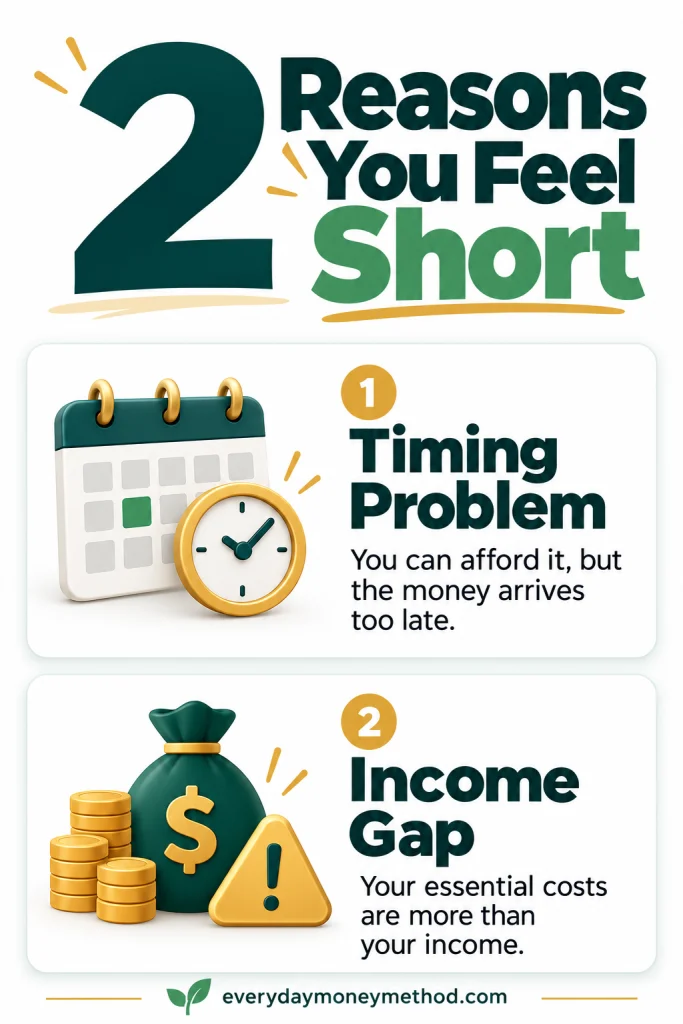
Paycheck budgeting helps you see both. Moving a due date may help the first problem. The second requires an actual change in income, costs, assistance, or payment terms. A tidier calendar cannot supply missing dollars.
How to budget by paycheck in six practical steps
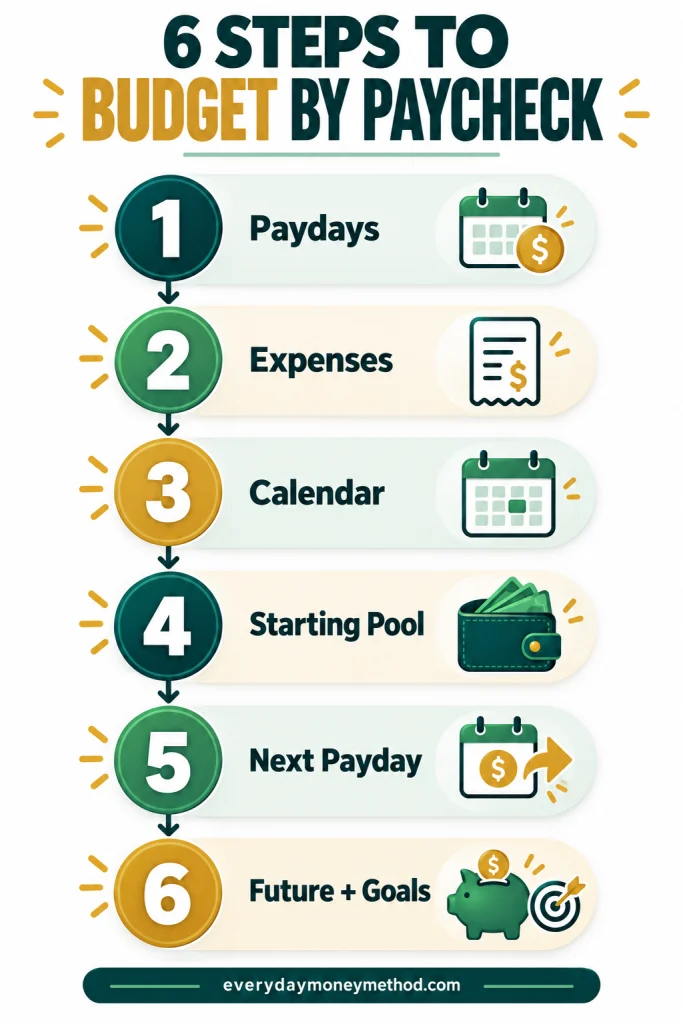
Step 1. Write down your actual take home pay and paydays
Related reading: Explore our emergency fund guide for a complementary approach.
Use the amount that reaches your account after payroll deductions. Your salary before taxes, health insurance, and other deductions isn’t the amount available to pay bills. [source]
Then check your employer’s payroll calendar. These schedules are different: [original source not verified]
| Pay schedule | When you generally get paid | Usual paychecks per year |
| Weekly | Every week | 52 |
| Biweekly | Every two weeks | 26 |
| Semimonthly | Twice a month on scheduled dates | 24 |
| Monthly | Once a month | 12 |
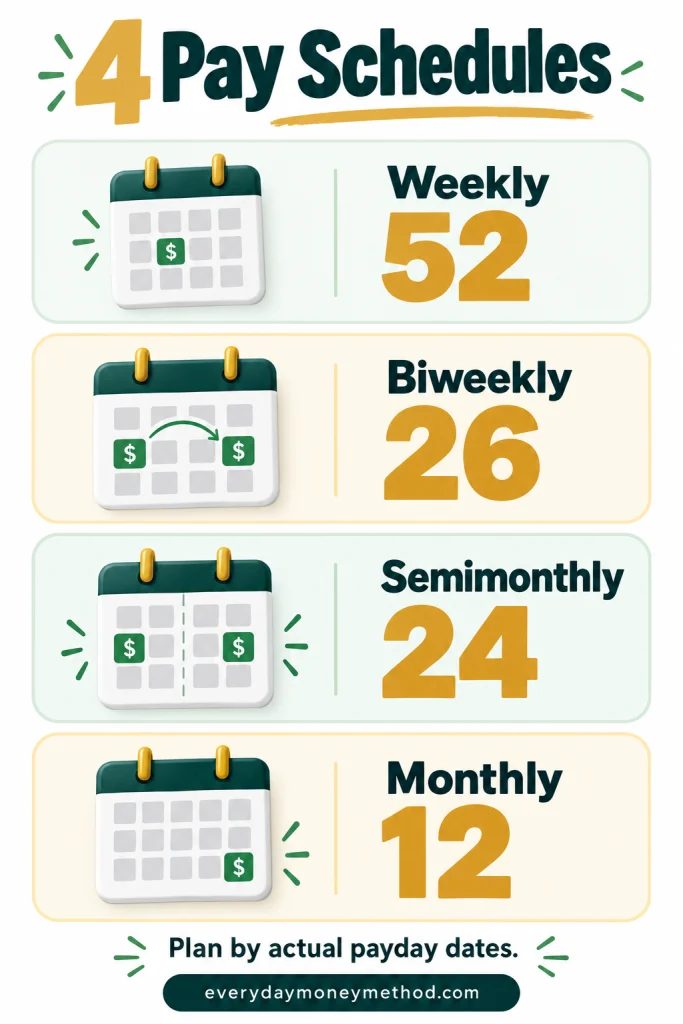
Those are usual counts. Some calendars produce an additional weekly or biweekly payday. Holidays and employer policies can also affect the deposit date, so build your plan around the dates your employer actually provides. [original source not verified]
If you’re paid every other Friday, don’t label your budget “twice a month.” That small mix-up changes how you fund bills and treat months with three paychecks.
For now, write down the next four to six weeks of expected deposits. Leave uncertain overtime and bonuses out of the money you’re committing to essential bills.
Step 2. Find your real expenses before setting new limits
Gather recent pay stubs, bank statements, credit card statements, and bills. Consumer.gov recommends building a budget from income and expense records, then tracking what you actually spend and revising the plan. [source]
A practical starting point is your last one to three months of transactions. Also scan the past year for expenses that happen less often, such as vehicle registration, annual subscriptions, school fees, and insurance premiums.
Include spending that doesn’t look like a traditional bill: laundry, parking, prescriptions, diapers, pet food, and the lunch you buy during a long shift.
Be careful with category labels. Groceries vary, but you still need to eat. A subscription may cost the same amount every month and still be optional. University of Illinois financial educators distinguish how often an expense changes from whether it’s a need or a want. [source]
Your first plan should describe your life well enough to work. You can make changes after you see the actual numbers.
Step 3. Put bills and paydays on the same calendar
Related reading: Explore our debt payoff guide for a complementary approach.
List each bill’s amount and due date beside your paydays. The CFPB’s bill calendar recommends recording what the payment is for, how much is owed, and when it’s due. [source]
Then look beyond the bills due before your next deposit. A large payment shortly afterward may need money from this paycheck, too.
For example, if your $1,200 rent is due December 1, and you get paid November 6 and November 20, you might reserve $600 from each check. Waiting until November 20 to think about the entire rent payment could crowd out groceries and other bills.
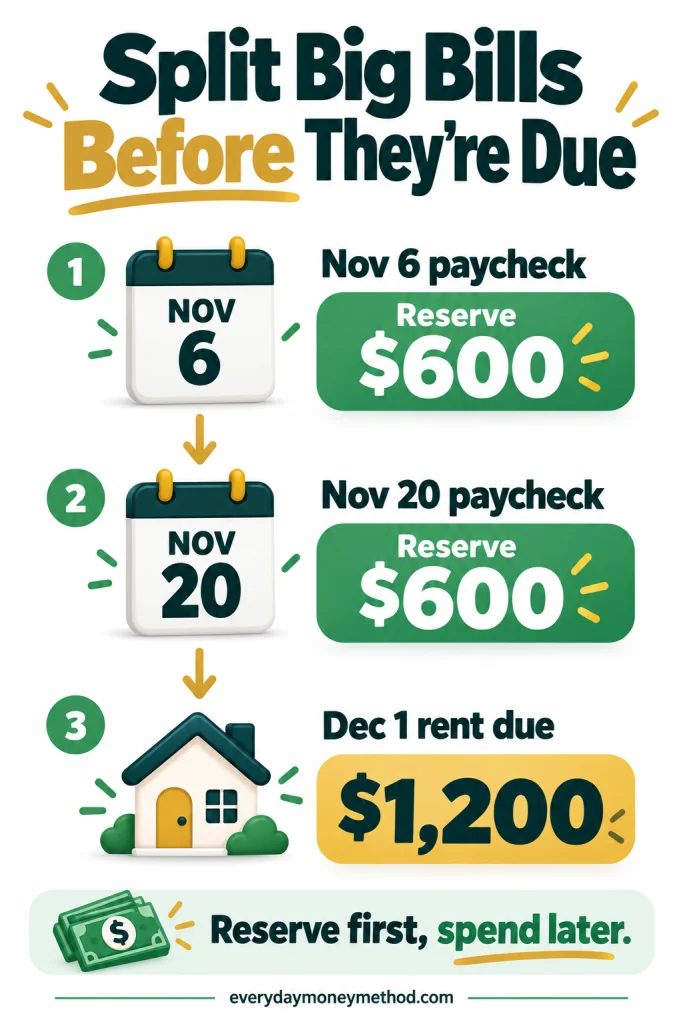
Mark when a payment needs to be initiated as well as its due date. A scheduled payment isn’t necessarily an immediately completed payment. Allow for the biller’s and bank’s processing rules.
Step 4. Separate the account balance from money you can assign
Before allocating a new paycheck, reconcile what is already in your account.
If your checking balance includes $600 reserved for rent, that money already has a purpose. Don’t treat it as available income again just because a new payday arrived.
Your starting pool is:
New take-home pay + unassigned carryover − any uncovered starting shortfall.
For example, a $1,800 deposit into an account already $100 overdrawn leaves $1,700 before additional charges. Include any charges not yet reflected, but don’t deduct the same shortfall again if you’re already working from the post-deposit balance.
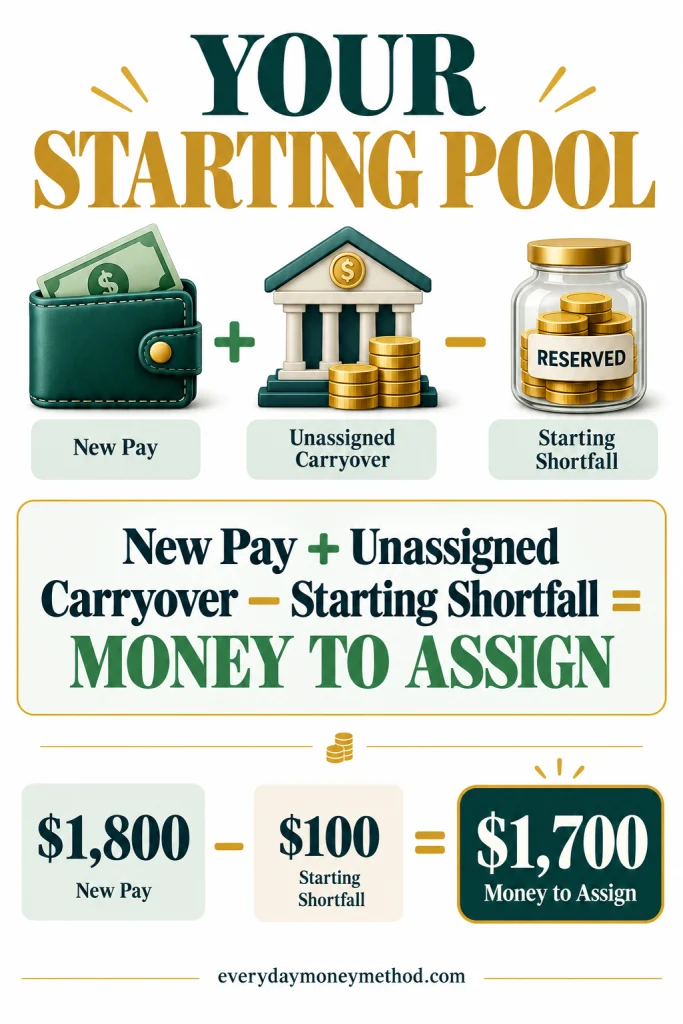
Keep a separate record of existing bill reserves and upcoming withdrawals. Account for payments that haven’t yet been reflected in the balance you’re using, but don’t subtract the same pending transaction twice.
This can be a notebook, a spreadsheet, an envelope system, or an app. University of Minnesota’s budgeting guidance describes several ways to organize spending; choose one you can keep updated. [original source not verified]
The useful feature is visibility. You should be able to tell how much belongs to rent without doing mental subtraction at the grocery store.
Step 5. Fund everyday life until the next payday
Assign money for food, transportation, medication, child care, and other needs through the day before your next paycheck.
Make those amounts fit the actual interval. A school break may mean more meals at home or different child care costs. A longer gap between scheduled deposits may need more grocery money.
If $280 must cover groceries and household supplies for two weeks, you might use $140 as a weekly checkpoint. It doesn’t have to be a rigid rule. Buying a large package of diapers in week one may leave less for week two, and your running balance should show that.
The question isn’t just whether a purchase fits today’s bank balance. It’s whether the remaining amount can cover the rest of this pay period.
Step 6. Assign the remaining money to future costs and goals
After current obligations and everyday needs, allocate money to predictable future expenses, a cash reserve, extra debt payments, and personal spending as your budget allows.
You can give every dollar a purpose without spending every dollar. A zero-based paycheck plan means zero dollars left unassigned, including dollars assigned to savings. It doesn’t mean an empty checking account. [source]
If the amounts don’t fit, adjust the plan before using it. Reduce a flexible category, change a savings contribution, investigate a payment arrangement, or work through the shortfall section below. Don’t fill the gap with income you merely hope will arrive.
A worked example with two paychecks
Jordan is a fictional U.S. worker. Every amount below is illustrative, not a national average or a recommended spending target. The dates are real calendar dates so you can follow the timing.
Jordan receives $1,800 after payroll deductions every other Friday. The next paydays are November 6, November 20, and December 4, 2026.
November’s rent and living costs through November 5 have already been covered by earlier funds. There are no overdue bills and no additional unassigned cash. This plan shows how Jordan allocates the next two deposits, including money needed in December.
| Purpose | November 6 | November 20 |
| Reserve for December 1 rent | $600 | $600 |
| Utilities due November 12 | $160 | $0 |
| Phone and internet due November 13 | $120 | $0 |
| Car payment due November 24 | $200 | $120 |
| Auto and renters insurance due November 25 | $0 | $160 |
| Existing credit card minimum due November 30 | $0 | $100 |
| Groceries and household supplies until next payday | $280 | $280 |
| Gas and transportation | $100 | $100 |
| Prescriptions and copays | $40 | $40 |
| Funds for planned future costs | $100 | $100 |
| Starter cash reserve | $100 | $200 |
| Personal spending | $100 | $100 |
| Total assigned | $1,800 | $1,800 |
Notice what happens with the car payment. Jordan holds $200 from November 6, adds $120 from November 20, and makes one $320 payment by November 24. Reserving money and paying a bill are two different events.
The same approach puts the full $1,200 rent in place before December 1. Meanwhile, the second paycheck’s everyday spending money must last from November 20 through December 3. Crossing into December doesn’t create a new grocery allowance.
If Jordan uses all the spending allowances and makes the listed payments, $500 from these checks remains: $200 for planned future expenses and $300 in the starter reserve. Only $300 belongs to that reserve. The other $200 is already committed to a different purpose.
The credit card minimum is a payment on existing debt. It isn’t a substitute for funding new groceries or other purchases. Those purchases have their own assigned cash in the plan.
Your amounts may look very different. The transferable part is the sequence: reserve, combine when necessary, pay, and carry the remaining balances forward.
Starting with no cushion
Jordan’s plan starts after the current rent has been paid. That matters if you’re starting today with nothing saved and rent almost due.
Suppose your next check is $1,800. Rent of $1,200 is due in five days, and you need another $700 for essential expenses before the following payday. You’re $100 short:
Setting aside “half the rent from each paycheck” won’t fix this first payment. Only one paycheck arrives before the due date.
You need an actual $100 change: lower spending you can safely reduce, additional spendable resources, or an approved arrangement that reduces what’s required during this interval.
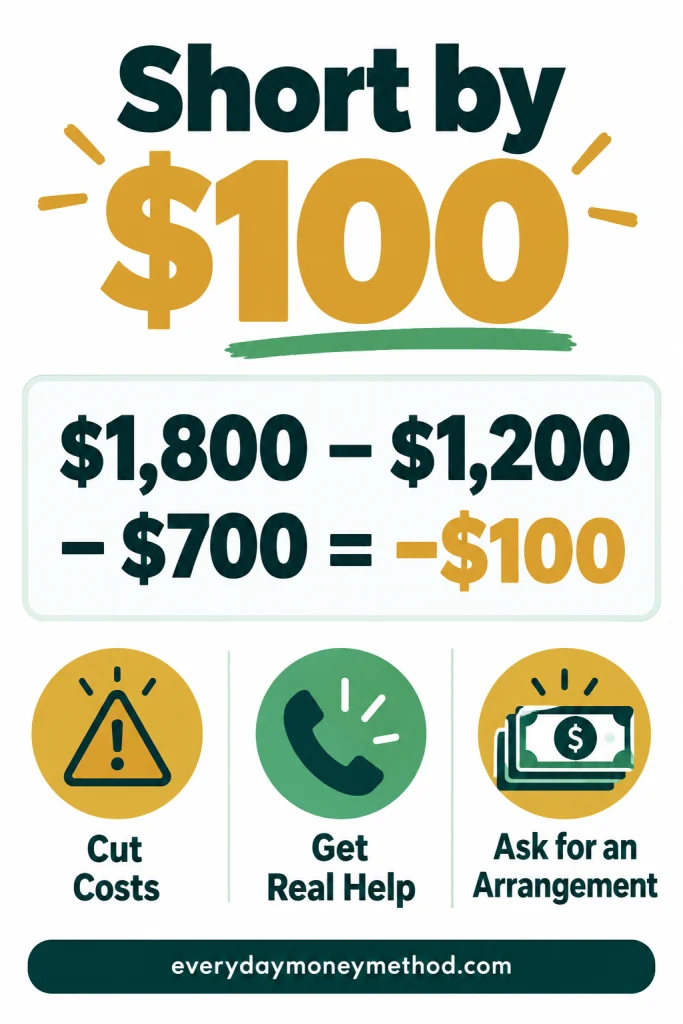
The CFPB recommends considering the consequences of missed payments and contacting creditors when you’re struggling. Housing, the ability to work, insurance, and other essential obligations deserve attention when you can’t pay everything. [source]
Call before the due date when possible. Ask what options exist and confirm the amount, new date, and any fees in writing. A landlord or creditor may not agree to partial payments or a date change. [source]
If a payment moves into the following pay period, put it in that period’s plan immediately. Delaying it doesn’t erase it. Once you’ve handled the immediate gap, begin reserving smaller amounts ahead of the next large bill.
Why monthly averages can mislead biweekly workers
A worker receiving $1,800 across 26 paychecks brings home $46,800 in a year. Divide that by 12 and the monthly average is $3,900.
But a month with two paychecks delivers $3,600, not $3,900.
The annual average is useful for a yearly overview. It doesn’t tell you how much cash will arrive before this month’s bills. PNC describes using two biweekly checks for a conservative monthly spending plan; the actual payday calendar still determines when money becomes available. [source]
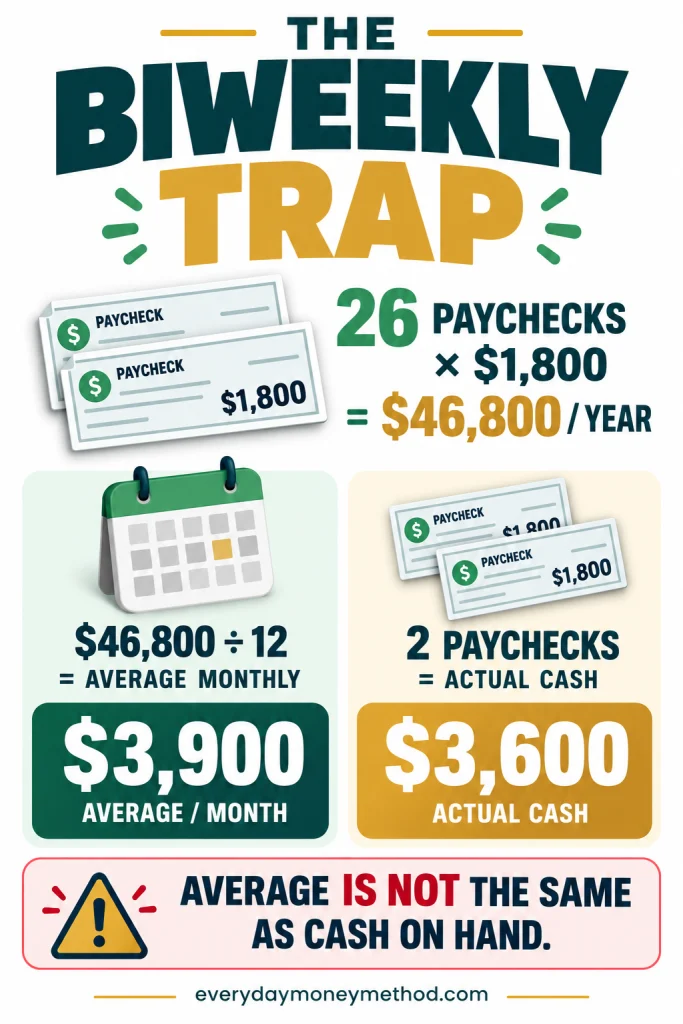
There’s a related trap with monthly bills. To spread $1,200 monthly rent across 26 checks, you might calculate:
That funds a year’s rent when used consistently across a full 26-paycheck cycle. However, two deposits of $553.85 total $1,107.70. Starting with no rent reserve, you’d still be $92.30 short when $1,200 comes due after only those two deposits.
Annual math and an on-time first payment are separate checks. Use your calendar to determine the startup amount you need.
You can instead reserve $600 from the first two paychecks of each month toward the following month’s rent. If you reserve $600 from all 26 checks, you’ll set aside $15,600, enough for 13 months of $1,200 rent. That could be an intentional way to get ahead. Just know which plan you’re using.
And when a third paycheck arrives, fund the next pay period’s groceries, transportation, and other obligations before deciding how much is available for savings or extra debt payments.
Give predictable expenses a place in the plan
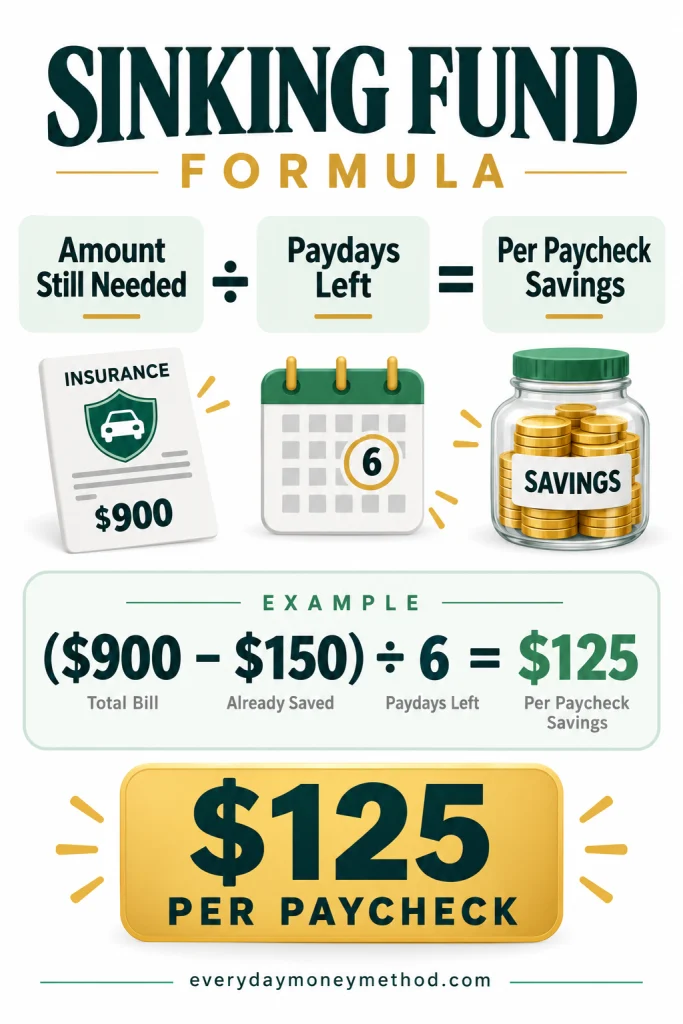
A registration renewal doesn’t become an emergency just because the bill arrives infrequently. Planned expenses need their own space in the budget.
In a NerdWallet article, writer Amanda Barroso described how she and her husband use separate savings buckets for costs such as home repairs, their child’s tuition, car expenses, and holidays. Seeing the categories helped her keep those goals organized. [original source not verified]
You can use that idea without opening an account for every expense. A simple list of balances can show how much of your savings belongs to each purpose.
These reserves are often called sinking funds. Set the contribution by the deadline, not automatically by the number of paychecks in a year:
Amount still needed ÷ paydays remaining before the expense = contribution per paycheck.
For a hypothetical $900 insurance bill, with $150 already saved and six paydays remaining, the calculation is:
If you can’t afford $125, that is useful information while you still have time to act. You might investigate a different payment schedule, adjust other spending, or revise the plan. Any new installment arrangement belongs in the calendar, including its fees.
Start with a few expenses most likely to disrupt your budget. You don’t need twenty perfectly named categories before saving for the next registration renewal.
Handling paychecks that cross into a new month
An anonymous Reddit poster asked how to handle groceries when a January 23 paycheck had to last until the next payday on February 6. They weren’t sure how a monthly grocery budget should work when the paycheck straddled two months. [original source not verified]
The practical answer is to keep the paycheck’s spending allowance available through the period it was meant to cover.
You can still record a February 2 grocery purchase in February’s expense report. Reporting spending by calendar month and assigning cash by payday are compatible. They answer different questions.
The date changing from January 31 to February 1 doesn’t refill the grocery category. Carry the remaining balance forward and avoid assigning the same money again.
Build a buffer that changes your next payday
As money becomes available, give your reserves clear purposes. Schwab’s cash management guidance distinguishes money for transactions, unexpected needs, and planned purchases. [source]
| Type of money | What it does | Example |
| Bill or checking buffer | Helps already planned payments clear despite a timing mismatch | Cash ready for an early-month bill |
| Sinking fund | Covers a known or anticipated cost | Registration or an annual premium |
| Emergency fund | Covers an unplanned financial shock | An unexpected repair or lost income |
You can track these within a small number of accounts. What matters is not counting the same dollar as available for several jobs at once.
The CFPB explains that an emergency savings goal depends on your situation and that even a small amount can provide some protection. Your first useful target might be enough to absorb a specific small surprise, rather than a large round number you can’t currently reach.
Then work toward funding one coming pay period’s obligations before that paycheck arrives. The target is the amount those obligations require, which may differ from your paycheck amount.
A later goal is a month ahead: cash already available to fund the following month’s expenses. YNAB describes this approach as building a one-month buffer. [source] The idea can work with a notebook or spreadsheet, too.
These are milestones to work toward as your numbers allow. They aren’t three separate claims on the same savings. If you use reserve money to pre-fund next month’s rent, that money now belongs to rent.
Adjust the method for irregular pay and shared bills
If your hours, tips, or commissions vary, begin with a conservative estimate supported by your own pay history. Utah State University Extension describes using a low-income baseline and holding surplus from stronger months to help cover weaker ones. [source]
Treat that baseline as an estimate. A previous low month is not a guaranteed minimum. When the deposit arrives, allocate the actual amount and update any plan that relied on a higher number.
For gig work, customer payments may also need to cover business costs and taxes. The IRS explains that independent contractors may need estimated tax payments, while some workers with both employee and gig income can adjust withholding. Don’t apply an arbitrary tax percentage or treat gross business receipts as household spending money.
If you share bills with a partner, put both people’s paydays and agreed contributions on one household calendar. You can keep separate accounts and still coordinate the same rent payment. The key is to assign each shared obligation once and make it clear who holds the money and who sends the payment.
A payday routine you can repeat
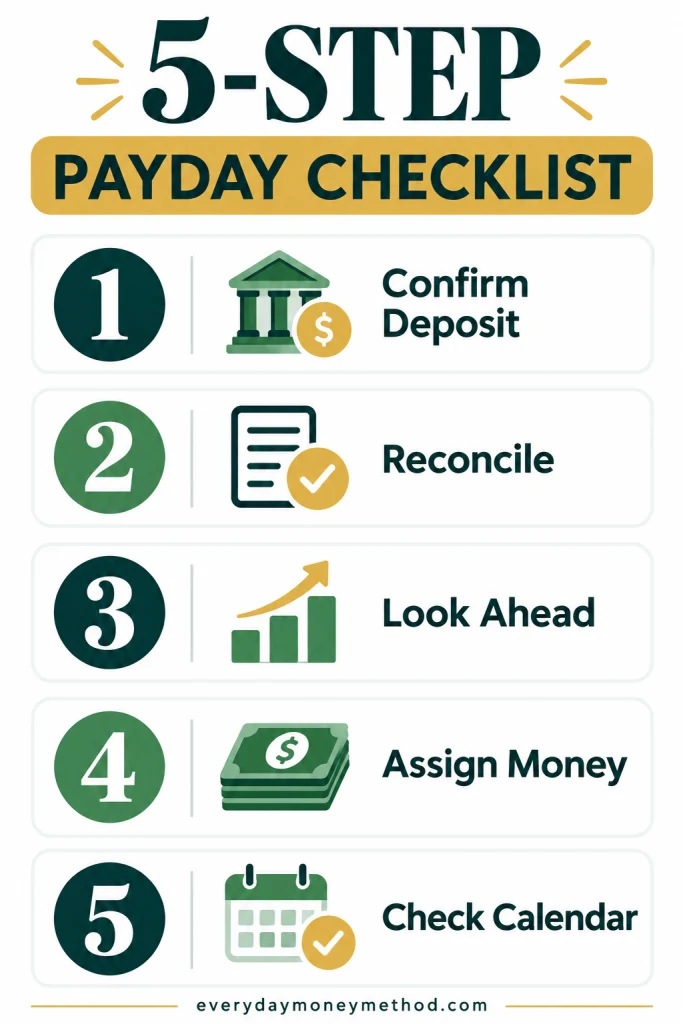
Set aside a short block of time when your deposit arrives. Ten to fifteen minutes is a reasonable starting appointment, not a requirement.
- Confirm the deposit. Use the amount actually received.
- Reconcile the balances. Check withdrawals, bills already paid, and money already reserved.
- Look ahead. Review obligations through the next payday and large bills beyond it.
- Assign the money. Cover bills, everyday needs, planned expenses, and savings as the numbers allow.
- Check the calendar again. Confirm that each payment has enough funding before it’s initiated.
Autopay can help execute the plan, but it can’t decide whether the account is funded. Check changing bill amounts and confirm payments complete successfully, especially after setting up or changing an automatic payment. [source]
A brief check halfway through the pay period can catch a grocery overrun while you still have choices. If you move $25 from personal spending to groceries, update both balances. That’s a plan adjustment you can see and evaluate.
What to do when the numbers truly don’t fit
Sometimes a close look at the budget confirms that you’re already stretching too little money across too much life.
Ashley Coté, a medical billing worker in Washington state, described that pressure in a Financial Health Network feature. She was already working full time, taking on extra work, and sharing housing costs with her mother. Her family’s expenses still pushed her toward debt. When a $1,100 basketball fee came up for her son, she asked the director to split the payments and reached an arrangement. [original source not verified]
Her story shows why “just earn more” or “just spend less” can be incomplete advice. It also offers a specific action: ask about a payment arrangement before assuming the entire bill must be paid at once. An arrangement changes timing; it doesn’t automatically make a cost affordable.
Research from JPMorgan Chase Institute also identifies limited discretionary spending among many households with low incomes, which constrains how much they can save by cutting it. Its findings come from Chase account data and do not describe every U.S. household. [source]
If your plan has a recurring deficit, write down its size and frequency. A $100 gap in one pay period needs a different response from being short $400 every month.
Then focus on the changes that could materially affect that gap:
- Address urgent bills. Ask the provider about due dates, hardship options, or payment plans. Confirm what is approved rather than assuming an option applies to your account.
- Check local assistance. 211 can help you look for resources for needs such as housing, food, and utility bills. Availability and eligibility vary. [source]
- Check energy assistance separately. USAGov directs households to LIHEAP and explains that rules differ by state. Eligibility and funding aren’t guaranteed. [source]
- Get help reviewing unmanageable debt. An NFCC-connected counselor can review your income, expenses, and options. Ask about fees before enrolling in a service. The FTC cautions that nonprofit status alone doesn’t mean a service is free or trustworthy. [source]
Larger changes, such as different housing, transportation, hours, or employment, deserve attention when they’re feasible. Include the costs of making the change. Additional work that requires child care, commuting, or business expenses won’t add its full gross earnings to your budget.
If the math doesn’t balance, the useful result of the budget is a clearly identified gap. That gives you something specific to address.
Common paycheck budgeting questions
Choosing budget percentages
Percentage rules can be a starting point, but they don’t replace your actual bills and available income. PNC presents 50/30/20 as a guideline that may need adjusting. [source]
Use your first paycheck plan to make required payments visible. If essential costs exceed 50% of take-home pay, forcing them into a smaller box on paper doesn’t change the amount due.
Balancing savings and extra debt payments
There isn’t one answer for every household. FINRA discusses both emergency reserves and reducing debt as parts of a financial foundation. [source]
First see whether essential expenses and required payments fit. Then weigh the value of an accessible reserve against the cost of carrying debt. Extra payments shouldn’t quietly use money already committed to rent or the next week’s food. If required payments themselves are unaffordable, seek a review of your options.
Avoiding double counting with credit cards
If you track purchases by category, a $75 grocery charge reduces the grocery category when you make the purchase. Hold the corresponding cash for the card payment. Sending that $75 to the card later is the settlement of the purchase, not another $75 of groceries.
Budget the planned payment on older debt, including any fees it already covers, once. Add other amounts separately only when they aren’t already accounted for. Keep that debt payment distinct from cash reserved for current purchases. Whichever tool you use, reconcile its categories with what your accounts actually owe and hold.
Choosing accounts and budgeting tools
No particular product is required. Paper, spreadsheets, envelopes, and digital tools can all help organize a budget. [original source not verified]
Choose a system that lets you answer three questions quickly: what is already reserved, what must last until payday, and what can be reassigned?
Start with the paycheck in front of you
Nick described reserving money for a regular payment as a habit that helped him budget his other bills. Your first task can be equally concrete. [source]
Write down your next payday, the amount you expect to receive, the bills that need funding, and the cost of getting through to the following deposit. Include the large bill waiting just beyond it.
If there’s a gap, identify it. If something is left, give it a purpose before spending it. Then carry the balances forward when you get paid again.
Learning how to budget by paycheck gives you a plan for the money arriving now and a way to prepare for what comes next. Progress starts when the next bill has money waiting for it.
Put the Numbers on Paper With a Paycheck Budget Worksheet
The first few times you budget by paycheck, it helps to see the entire decision on one page. Start with the money that is actually available: your take-home pay and any balance you are intentionally carrying forward. Then work through the bills due before the next payday, everyday spending, savings or sinking funds, and personal spending.
The most useful number is the one at the bottom: what is left to assign. That amount should not be confused with “extra money.” Before spending it, look ahead for expenses that have not arrived yet.
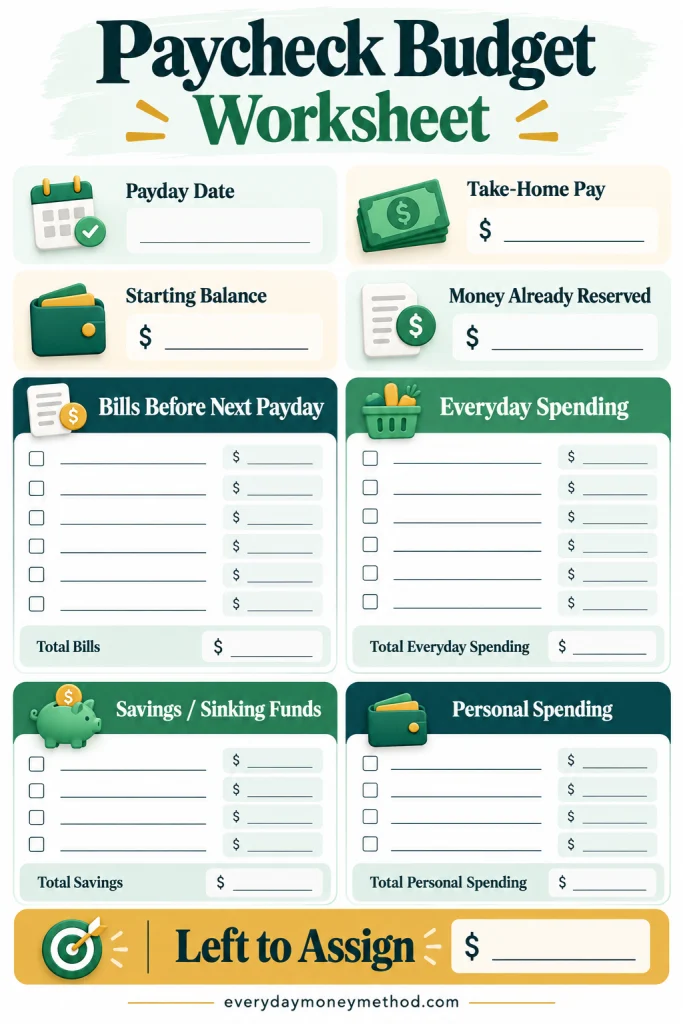
Use this paycheck budget worksheet to assign one paycheck before the next payday arrives.
Put Your Bills and Paydays on the Same Page
A monthly total can tell you that you earn enough to cover your bills and still fail to tell you whether the money will be there on the day a bill is due. That is why the next step is less about categories and more about timing.
Write down the bills coming up, their due dates, and the amount you need for each one. Then mark whether the money has already been set aside. The short to-do list underneath turns that information into action: review the next payday, cover essentials, reserve money for larger bills, check subscriptions, and prepare for the paycheck that follows.
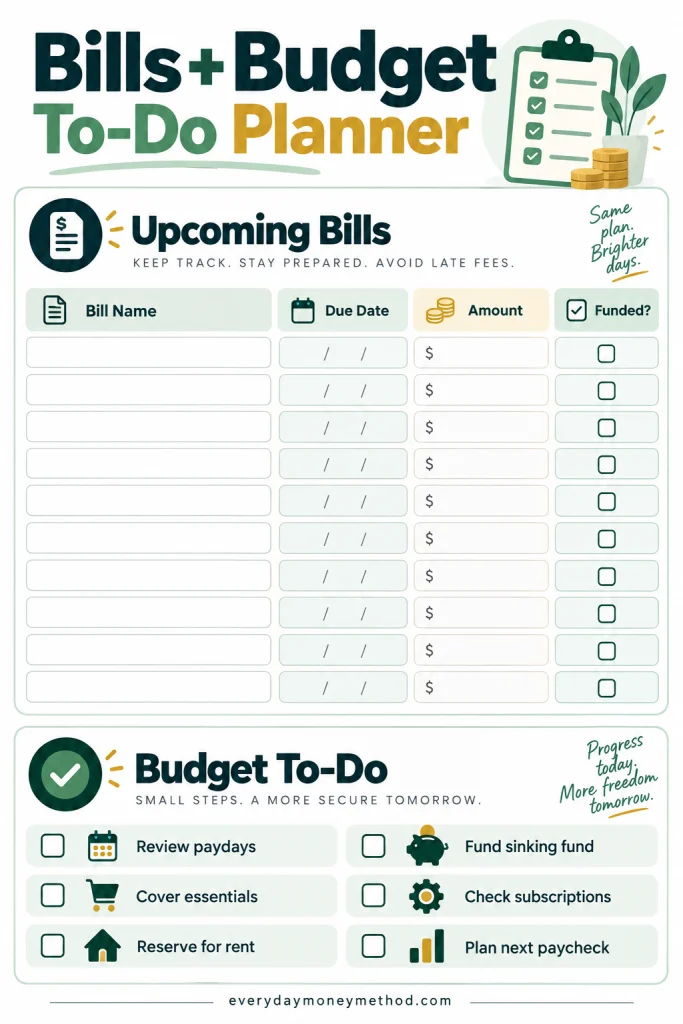
Track upcoming bills first, then turn them into a short budget to-do list.
This is especially useful when rent, insurance, or another large bill falls close to one payday. Seeing it early gives you the chance to reserve part of an earlier paycheck instead of discovering the shortage when the bill arrives.
Give Yourself the Same Payday Routine Every Time
Payday can feel like the moment when there is finally room to spend. A simple routine changes that order. Instead of deciding what is affordable after purchases begin, make a few decisions while the deposit is still intact.
Confirm what actually arrived, update your available balance, review bills and due dates, fund groceries and transportation, set aside money for rent or other future obligations, and decide whether anything can move to savings. Only then look at what is left.
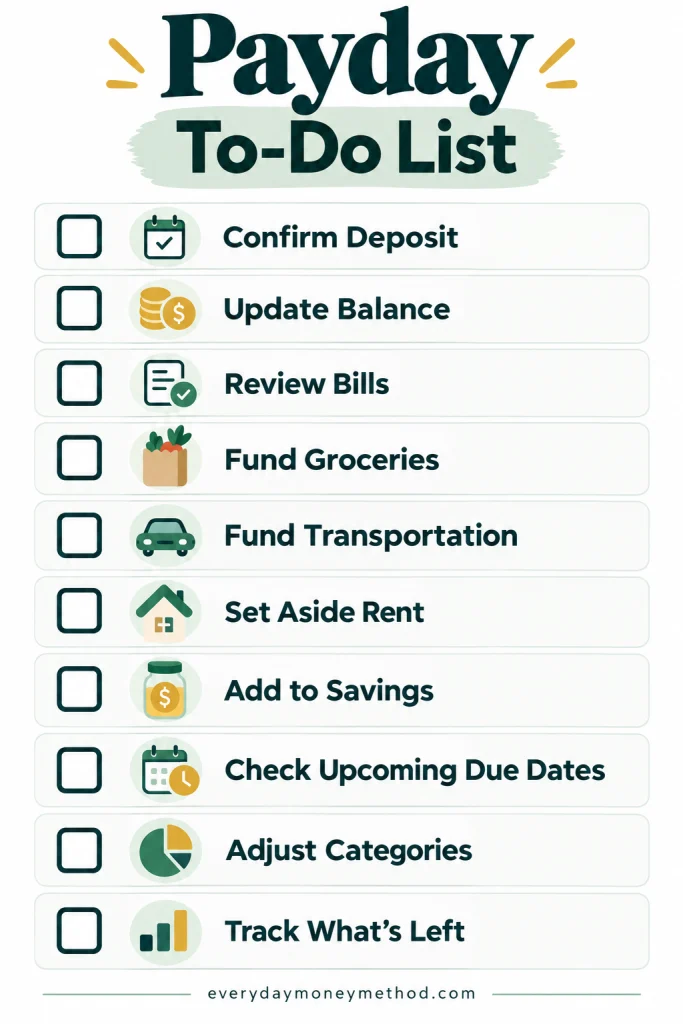
A simple payday checklist can keep the first few hours after a deposit from setting the tone for the entire pay period.
You do not have to make ten perfect decisions. The value of this checklist is repetition. Following the same sequence every payday makes it harder for an important bill to become an afterthought.
Plan the Days Between This Paycheck and the Next One
A paycheck budget can look balanced on payday and still fall apart ten days later. The gap is usually in the ordinary days between the big bills: another grocery trip, fuel, lunch, a school expense, or one purchase that was not in the plan.
If your next paycheck is roughly two weeks away, use a 15-day plan to give that stretch of time some structure. Start with the bills and spending categories the paycheck must cover, then use the daily boxes to note expenses, reminders, no-spend days, or small adjustments.
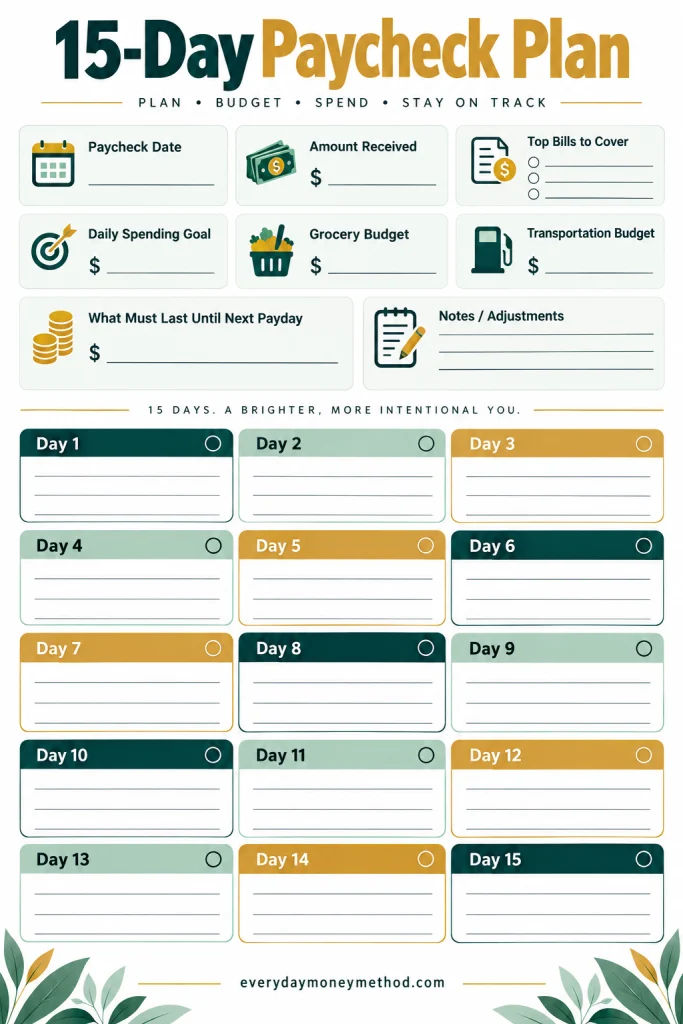
Use a 15-day paycheck plan to track the stretch between one payday and the next.
The goal is not to create fifteen tiny daily budgets. It is to keep the remaining money visible long enough to notice when the plan is drifting. If Day 8 looks very different from what you expected on Day 1, you still have time to adjust before the next payday.
30-Day Paycheck Reset Planner
One paycheck budget can prevent a bad week. Repeating the process for a month is where you start learning what needs to change.
For the next 30 days, choose one realistic goal. It might be keeping a small amount in checking before payday, getting one bill funded earlier, reducing one spending category, adding to savings, or simply finishing the month without being surprised by a due date.
Use the planner to keep upcoming bills visible, set a savings or payment goal, and check in with spending each week. The 30-day tracker is not there to measure perfection. It is a reminder to come back to the plan before small changes turn into another shortfall.
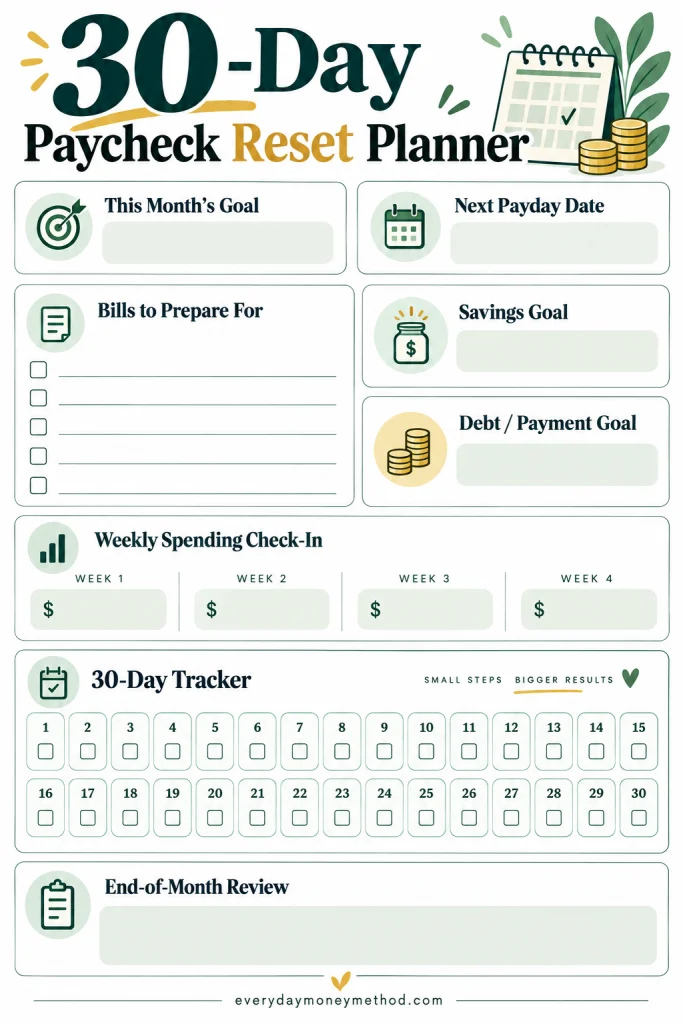
Use the 30-day reset to turn individual payday decisions into a repeatable monthly routine.
At the end of the month, look at what changed. Which paycheck felt tight? Which expense kept showing up higher than expected? What did you manage to fund earlier than before? Those answers are more useful than whether the month went exactly according to plan. They become the starting point for your next paycheck budget.
References and further reading
- Consumer.gov — Making a budget
- CFPB — Cash flow budget and bill calendar
- Money Management International — Nick’s debt repayment interview
- Utah State University Extension — Irregular income budgeting
These resources support the general educational topics discussed; individual circumstances and current rules may differ.
Continue learning
monthly budget guide · emergency fund guide · debt payoff guide · saving money quickly

Personal finance writer and content creator at Everyday Money Method.
Editorial Policy · Report a correction