
Editorial voice: Monem · Published 2026-10-08 · Article resources updated November 18, 2026
Key takeaways
- Check employer plan terms, matching and vesting before selecting contributions.
- Review traditional and Roth options, investment choices and fees.
- Use the current IRS limits for the applicable tax year.
General educational information, not personalized financial advice. Read our Financial Disclaimer.
Your benefits portal asks what percentage of your paycheck you want to save, and suddenly a small box feels like a very big decision. This 401(k) for beginners guide starts with the question that matters first: what can you put toward retirement without making this month’s bills harder?
You can begin by checking your employer’s match, choosing an affordable contribution, and making sure that money goes into investments you understand. The first contribution doesn’t have to solve your entire retirement plan. It needs to be a decision you can explain, afford, and revisit.
Let’s work through the choices in the order you’ll actually make them, including what to check after you click Submit.
What is a 401(k), and how does it work?
Related reading: Explore our beginner investing guide for a complementary approach.
A 401(k) is an employer-sponsored retirement savings plan that lets eligible employees contribute part of their pay to an account with tax advantages. Your employer may contribute money, too. You generally choose investments from the options available in the plan.
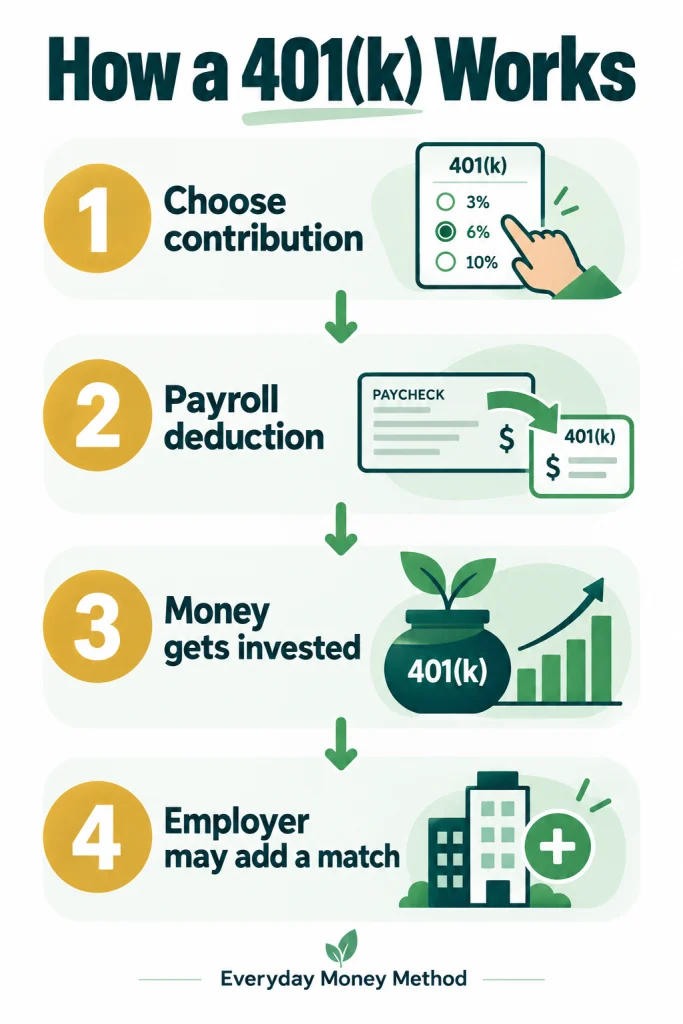
Here’s what happens after enrollment:
- You select a contribution percentage or dollar amount.
- Payroll deducts that contribution from your paycheck.
- The money enters your retirement account and is invested according to your selections or the plan’s default.
- Your employer adds any contributions you’re eligible to receive under its rules.
The balance changes as money goes in, investments rise or fall, fees are charged, and any withdrawals occur. Its investment results depend on what you hold inside it.
That distinction helps when you’re looking at the enrollment screen. How much you contribute is your saving decision. Where the contribution is invested is your investment decision. Both deserve attention.
401(k) for beginners: Seven steps to get started
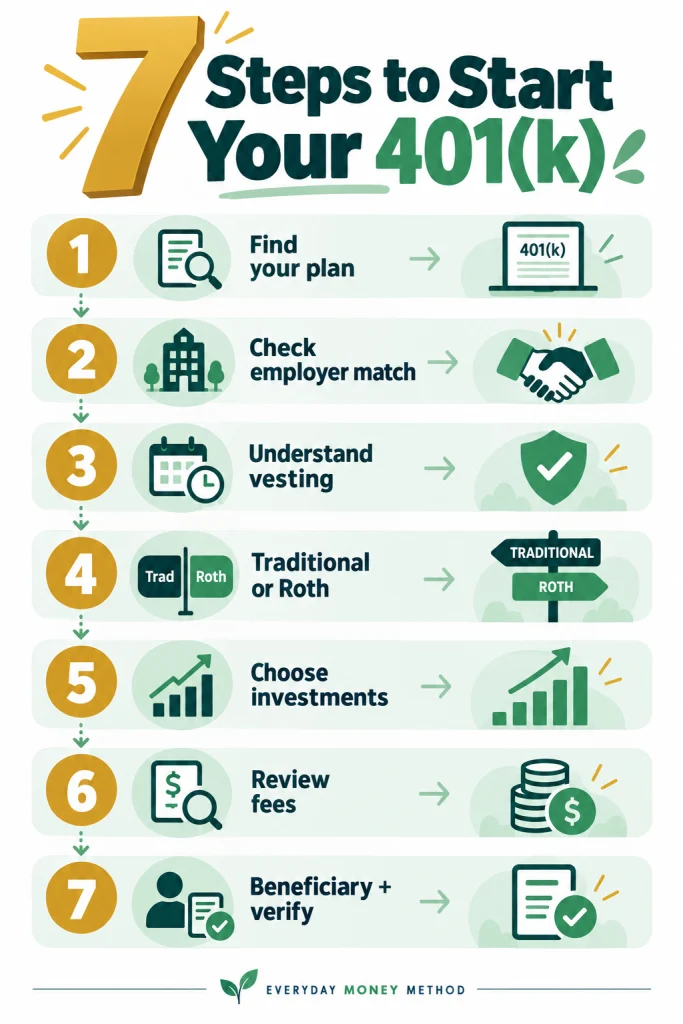
1. Find your plan and check whether you’re already enrolled
Related reading: Explore our monthly budget guide for a complementary approach.
Start with your employee benefits portal or HR department. Ask when you become eligible and whether you need to enroll yourself. Some plans enroll eligible workers automatically, using a default savings rate and investment. Check those settings even if you never filled out a form.
Request the Summary Plan Description, often shortened to SPD, and any current amendments. Use it to locate your eligibility date, matching formula, vesting schedule, and the contact who handles questions. You don’t need to memorize the document. You need to know where your plan’s answers live.
A practical message to HR is: “Am I eligible for the 401(k), am I already enrolled, and what contribution gets the full employer match?”
Also check when a new election takes effect. Enrollment today doesn’t necessarily mean a deduction from tomorrow’s paycheck.
2. Understand the employer match before picking your percentage
An employer match is money your employer contributes based on your contributions, using the plan’s formula. A plan might match every dollar up to a certain percentage of pay, or contribute a fraction of each dollar. Some employers make contributions that don’t depend on you contributing.
If your budget allows, contributing enough to receive the full available match is a useful starting target. First, make sure you understand what “full match” means.
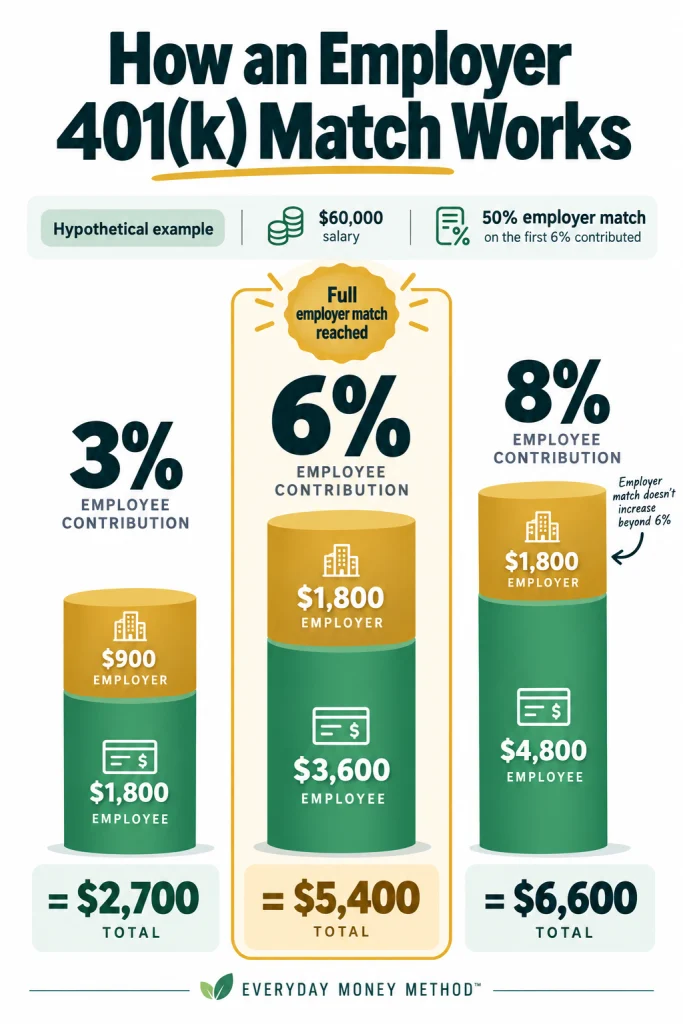
Consider a hypothetical plan that matches 50% of your contributions on the first 6% of eligible pay. Assume you earn $60,000 a year, all of it counts as eligible pay, and the same contribution rate applies throughout the year.
| Your contribution rate | You contribute annually | Employer contributes annually | Combined annual contributions |
| 3% | $1,800 | $900 | $2,700 |
| 6% | $3,600 | $1,800 | $5,400 |
| 8% | $4,800 | $1,800 | $6,600 |
Here, you need to contribute 6% to receive the maximum employer contribution of 3% of pay. Contributing 8% increases your own savings, but the match has already reached its cap.
Choose a contribution rate your budget can support. If the rate needed for the full match is more than you can manage today, start with an affordable amount and set a date to review it.
Ask whether bonuses count as eligible pay and when matching contributions are deposited. The match may arrive on a different schedule from your payroll deductions.
If you eventually contribute enough to reach the annual employee limit early, ask about a true-up. In a plan that matches each paycheck, stopping contributions after hitting the limit can mean missing later matches. A true-up may reconcile the annual match, but it depends on the plan’s terms.
3. Check which money is already yours
Related reading: Explore our emergency fund guide for a complementary approach.
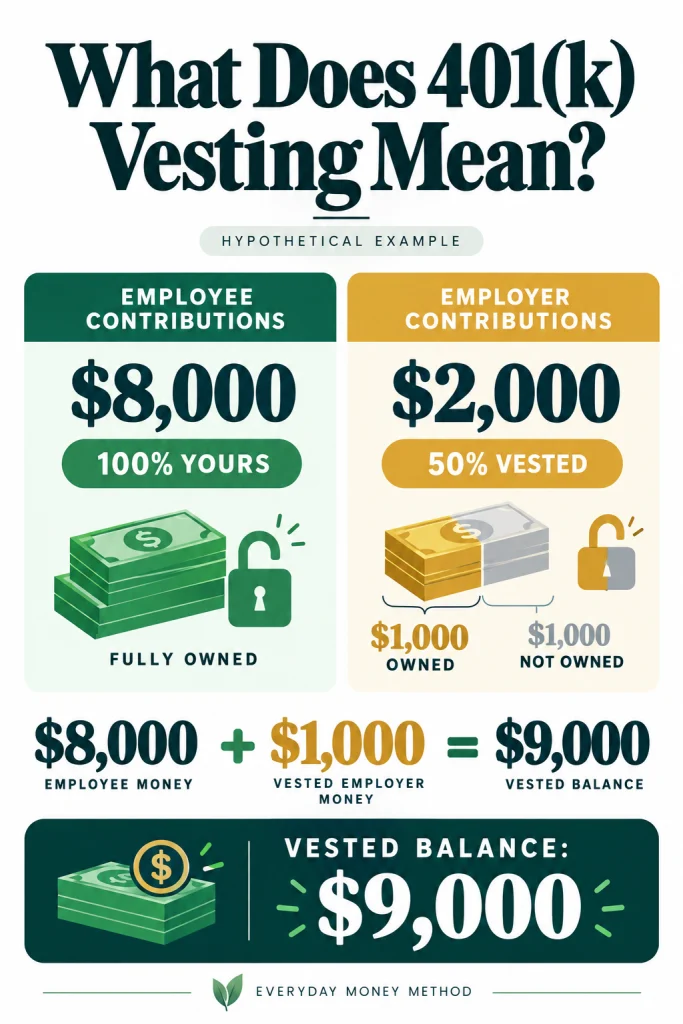
Vesting means ownership. Your own salary contributions are always fully vested. Employer contributions may belong to you immediately or become yours gradually under a vesting schedule.
For a hypothetical example, suppose your account holds $8,000 attributable to your contributions and $2,000 attributable to employer contributions. If you’re 50% vested in the employer portion, your vested balance would be $9,000. The remaining $1,000 could be forfeited when you leave, depending on the plan’s rules.
Check the “vested balance” on your statement before counting all employer money as yours. Also remember that ownership doesn’t make an investment immune to losses or give you unrestricted withdrawal rights. Vesting and access are separate questions.
4. Choose between traditional and Roth contributions
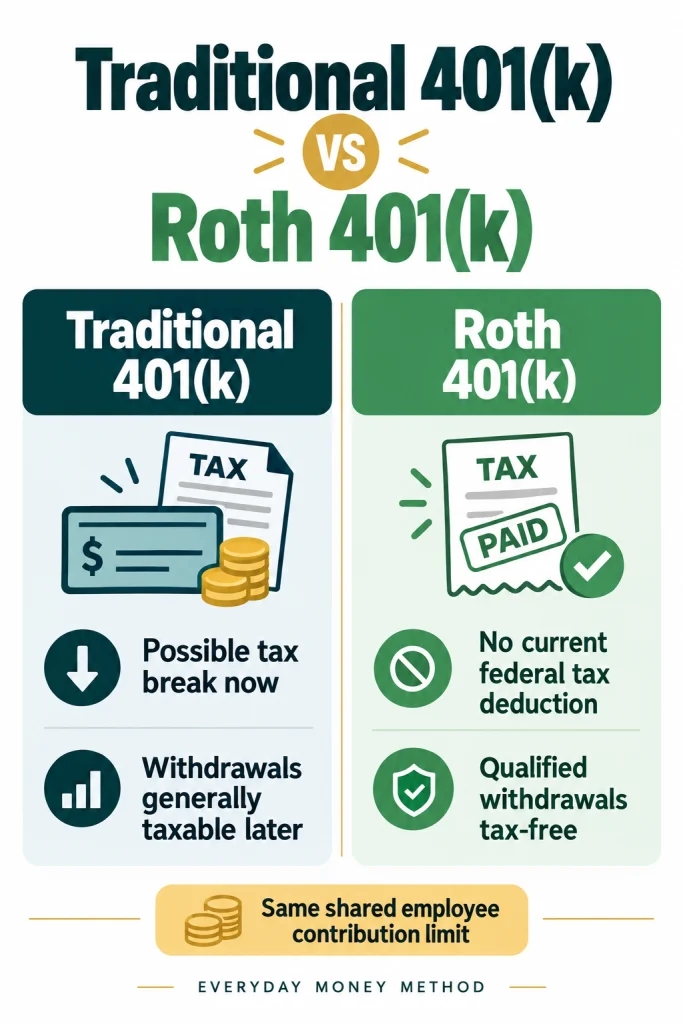
Traditional and Roth describe the tax treatment of contributions. They don’t tell you whether to buy stock funds, bond funds, or another investment.
| Question | Traditional 401(k) contributions | Roth 401(k) contributions |
| Do contributions reduce current federal taxable wages? | Generally, yes | No |
| How are retirement withdrawals treated? | Previously untaxed money is generally taxable | Qualified withdrawals of contributions and earnings are tax-free |
| When might this fit? | A current tax deduction is valuable and you expect a lower tax rate on withdrawals | Your current tax rate is relatively low or you expect a higher rate on withdrawals |
| Can you use both? | Yes, if your plan offers Roth; the combined employee contribution limit still applies | Yes, under the same shared limit |
The better choice depends on your current tax situation and what you expect in retirement.
A qualified Roth 401(k) withdrawal generally requires a five-tax-year participation period and age 59½ or older, disability, or death. Also, a Roth 401(k) doesn’t have the income eligibility ceiling that applies to direct Roth IRA contributions.
What does the choice do to your paycheck? Suppose you make a $100 traditional contribution and the entire amount would otherwise be taxed at a 22% federal marginal rate. The simplified federal income-tax reduction is $22, so take-home pay falls by about $78. A $100 Roth contribution receives no current federal income-tax reduction, so its take-home cost is about $100. This example ignores state taxes and other payroll effects. Traditional salary deferrals generally remain subject to Social Security and Medicare taxes.
If you can’t confidently predict your future tax rate, consider whether splitting new contributions between traditional and Roth fits your situation. You can revisit future contribution elections under your plan’s rules.
Your employer’s contribution has its own tax treatment. Choosing Roth for your paycheck deductions doesn’t automatically make the match Roth. Plans may permit employees to designate fully vested employer matching contributions as Roth, which creates taxable income for the year allocated. Ask what your plan offers.
5. Choose investments that fit your retirement timeline
Once you’ve selected your savings rate, find the investment election screen. If money is already going into the account, check its actual holdings. You may already be invested through a default selection.
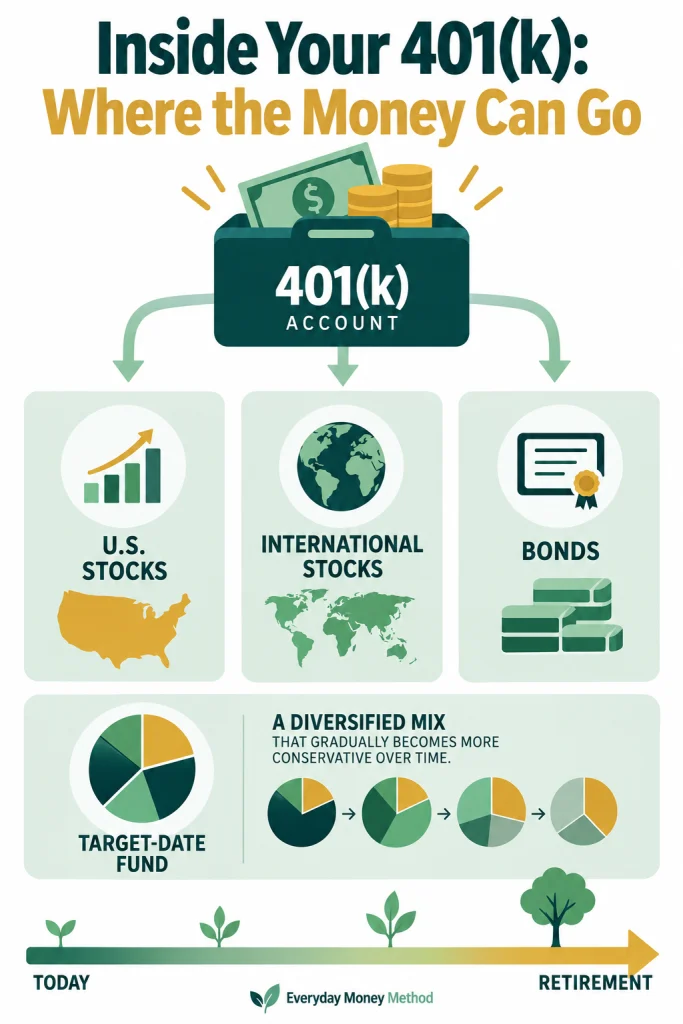
One option to evaluate is a target-date fund. It usually holds a mix of investments and adjusts that mix over time, generally becoming more conservative as its target year approaches. A fund with 2060 in its name typically targets someone expecting to retire around 2060.
Before choosing one, compare its fees, stock-and-bond mix, and how that mix changes. Two funds with the same year can carry different risks. A target date doesn’t guarantee a retirement income or protect you from losses.
Another approach is to build a portfolio using your plan’s individual funds. You might compare broad U.S. stock, international stock, and bond funds, then decide the mix that fits your time horizon and ability to handle losses. Asset allocation means that mix. Diversification means spreading money across investments rather than depending heavily on one company or narrow sector.
More fund names don’t automatically create better diversification. Several funds can own many of the same stocks. Review the holdings before adding another fund, especially if you already have a target-date fund designed to provide a broad portfolio.
If the menu still feels confusing, ask whether your plan provides investment education or advice and what it costs. Have someone explain the options in plain English before you select them.
6. Read the fees before you finish
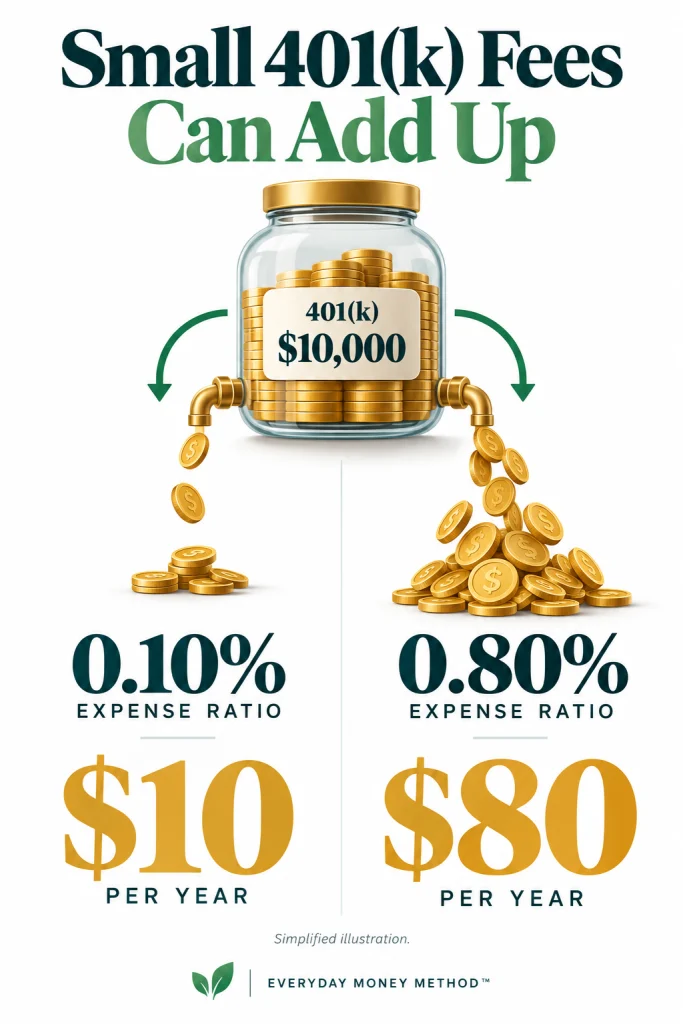
An expense ratio is a fund’s annual operating expenses expressed as a percentage of its assets. Those costs generally reduce the fund’s returns. Your account may also carry separate plan administration or advisory fees.
For a simplified illustration, a 0.10% annual expense ratio on a constant $10,000 balance is about $10. A 0.80% ratio is about $80. Actual costs depend on the balance during the year and the fund’s fee structure.
Ask for the investment comparison and fee disclosures. Compare costs alongside what each investment holds and the service you receive. A low-cost stock fund and a bond fund serve different purposes, so price alone won’t tell you which belongs in your portfolio.
You may not receive a separate bill for every fee. That’s why it’s useful to check the disclosures before assuming the account is free.
7. Name a beneficiary and check your paycheck and account
Complete the beneficiary designation, which tells the plan who should receive the account after your death. Follow your plan’s process, including any spousal consent requirements, and review the election after major life changes.
Then save your enrollment confirmation and check the first paycheck that should reflect your election. Confirm:
- The contribution amount matches the rate you selected.
- Traditional and Roth deductions appear as intended.
- Contributions reach your retirement account and the expected investments.
- Employer contributions follow the plan’s stated schedule.
If the new deduction hasn’t appeared, ask about payroll timing before submitting another change. A change made close to the payroll cutoff may not appear until a later paycheck. Ask your employer when the new deduction should begin.
Once the first contribution arrives, you have something concrete to review: the amount saved, its effect on take-home pay, and where the money is invested.
How much can you contribute to a 401(k) in 2026?
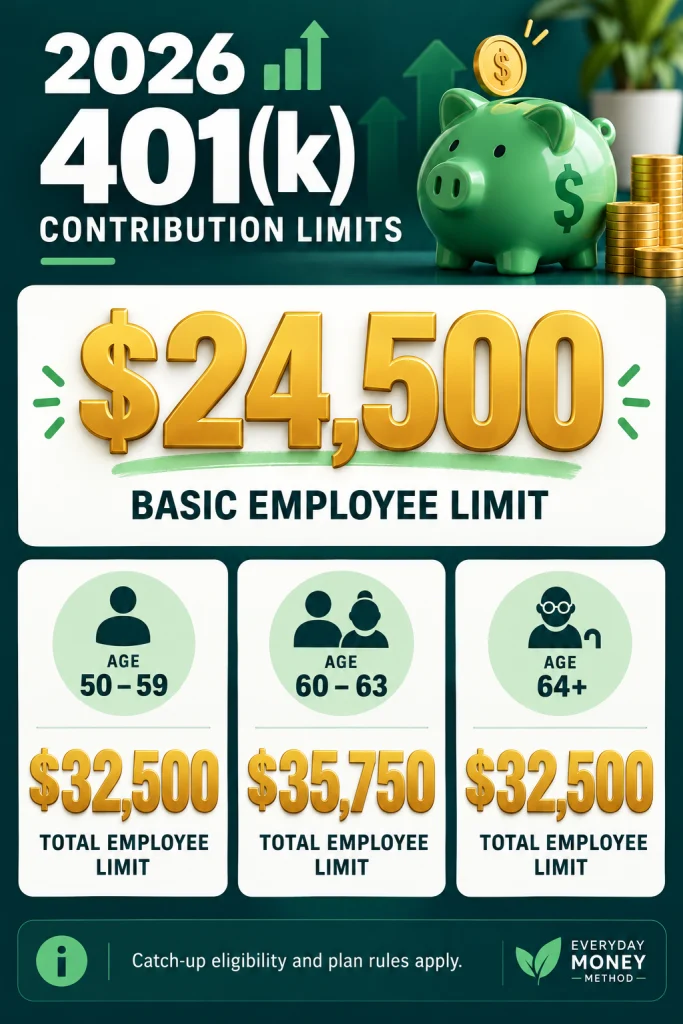
For most standard 401(k) plans, the 2026 employee contribution limit is $24,500. If your plan permits catch-up contributions, higher limits apply based on your age at the end of the calendar year.
| Age at the end of 2026 | Basic employee limit | Available catch-up | Total employee limit |
| Under 50 | $24,500 | None | $24,500 |
| 50 to 59 | $24,500 | $8,000 | $32,500 |
| 60 to 63 | $24,500 | $11,250 | $35,750 |
| 64 or older | $24,500 | $8,000 | $32,500 |
The higher age-60-to-63 catch-up replaces the ordinary catch-up; you don’t add both. These figures describe standard 401(k) limits. SIMPLE 401(k) and certain other arrangements have different limits, and your plan or compensation can restrict what you can contribute.
Your traditional and Roth employee contributions share the employee limit. Changing jobs doesn’t reset it, so tell your new payroll team what you already contributed that calendar year.
Employer contributions don’t use up that $24,500 employee allowance. A separate combined limit generally applies to annual additions from you and your employer: the lesser of $72,000 or 100% of compensation for 2026, excluding catch-up contributions. This combined limit also includes certain other additions to the account; it isn’t an extra amount you can simply elect from your paycheck.
A 2026 rule for higher earners: If your prior-year Social Security wages from the employer sponsoring the plan exceeded $150,000, catch-up contributions generally must be Roth. For 2026 contributions, that means looking at 2025 wages. This affects catch-up contributions, not automatically every regular contribution. Ask payroll how the rule applies to you.
You don’t need to approach the maximum to begin. Use the limits to avoid contributing too much, then choose your actual savings rate around your budget and retirement needs.
How do you fit retirement saving into a tight budget?
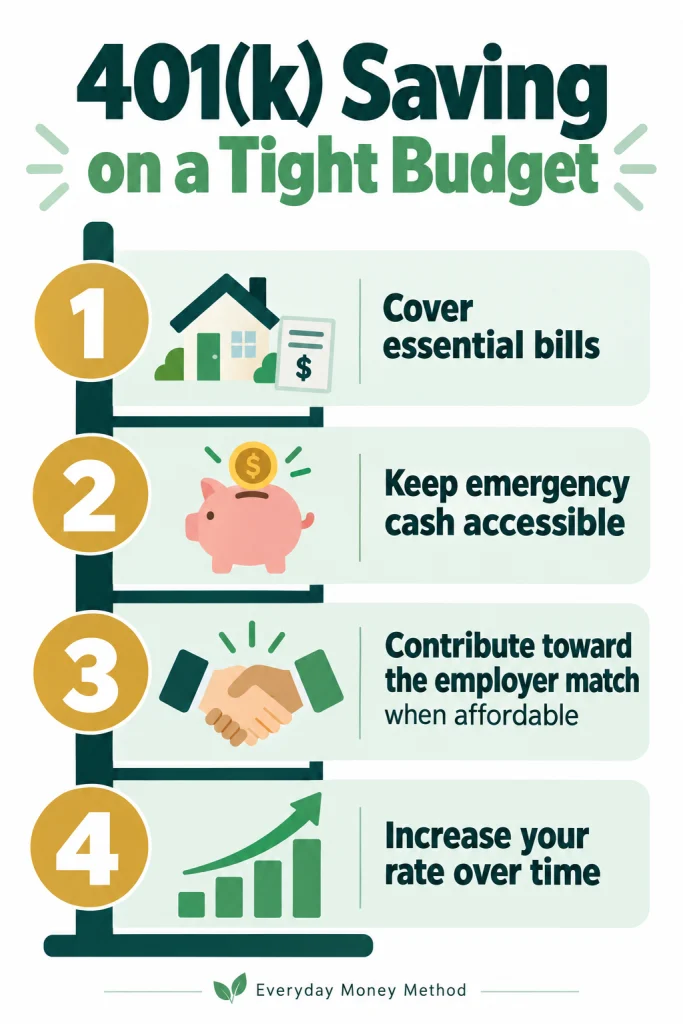
Before selecting a contribution, look at what the next paycheck must cover. Include housing, food, utilities, necessary transportation, insurance, and minimum debt payments. A retirement election that repeatedly sends those expenses onto a credit card needs another look.
Then decide what cash cushion you need outside the 401(k). Emergency savings give you accessible money for unplanned expenses and can reduce the need to borrow or tap retirement savings. The CFPB emphasizes that the right amount depends on your situation and that even a small reserve can help.
One workable starting approach is to keep essential payments current, contribute toward the employer match when affordable, and build a starter emergency fund alongside it. If expensive debt is consuming your cash flow, compare extra debt payments with contributions above the match. Your job stability, vesting, and available cash all affect that decision.
If you can only contribute 1% or 2% for now, choose a date to reassess. For example, review the amount after three paychecks or after paying off a specific bill. The useful part is having a next decision instead of assuming today’s rate must last forever.
If student loans are the obstacle, ask one extra question: Does your plan match qualified student loan payments? Some employers adopt this optional feature, which can place employer contributions into your retirement account based on eligible loan payments. You still need to meet the plan’s rules and certification requirements. The employer’s retirement contribution doesn’t pay down the loan itself.
Check whether the Saver’s Credit applies
For 2026, eligible retirement contributions may qualify for the federal Saver’s Credit, potentially up to $1,000 per eligible person. Age, student and dependent status, income, eligible contributions, and available tax liability affect the result. The credit is nonrefundable, so it cannot exceed the tax it is allowed to offset.
The 2026 upper adjusted gross income (AGI) limits are $40,250 for single filers, $60,375 for heads of household, and $80,500 for married couples filing jointly. Being below a ceiling doesn’t automatically qualify you for the maximum credit. Check the year’s Form 8880 instructions or ask your tax preparer.
How much should you aim to save over time?
The employer match gives you an initial target. Your retirement plan needs a longer view.
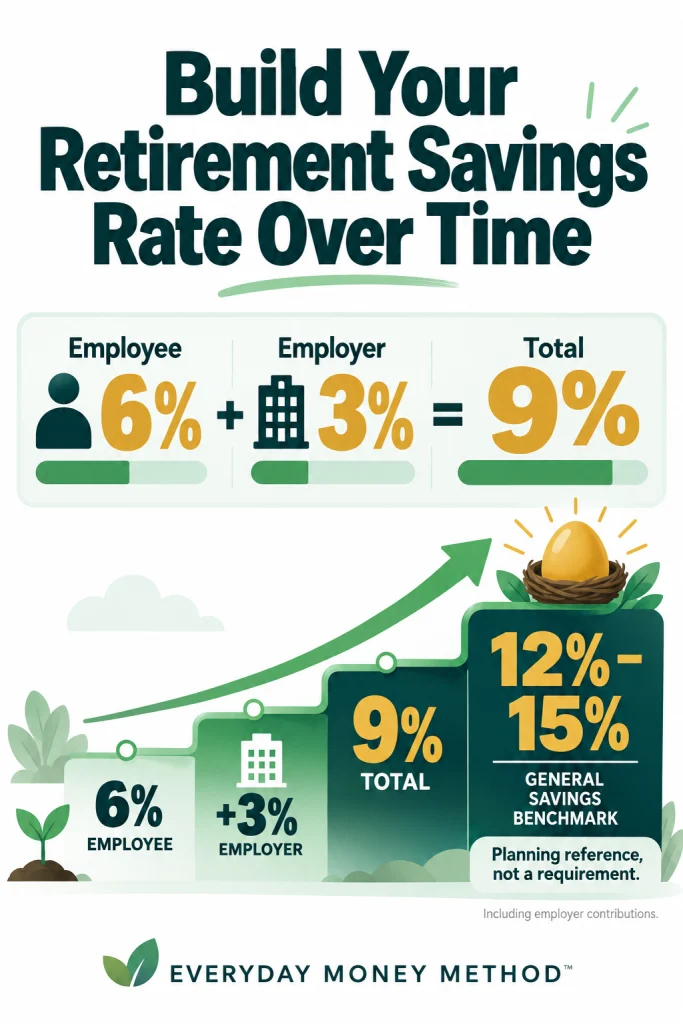
Vanguard suggests saving roughly 12% to 15% of pay, including employer contributions, as a general benchmark. Treat that range as a planning reference. Your starting age, existing savings, retirement date, spending needs, and other income can mean you need a different amount.
Return to the hypothetical $60,000 salary and 50%-of-the-first-6% match. Contributing 6% yourself and receiving 3% from your employer puts 9% of pay into the account. You have captured the full match, but your total savings rate is still 9%.
If you choose a 15% total savings target, the same 3% employer contribution would leave 12% for you to contribute, assuming that match remains available. That’s a target to evaluate against your broader retirement plan.
You can work toward a higher rate in steps. Moving from 6% to 7% on a $60,000 salary adds $600 a year, or $50 a month, before the effect of taxes. Set an annual increase if your plan offers it, or review your rate when your pay changes. Check what the increase does to your budget before it takes effect.
To make the target more personal, estimate retirement spending and compare it with your expected income. Your my Social Security account can show benefit estimates based on your earnings and different claiming ages. Include other retirement savings and any pension when reviewing the gap.
Keep the comparison consistent: projected future dollars and today’s purchasing power are different. Check whether a retirement calculator accounts for inflation, fees, and taxes before treating its result as a spending plan.
What could a small monthly contribution grow into?
Compounding means that investment returns, if earned and left invested, can themselves produce further returns. Time gives that process more opportunities, although actual market results fluctuate.
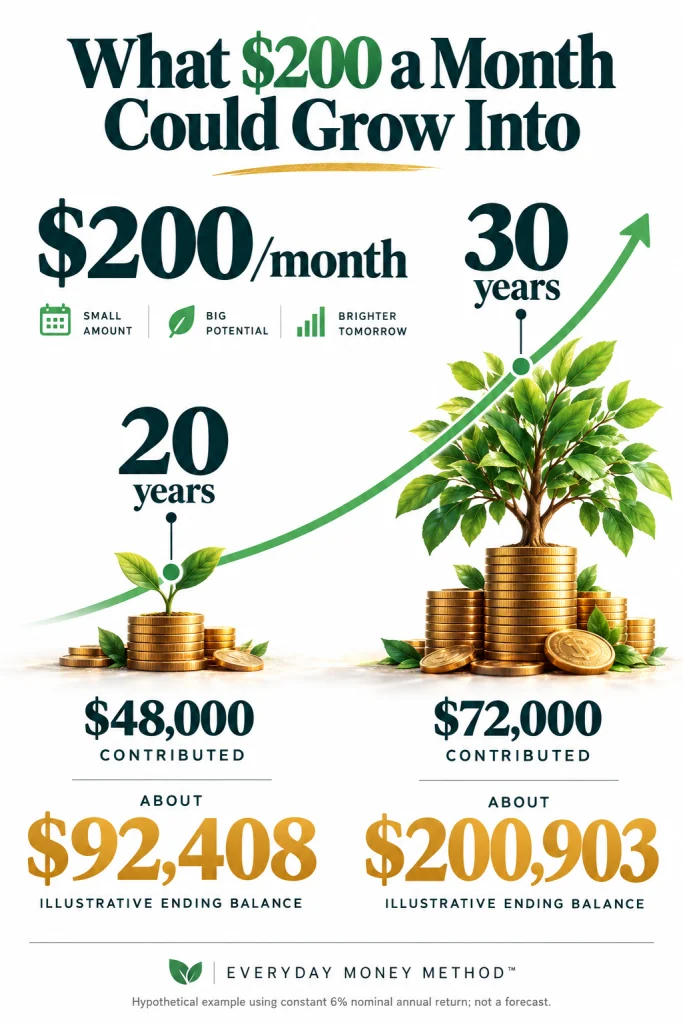
Here’s a hypothetical illustration using $200 deposited at the end of each month, no starting balance, and a constant 6% nominal annual return compounded monthly.
| Time invested | Total you contribute | Illustrative ending balance |
| 20 years | $48,000 | About $92,408 |
| 30 years | $72,000 | About $200,903 |
These are calculated examples, not forecasts. They exclude employer contributions, fees, taxes, and inflation. Real returns won’t arrive at a steady monthly rate, and the future balances would buy less than the same dollar amounts buy today if prices rise.
The extra decade in this example adds $24,000 in contributions and gives invested money more time to grow. If you’re starting later, use a calculator to explore what you can change: the monthly contribution, the retirement date, or expected spending. Raising the assumed return just to make the calculation look better won’t improve the actual plan.
What happens to your 401(k) when you change jobs?
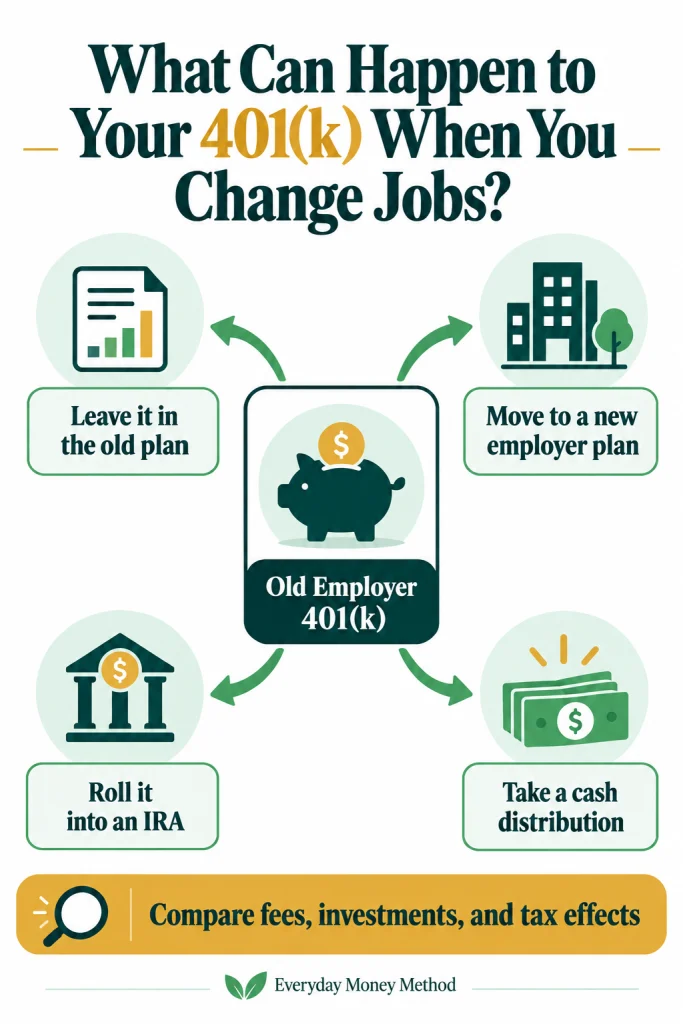
Leaving a job doesn’t automatically mean cashing out your retirement account. Depending on the plans and your circumstances, you may be able to leave the money where it is, move it to a new employer’s plan that accepts rollovers, or roll it into an IRA. Taking a cash distribution is another option, but it can create taxes and reduce your retirement savings.
Before choosing, compare fees, investments, withdrawal rules, and services in both accounts. Check your vested balance and read any notice about what must happen to a small account after you leave.
If you decide to move the money, ask about a direct rollover. The old plan sends the payment directly to the receiving retirement account, or issues a check payable to that account. This avoids mandatory withholding on an eligible direct rollover. If a taxable eligible rollover distribution is paid to you instead, the plan generally withholds 20%, and the usual 60-day rollover deadline creates extra work and risk.
Keep tax treatment in view. Moving pretax money to a Roth IRA generally creates taxable income. Moving it to an eligible traditional account generally preserves tax deferral. Roth money needs a permitted Roth destination. Confirm the instructions with both account providers before authorizing the transfer.
Once a rollover finishes, check that the money is invested as you intended. A successful transfer and a completed investment choice are separate things to verify.
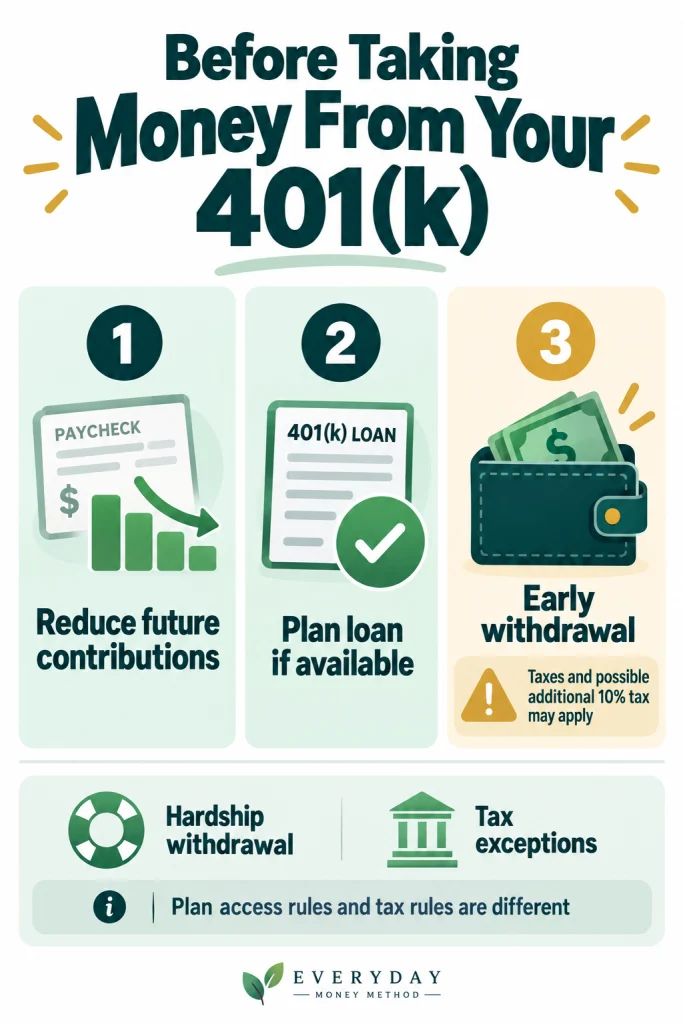
Can you take money out before retirement?
A 401(k) is meant for long-term saving, so the plan limits when you can take distributions. An early taxable withdrawal generally creates ordinary income tax and, before age 59½, an additional 10% tax unless an exception applies.
Permission to take a hardship withdrawal doesn’t automatically remove the additional tax. A hardship may let the plan release money, while a separate tax exception determines whether the 10% applies. Some IRA exceptions also differ from 401(k) exceptions, so don’t apply an IRA rule to your workplace account without checking.
A Roth 401(k) isn’t an unrestricted source of your original contributions either. Plan distribution rules still apply, and a nonqualified withdrawal generally includes a proportional share of contributions and earnings. The earnings portion may be subject to income tax and, before age 59½, an additional 10% tax unless an exception applies.
Some plans offer loans. A qualifying loan generally needs repayment within five years, although a longer repayment period may be allowed for a loan used to buy your primary residence. Missed repayments or leaving the employer can create tax consequences, depending on the circumstances. Ask about fees, repayment terms, and job-separation rules before borrowing.
Reducing future payroll contributions is a different decision from withdrawing money already in the account. If the immediate problem is a smaller paycheck, check whether changing upcoming contributions can help before taking a distribution.
A practical first-month plan
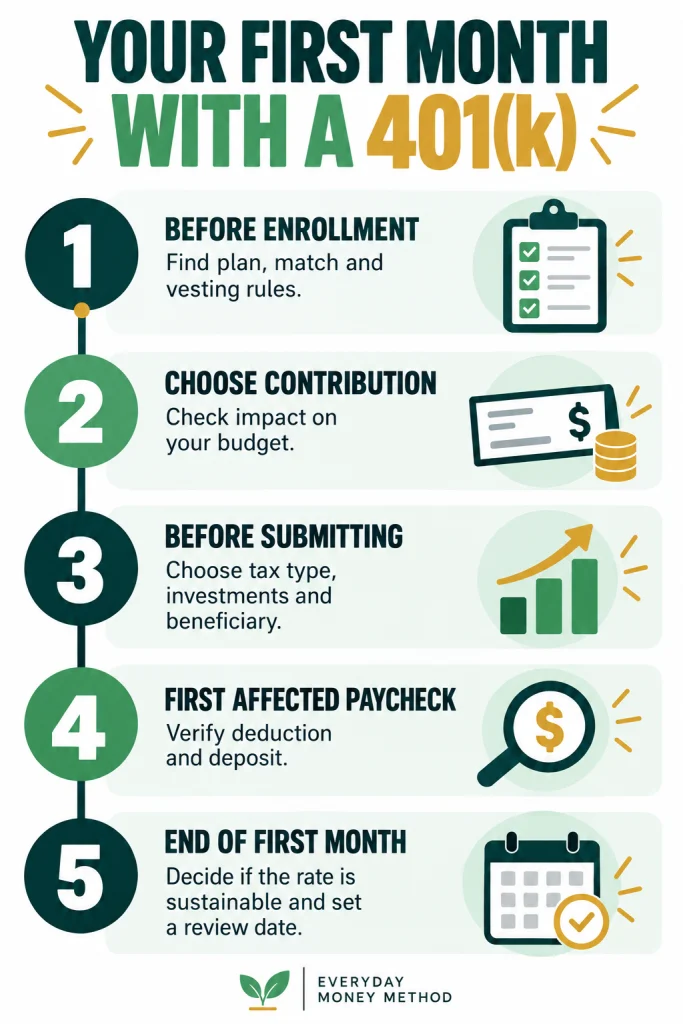
You can turn the information above into a short sequence of tasks:
| When | What to do |
| Before enrollment | Find the SPD, eligibility date, match formula, and vesting terms. |
| When choosing a contribution | Compare the payroll deduction with your actual bills and cash reserve. |
| Before submitting | Select traditional, Roth, or both; choose investments; check fees; name a beneficiary. |
| After the first affected paycheck | Verify the deduction, deposit, investments, and match schedule. |
| At the end of the first month | Decide whether the rate is sustainable and set the next review date. |
For the $60,000 hypothetical example, a 6% employee contribution is $300 per month, and a 3% employer contribution is $150 per month on an annualized basis. That’s $450 going toward retirement each month before investment results and fees. Actual payroll and employer deposit schedules may differ.
The number worth watching first is the change in your take-home pay. It tells you whether the plan you selected works alongside the expenses you still have to cover.
Questions beginners often ask
Is a 401(k) worth considering if my employer doesn’t match?
Yes. The plan can still offer tax advantages and convenient payroll saving. Compare its investment options and total fees with an IRA, along with contribution limits and your eligibility for IRA tax benefits. The absence of a match changes the comparison; it doesn’t erase every benefit of the workplace plan.
Can you have a 401(k) and an IRA at the same time?
Yes, if you meet the IRA contribution requirements. The accounts have separate contribution limits. Workplace coverage and income can restrict the deduction for a traditional IRA, while income limits can restrict direct Roth IRA contributions. Don’t assume that owning a 401(k) makes every IRA contribution deductible.
What if your employer doesn’t offer a 401(k)?
An IRA may provide a way to save independently, subject to eligibility and contribution rules. If you’re self-employed, a one-participant or solo 401(k) may be an option for a business with no employees other than the owner and spouse. Self-employed contribution calculations need extra care.
Can you lose money in a 401(k)?
Yes. Investments inside the account can fall in value. Your allocation should fit your timeline and ability to handle losses. Diversification can help spread risk, but it cannot guarantee a profit or prevent every loss. A target-date fund is also subject to investment risk.
Is it too late to start in your 40s or 50s?
You can still begin if you’re eligible. Start with your existing savings, likely retirement date, and an affordable contribution, then estimate the gap. Eligible workers age 50 and older may have access to catch-up contributions, but the availability of a higher limit doesn’t mean you must contribute that much.
A later start may require saving more, working longer, changing expected retirement spending, or combining those adjustments. Use realistic assumptions and consider qualified financial advice if the gap is substantial.
Start with the next paycheck
Open the benefits portal and find the matching formula. Then work out what the required contribution would mean in dollars from each paycheck. If that amount fits, complete the election and the investment choice. If it doesn’t, choose an affordable starting rate and a specific time to review it.
Use this 401(k) for beginners guide to make that first decision with a clear understanding of your pay, your investments, and your employer’s rules. Once the contribution is running, you can build the rest of your retirement plan around real numbers.
Free 401(k) Worksheets and Printables
Use these free 401(k) worksheets to plan your contributions, understand your employer match, compare your options, and review your retirement account with more confidence. Save or print any worksheet and use it alongside the steps in this guide.
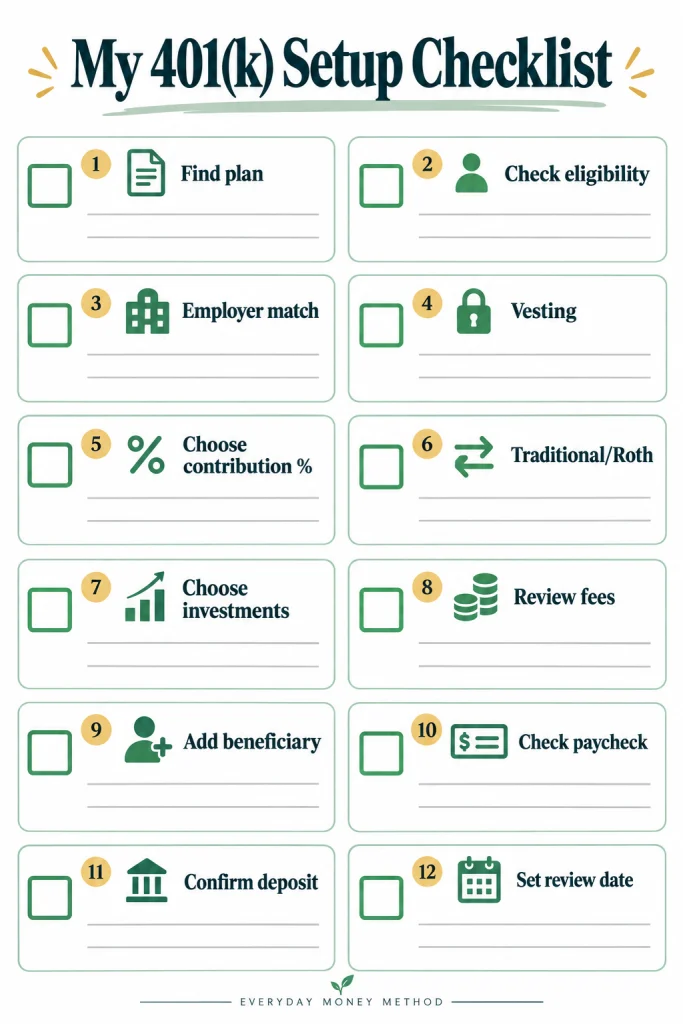
1. Free 401(k) Setup Checklist
Use this checklist to work through the key steps of setting up your 401(k), including eligibility, employer match, vesting, contributions, investments, fees, and beneficiaries. Print it and check off each task as you complete it.
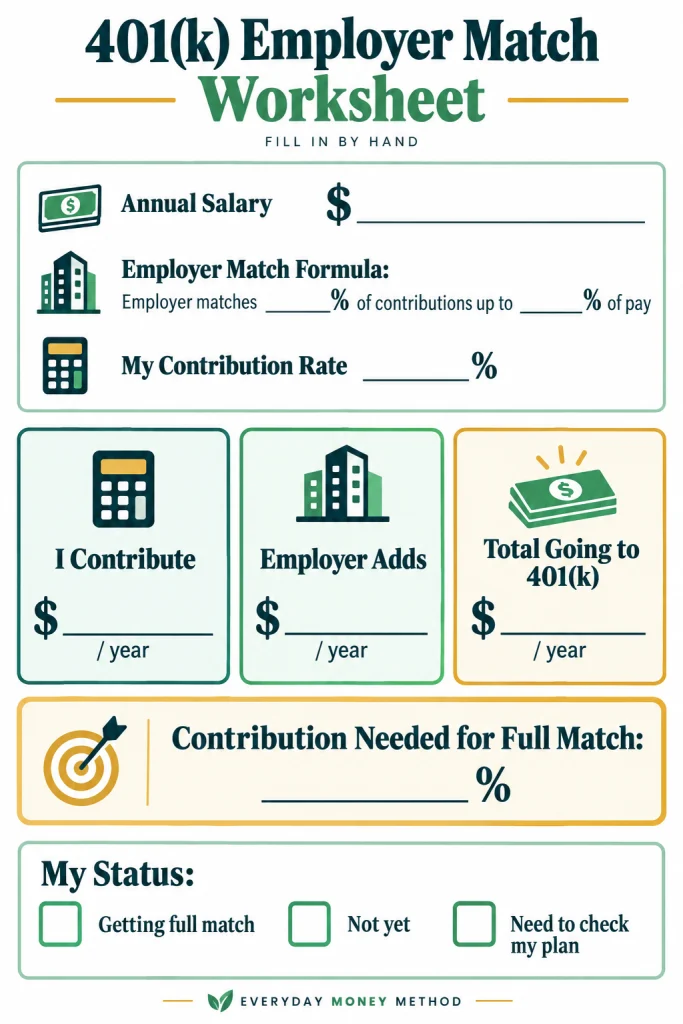
2. Free 401(k) Employer Match Worksheet
Use this worksheet to enter your salary, contribution rate, and employer match formula so you can estimate how much you contribute, how much your employer may add, and the contribution rate needed to receive the full available match.
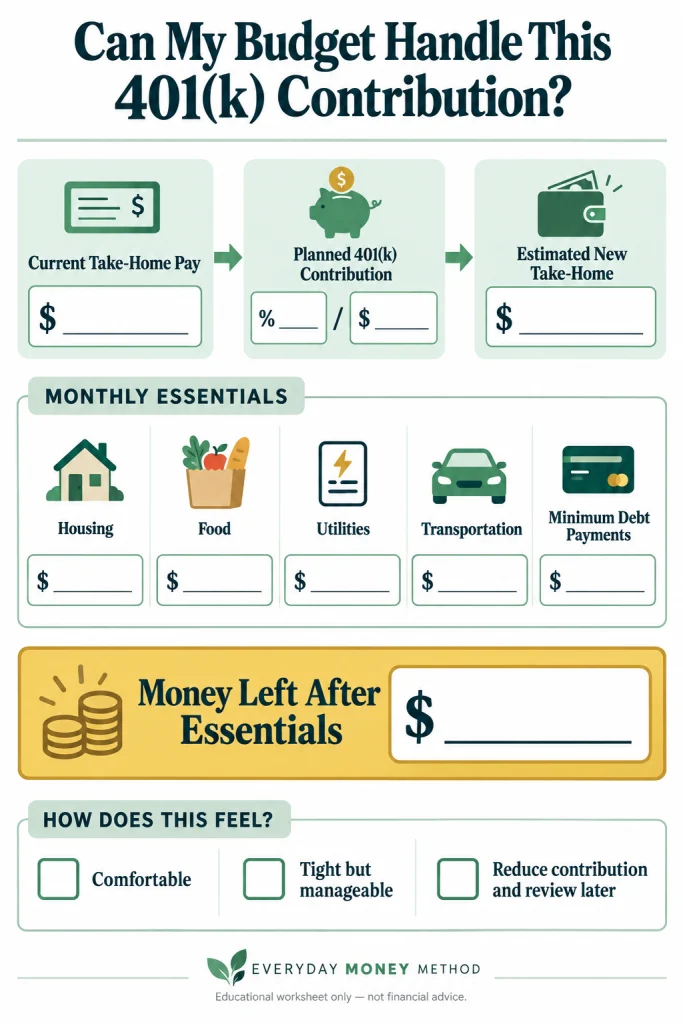
3. Free 401(k) Budget Worksheet
Use this worksheet to see how a planned 401(k) contribution could fit alongside your take-home pay and essential monthly expenses. Fill in your numbers before choosing a contribution rate that works with your current budget.
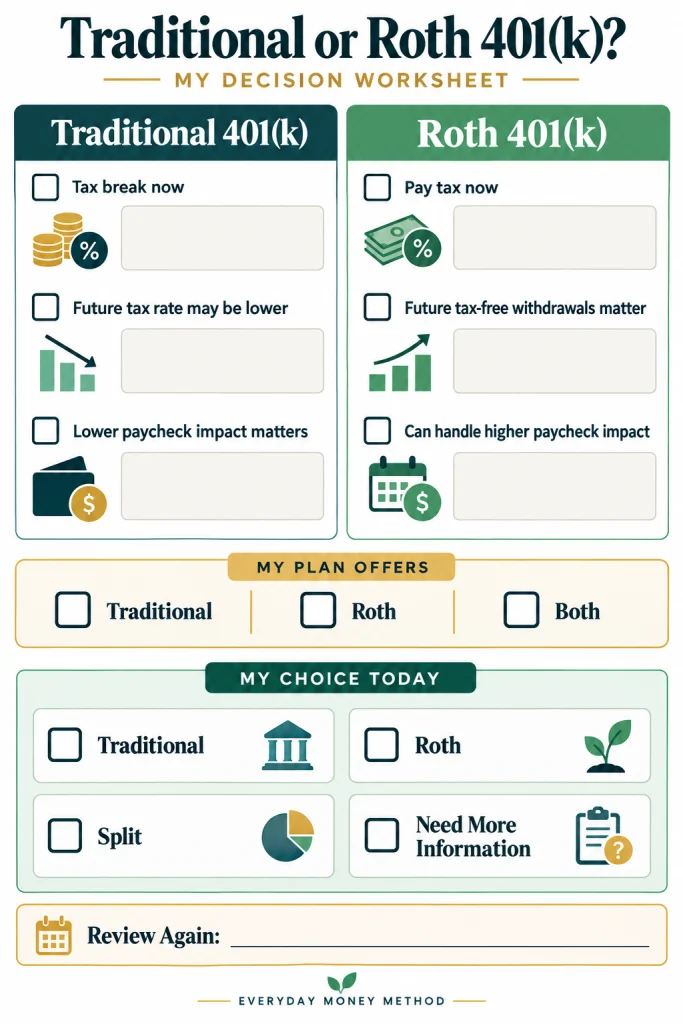
4. Free Traditional vs Roth 401(k) Worksheet
Use this worksheet to compare Traditional and Roth 401(k) contributions based on current tax treatment, possible future tax expectations, and the effect on your paycheck. Use it as a starting point for reviewing the choices available in your plan.
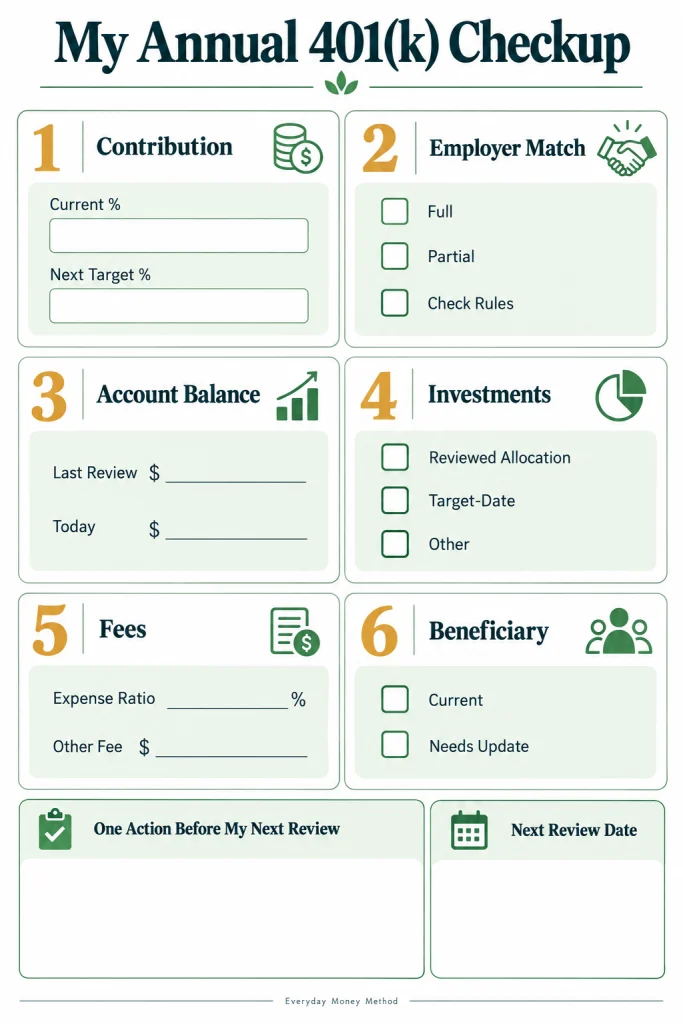
5. Free Annual 401(k) Checkup Worksheet
Use this annual 401(k) checkup to review your contribution rate, employer match, account balance, investments, fees, and beneficiary information. Add your next review date so your retirement plan does not become a set-it-and-forget-it decision.
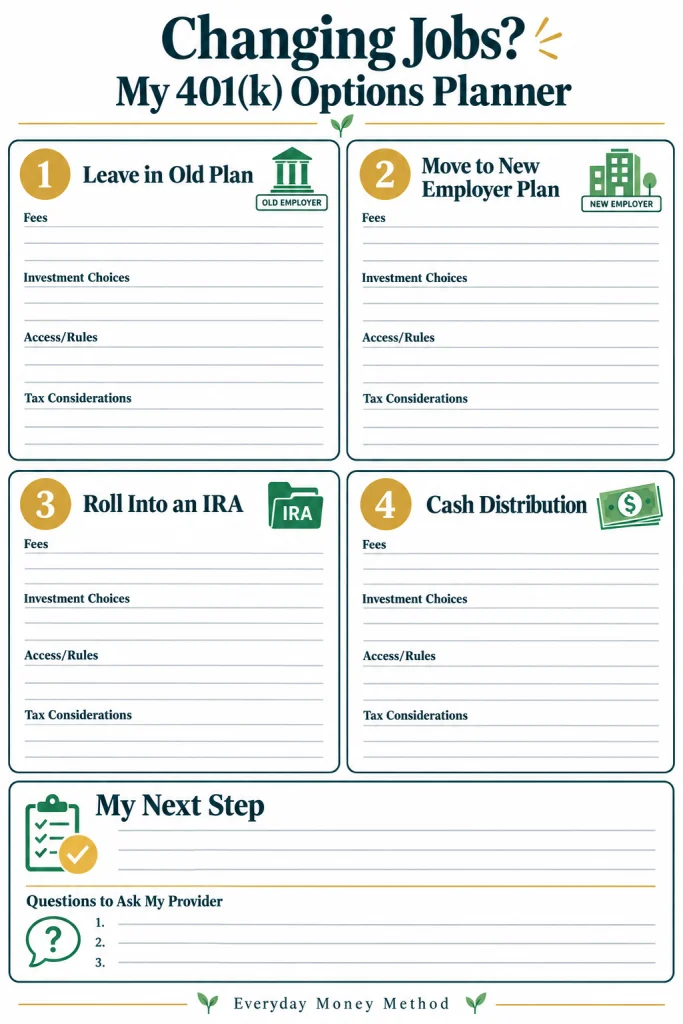
6. Free 401(k) Rollover Options Planner
Changing jobs? Use this planner to compare the main choices for an old 401(k), including leaving it in the former employer plan, moving it to a new employer plan, rolling it into an IRA, or taking a distribution. Record fees, investment choices, rules, and tax considerations before deciding your next step.
These worksheets are for educational purposes only and are not tax, investment, or financial advice. Your employer plan rules and personal tax situation may differ.
References and further reading
These resources support the general educational topics discussed; individual circumstances and current rules may differ.
Continue learning
beginner investing guide · monthly budget guide · emergency fund guide · paycheck budgeting guide

Personal finance writer and content creator at Everyday Money Method.
Editorial Policy · Report a correction