
Editorial voice: Monem · Published 2026-10-01 · Article resources updated November 18, 2026
Key takeaways
- List balances, minimums and due dates before planning extra payments.
- Choose a repayment approach that fits your budget and obligations.
- Ask creditors about available hardship options if payments are unaffordable.
General educational information, not personalized financial advice. Read our Financial Disclaimer.
You make your payments, check your balances, and wonder why the numbers barely move. Learning how to pay off debt faster starts with a clear plan for your next dollar, not another vague promise to spend less.
The basic approach is straightforward: keep required payments current, choose one debt to focus on, and put any extra money toward paying it off. Once that balance is cleared, redirect the same payment amount toward the next debt. Starting with the smallest balance can help you achieve quicker wins, stay motivated, and make steady progress toward becoming debt-free.
But the plan has to leave room for groceries, housing, and expenses that do not arrive on a neat monthly schedule. The goal is steady progress you can afford to repeat.
How to Pay Off Debt Faster in 5 Steps
Related reading: Explore our monthly budget guide for a complementary approach.
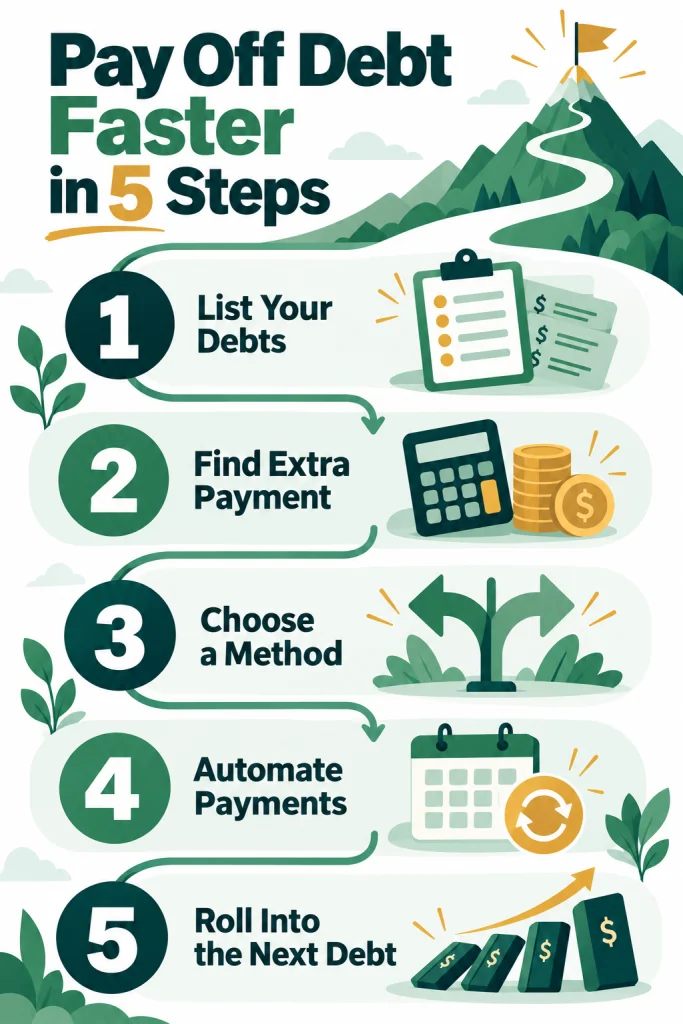
A debt payoff plan answers three questions: What do you owe? How much can you consistently pay? Which balance gets the extra money first?
You can build one with a spreadsheet, a budgeting app, or a notebook. Start with the numbers you have today.
1. List every debt and flag anything urgent
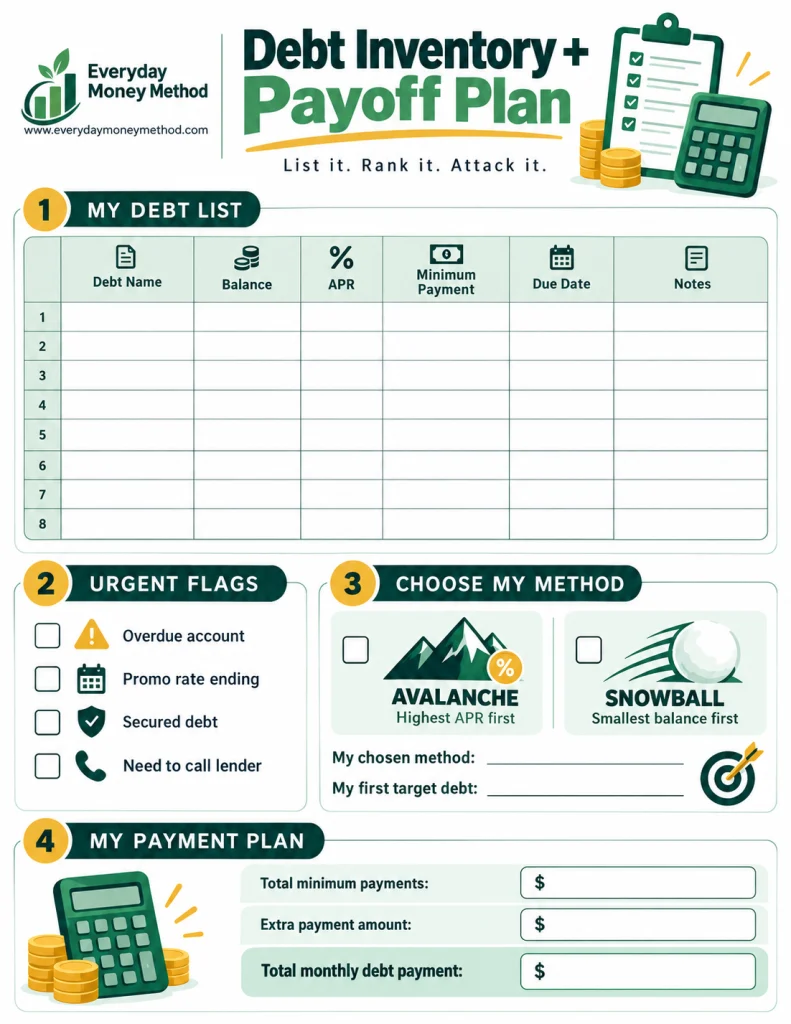
Gather your latest statements and online account balances. For each debt, record the creditor, current balance, annual percentage rate (APR), minimum payment, and due date. Include credit cards, personal loans, student loans, auto loans, and other outstanding obligations. Statements and lender accounts can provide more current balances than a credit report.
Here is a hypothetical inventory of three debts selected for accelerated repayment:
| Debt | Current balance | APR | Monthly minimum |
|---|---|---|---|
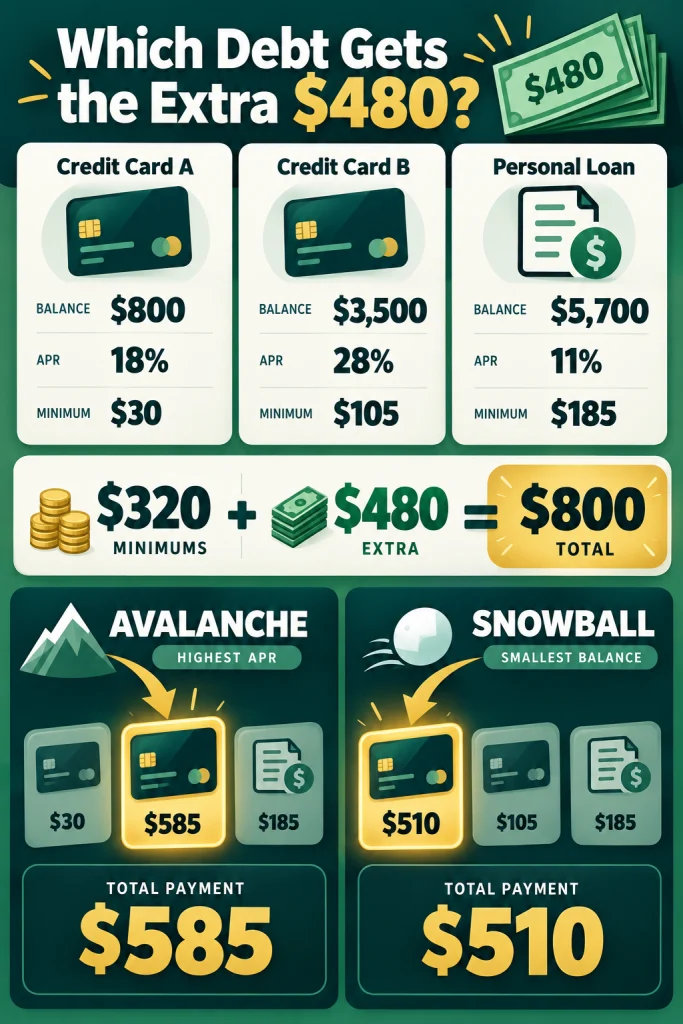
| Credit card A | $800 | 18% | $30 |
| Credit card B | $3,500 | 28% | $105 |
| Personal loan | $5,700 | 11% | $185 |
| Total | $10,000 | $320 |
Add a note beside any overdue account, promotional rate expiration, or loan secured by property. Those details can change your priorities.
Protect essentials before making extra debt payments. When money cannot cover everything, food, housing, utilities, necessary transportation, and medical care generally take priority. If you rely on your car for work, an overdue auto loan deserves special attention because missed payments could put your transportation at risk. Address immediate threats to housing, transportation, and essential services before making additional payments toward other debts.
This does not mean ignoring other creditors. It means separating an urgent payment problem from a long-term payoff strategy.
2. Calculate an extra payment your budget can support
Related reading: Explore our credit score guide for a complementary approach.
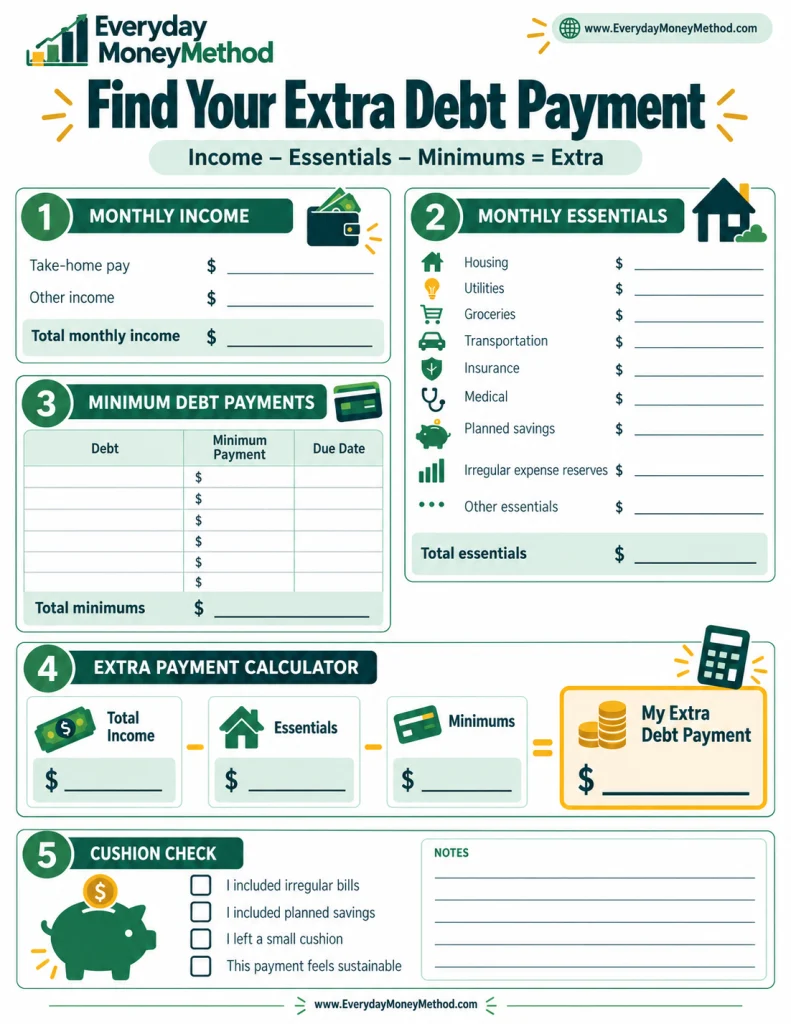
Review the last two or three months of spending. Use take-home pay, not your salary before deductions, to work out what is available. Include everyday expenses, required debt payments, and spending that varies from month to month.
A practical formula is:
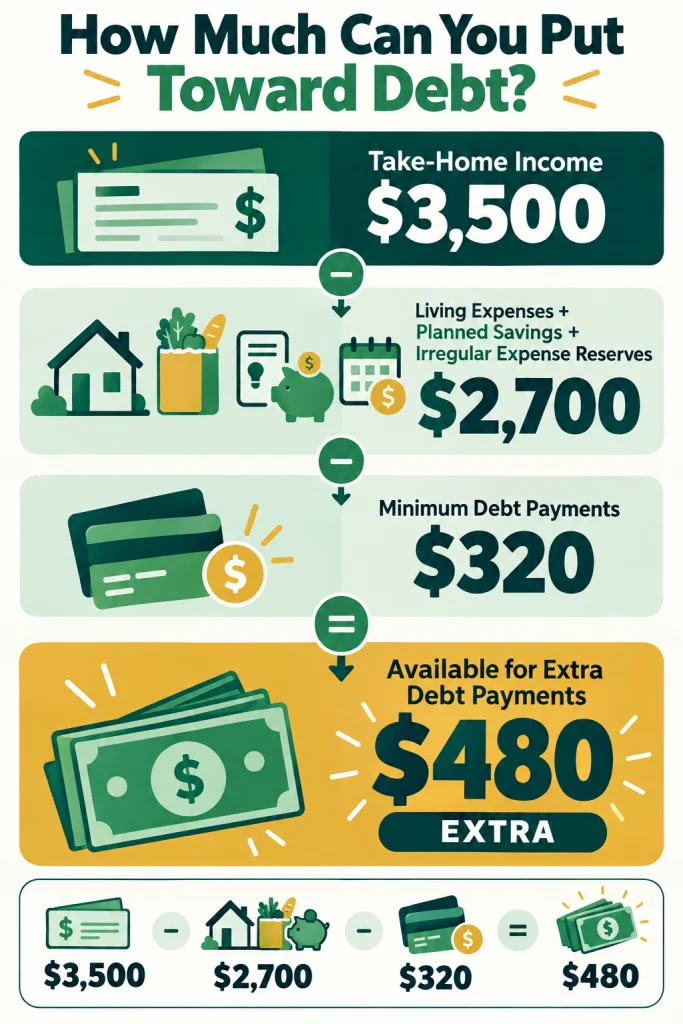
Extra debt payment = take-home income − living expenses − minimum debt payments − planned savings and irregular-expense reserves.
Suppose your monthly numbers look like this:
| Budget category | Monthly amount |
|---|---|
| Take-home income | $3,500 |
| Living expenses, planned savings, and irregular-expense reserves | −$2,700 |
| Minimum payments on the three target debts | −$320 |
| Available for extra debt payments | $480 |
Your total monthly payment toward these debts would be $800: $320 in minimums plus $480 extra. Any other required debt payments must already be included in the budget; do not leave them out or count them twice.
Leave a cushion for real life
An emergency fund helps keep an unexpected expense from becoming new debt. There is no single correct starting amount for everyone. The Consumer Financial Protection Bureau recommends considering your own circumstances and the unexpected expenses you have faced before. Even a small reserve can help.
For example, someone with unpredictable income or an unreliable car may need a different cushion from someone with stable pay and fewer immediate risks. Choose an initial savings target you can explain, rather than copying a number without checking whether it fits.
Also separate emergencies from predictable bills. A $600 annual insurance premium is not extra spending money in the months before it comes due. Setting aside $50 monthly gives that future bill a place in your budget.
When income varies, consider basing your regular debt payment on a conservative month. Treat additional income as an opportunity to pay extra after essential expenses and reserves are covered.
3. Choose the debt avalanche or debt snowball
Related reading: Explore our emergency fund guide for a complementary approach.
Both methods keep minimum payments going on the other accounts. The difference is where you direct the extra money.
| Method | First target | Main advantage | Main tradeoff |
|---|---|---|---|
| Debt avalanche | Most urgent debt or overdue payment | Helps protect essential assets and avoid serious consequences | The first balance may take longer to eliminate |
| Debt snowball | Smallest balance | Produces an earlier paid-off account when balances differ | Larger balances may remain outstanding longer |
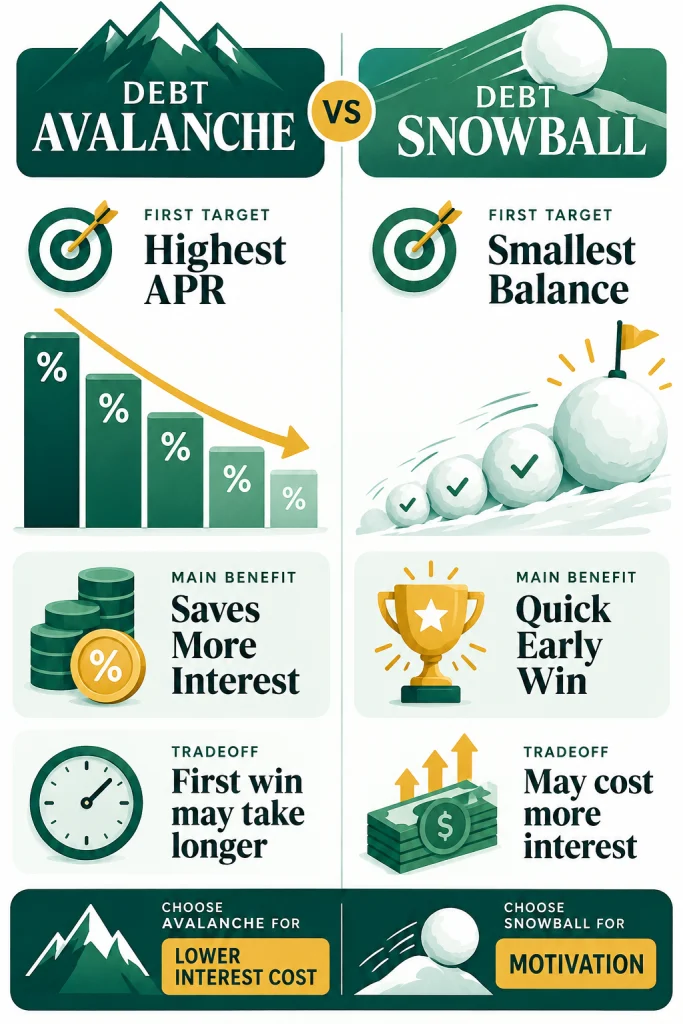
Debt avalanche: Address urgent debts first
With the priority-based repayment method, organize your debts according to payment deadlines, overdue status, and the potential consequences of missed payments. Make every required minimum payment, then direct any available extra money toward the debt that needs the most immediate attention.
Using the example above, your required minimum payments total $320 per month, with an additional $480 available for debt repayment. That gives you a total monthly repayment budget of $800. After covering all minimum payments, you can direct the extra $480 toward your most urgent debt. Once that priority is resolved, review your remaining balances and decide where the additional payments should go next.
This approach helps you stay current on essential obligations, reduce outstanding balances, and avoid serious consequences from missed payments. Review your repayment priorities regularly, as due dates, account balances, and financial circumstances may change over time.
Debt snowball: prioritize an early paid-off balance
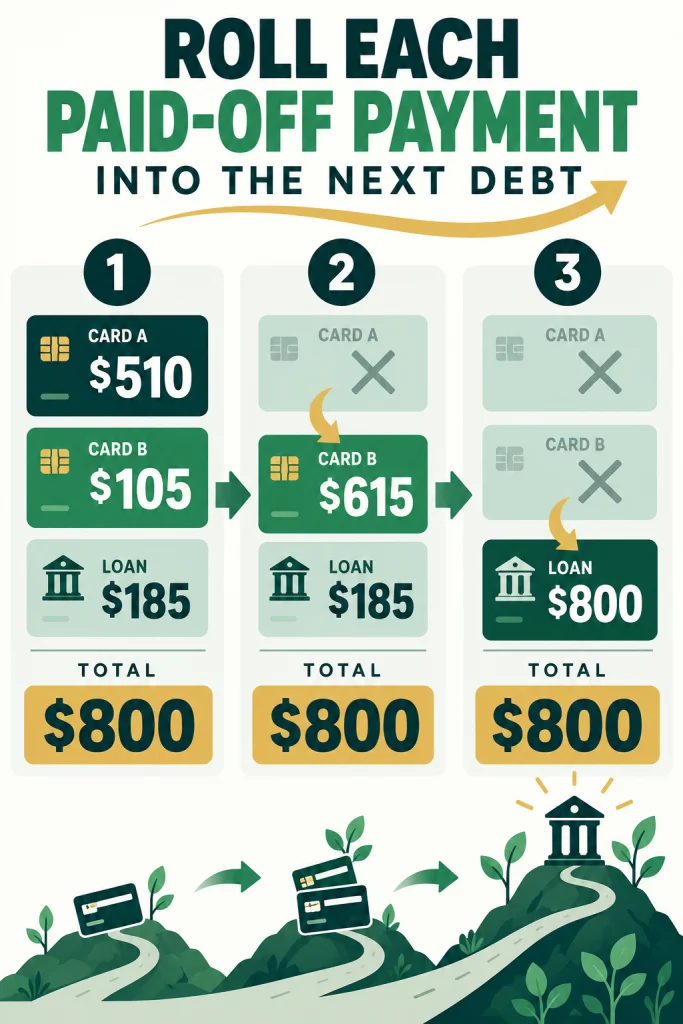
With the snowball method, sort debts from smallest to largest balance. In this example, card A comes first. It receives $510 monthly: its $30 minimum plus $480 extra. Card B receives $105, and the loan receives $185.
An early zero balance may help you stay engaged. Research described by Northwestern University found an association between closing debt accounts and successful debt elimination among people in a debt settlement program. That supports a possible motivational benefit, not a guarantee that snowball works better for every borrower.
Choose priority-based repayment when an overdue debt or upcoming payment deadline could create serious financial consequences. Consider the debt snowball method when paying off a smaller balance would help you stay motivated and committed to your plan. Whichever approach you choose, focus on staying organized, making affordable payments, and reducing your outstanding debt consistently.
Payment deadlines and special repayment terms deserve separate attention. Some financing agreements may impose additional fees, penalties, or other consequences if payments are missed or balances are not cleared by a specified date. Review your agreements carefully, track important deadlines, and prioritize payments that help protect your financial stability.
4. Automate the minimums and direct extra money to one target
Set up minimum-payment autopay where available, provided your payment account will have enough money. Add a reminder before each withdrawal so you can check the balance. Autopay can help prevent late payments, but insufficient funds can lead to fees.
Then schedule your extra payment to the chosen target. With the avalanche example, your monthly plan is $30 to card A, $585 to card B, and $185 to the loan.
Before combining autopay with manual payments, check how the lender handles them. Confirm the amount still scheduled for withdrawal rather than assuming a manual payment cancels autopay.
For installment loans, ask your lender how extra payments are applied and whether they can directly reduce your outstanding principal, which is the remaining amount borrowed. Review your loan statement to confirm that payments are recorded correctly. Also, check your loan agreement for any prepayment penalties, additional fees, or restrictions before making extra payments.
The useful question is specific: “How do I make an additional payment that reduces my principal balance, and are there any fees?”
5. Roll each paid-off payment into the next debt
When one balance reaches zero, keep the overall debt payment going if your budget still supports it. Move the amount you were paying on that debt to the next target. This rollover is part of both snowball and avalanche repayment.
Under the snowball example, the progression would look like this:
| Stage | Card A payment | Card B payment | Loan payment | Total monthly budget |
|---|---|---|---|---|
| All three debts remain | $510 | $105 | $185 | $800 |
| Card A is paid off | $0 | $615 | $185 | $800 |
| Both cards are paid off | $0 | $0 | $800 | $800 |
These are illustrative payment allocations, not a prediction of how many months each stage lasts. Actual minimums can change, and a debt’s final payment may be smaller. Redirect unused payoff money to the next debt when practical.
Review your debt repayment plan monthly. Update your outstanding balances, required minimum payments, upcoming due dates, and any special repayment deadlines. Check whether your extra payments remain affordable and whether new purchases are increasing your debt while you are working to pay it down.
When a loan is nearly paid off, contact your lender to confirm the exact amount required to close the account. The final payoff amount may differ from your most recent statement balance due to pending transactions, payment adjustments, or applicable fees. Request written confirmation once the loan has been fully repaid.
How Much Faster Can an Extra $100 a Month Pay Off Debt?
Consider a hypothetical $5,000 outstanding balance. The following calculation shows how different fixed monthly payments affect the time needed to clear the balance. It assumes no additional fees or charges, no new purchases, and a smaller final payment when necessary.
| Fixed Monthly Payment | Time to Pay Off | Final Payment |
|---|---|---|
| $150 | 34 months | $50 |
| $250 | 20 months | $250 |
| $350 | 15 months | $100 |
In this example, increasing your monthly payment from $150 to $250 helps you pay off the balance 14 months sooner. Increasing it to $350 reduces the repayment period to just 15 months.
With no additional charges, each payment goes directly toward reducing the outstanding balance. A $150 monthly payment reduces the balance by $150, while a $250 payment reduces it by $250. That additional $100 each month helps you reach a zero balance significantly sooner.
These figures are simplified mathematical illustrations, not actual lender quotes. Real repayment timelines depend on the terms of your agreement, applicable fees, and payment adjustments. Always meet your required minimum payments and confirm how additional payments are applied.
Explore Repayment Relief Before Taking on New Debt
Making extra payments can help reduce outstanding debt faster. However, adjusting repayment terms, reducing unnecessary fees, or arranging a more manageable payment schedule may also improve your financial situation.
Before considering additional borrowing, carefully evaluate your current obligations, repayment options, and potential risks.
Ask Your Current Creditor About Hardship Assistance or Payment Flexibility
Contact your creditor directly and explain your financial situation. Ask whether they offer hardship assistance, fee waivers, flexible payment schedules, or an affordable repayment arrangement.
Make sure you understand the conditions and request written confirmation of any agreement before proceeding.
You could say:
“I’m working on a repayment plan and can afford $___ per month. Do you offer hardship assistance, fee waivers, or a payment arrangement that fits my budget? Please explain the monthly payment, repayment period, total amount owed, and any additional conditions. I would appreciate receiving the terms in writing.”
Review any proposed arrangement carefully. Compare the total repayment amount, payment schedule, and conditions with your existing plan.
Only agree to an arrangement that you understand and can realistically afford without compromising essential living expenses. a guaranteed solution. Compare it with your existing payment plan before agreeing.
Calculate an Affordable Repayment Plan Without New Borrowing
Before considering another loan or credit card, explore whether you can pay off your existing balance through a manageable repayment arrangement with your current creditor.
Ask for a clear payment schedule, confirm the total amount you must repay, and check for any additional fees or conditions. Get the agreed terms in writing.
Here is a hypothetical example:
Suppose you have a $6,000 outstanding balance and want to repay it over 18 months, with no additional fees or charges.
$6,000 ÷ 18 = approximately $333.33 per month.
To repay the balance exactly, you could make:
- 17 monthly payments of $333.33
- One final payment of $333.39
Total repaid: $6,000.
This example assumes the repayment balance remains unchanged and no additional charges apply. Your actual payment schedule will depend on the agreement with your creditor.
Before committing, make sure the monthly payment fits your budget without affecting essential expenses such as housing, groceries, utilities, and transportation.
If the proposed payment is unaffordable, ask whether a longer repayment schedule or a hardship arrangement is available. Confirm the total repayment amount and any conditions before agreeing.
The goal is to clear your existing debt through an affordable, transparent repayment plan without taking on unnecessary new borrowing.
Compare consolidation by total cost, not just monthly payment
A personal consolidation loan replaces existing debts with a new loan. Before accepting, compare its APR, fees, repayment term, monthly payment, and total amount you would repay.
A lower monthly payment is not proof of a cheaper loan. It may simply spread repayment over more months. Where practical, compare the new loan with what you would pay by keeping your current debts and maintaining the same total monthly payment.
Consolidation also does not eliminate the amount you owe. Avoid treating the newly available credit on paid-off cards as spending money.
Be particularly cautious about moving unsecured credit card balances into a home equity loan or line of credit. Your home becomes collateral, putting it at risk if you cannot repay.
Federal student loans need a separate review. Refinancing them with a private lender takes them out of the federal system and removes federal benefits. Check your current repayment and forgiveness options before making that decision.
Find Extra Money Without Making Your Budget Unlivable
Reducing expenses and increasing income can create room for larger debt payments. Start with changes that are realistic enough to maintain, rather than a budget that works only when nothing goes wrong.
Try one recurring expense change and one income opportunity. For example, a hypothetical $35 subscription reduction, $65 reduction in takeout, and $100 from occasional extra work would create $200 before any additional work-related costs or taxes.
Count what is actually available to keep. Extra work that brings in $100 but requires $25 in expenses does not create a $100 debt payment.
For a bonus, refund, or sale of unused belongings, decide what portion can go toward debt after upcoming bills and reserves are covered. Treat one-time money as an extra payment, not as income you can count on every month.
Also check what is creating new balances. Removing stored card details or temporarily locking a card may help with unplanned purchases. But when borrowing is covering basic living costs, spending friction alone will not fix the shortfall. The budget needs more income, lower essential costs where possible, assistance, or a different repayment arrangement.
What to Do When You Cannot Afford the Plan
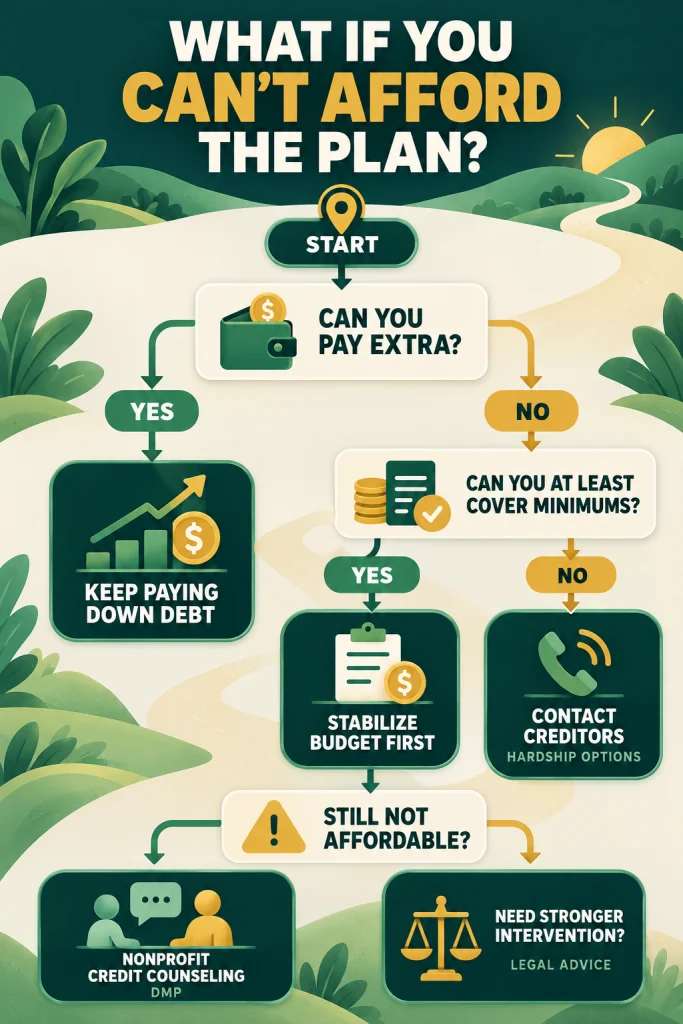
When there is no money beyond the minimums
Making required payments while stabilizing your finances is still a legitimate starting point. Do not create an unaffordable extra payment just to make the payoff date look better.
If even the minimums are becoming difficult, contact creditors before payments are missed when possible. Ask about available hardship arrangements and changes that could make the payment manageable.
Your debt-to-income ratio can provide context, but it is not a pass-or-fail test for snowball or avalanche. DTI means monthly debt payments divided by gross monthly income, and lenders use different limits. There is no universal DTI cutoff that, by itself, makes a payoff method stop working. The practical question is whether your take-home income covers essentials and a sustainable payment.
When credit counseling or a debt management plan may help
A nonprofit credit counselor can review your finances and explain options. A debt management plan (DMP) is not a new loan. You generally make a payment to the counseling agency, which distributes it to participating creditors.
A DMP may reduce certain fees, depending on creditor participation. Programs commonly aim to repay eligible unsecured debts over three to five years. Enrolled credit accounts may be closed, and credit scores can be affected by those closures and other changes.
Ask for the full written payment schedule, eligible accounts, fees, and consequences of missing a payment. Fees are not universal: providers may charge enrollment and monthly fees, with reductions or waivers depending on circumstances and state rules.
The proposed payment still has to fit your budget. A reputable counselor should assess that before recommending enrollment.
Do not confuse debt management with debt settlement
Debt settlement seeks an agreement to pay less than the full balance. Some programs encourage stopping payments while money accumulates for negotiations. That can lead to growing fees, damaged credit, collection activity, and possible lawsuits. Creditors do not have to agree to settle.
Be wary of guaranteed results or demands for payment before debts are settled, and get any agreement in writing. Forgiven debt may also create taxable income, although exceptions and exclusions can apply.
When repayment is not realistically affordable, or you are facing legal action, qualified legal advice may be appropriate. Chapter 7 bankruptcy can involve liquidation of nonexempt assets; Chapter 13 generally involves a court-approved three-to-five-year repayment plan for eligible individuals. Neither should be treated as a simple shortcut without reviewing eligibility, property risks, and which debts can be addressed.
Legal Services Corporation provides a directory of legal aid organizations for people seeking eligible civil legal assistance.
Frequently Asked Questions
Will paying every two weeks automatically pay off debt faster?
Not automatically. Paying half a monthly payment every two weeks creates 26 half-payments in a typical 52-week year, equal to 13 full monthly payments. The extra annual payment is a major reason this arrangement can accelerate payoff. Some lenders charge fees for these programs.
Paying half twice a month creates only 24 half-payments, equal to 12 monthly payments. It does not create an extra annual payment. Check how your lender applies partial payments, and do not let a split-payment schedule leave a required payment late.
Should I stop retirement contributions while paying off debt?
Not necessarily. Start by making sure you can cover essential living expenses and keep required debt payments current. Then review your employer’s matching contributions, vesting rules, and available retirement investment options.
An employer match may provide valuable additional contributions, but it is important to understand the plan’s conditions and choose investments that align with your financial goals and personal beliefs.
If your budget is tight, consider whether temporarily adjusting retirement contributions would help you manage immediate obligations. Review the decision regularly as your financial situation improves.
Are minimum payments useless?
No. Making the required minimum payment on time helps keep your account current and reduces the risk of missed payment consequences. However, paying only the minimum may leave a substantial outstanding balance for a long time.
Review your account statements to understand how much your balance decreases after each payment.
When your budget allows, consider making a consistent monthly payment above the required minimum. This can help you reduce your outstanding balance faster and make steady progress toward becoming debt free.
Always prioritize essential expenses and choose a repayment amount you can comfortably maintain.
Start With One Payment You Can Repeat
You do not need a perfect spreadsheet or an impressive first payment. Start by listing your balances, checking the rates, and finding an extra amount that does not put next month’s essentials at risk.
Then choose your target and schedule the payment. Review the numbers each month and adjust when your circumstances change.
Learning how to pay off debt faster is about making a clear, affordable plan work repeatedly. The next useful step is not promising to eliminate everything at once. It is deciding where your next available dollar will go.
References and further reading
These resources support the general educational topics discussed; individual circumstances and current rules may differ.
Continue learning
monthly budget guide · credit score guide · emergency fund guide · paycheck budgeting guide

Personal finance writer and content creator at Everyday Money Method.
Editorial Policy · Report a correction