
Editorial voice: Monem · Published 2026-10-05 · Article resources updated November 18, 2026
Key takeaways
- Plan meals around food you already have and a realistic shopping list.
- Compare unit prices, quantities and likely waste.
- Track the total grocery bill rather than treating discounts as guaranteed savings.
General educational information, not personalized financial advice. Read our Financial Disclaimer.
Somehow, you bought groceries and still need dinner.
If you’re trying to save money on groceries, that familiar little problem is a useful place to start. The bags are unpacked. There’s food in the kitchen. But the chicken needs thawing, the recipe needs three more ingredients, and you’re already hungry.
A workable grocery routine connects what you buy to what you’ll actually eat. Start with the food you have, plan meals that fit your week, and compare prices on the ingredients you still need. Then give the food a place in your next few meals before it gets forgotten.
You can build that routine without spending Sunday cooking twenty containers of the same lunch. A few well-chosen meals and some clear buying decisions will give you a place to begin.
Start with the grocery bill you actually pay
Related reading: Explore our monthly budget guide for a complementary approach.
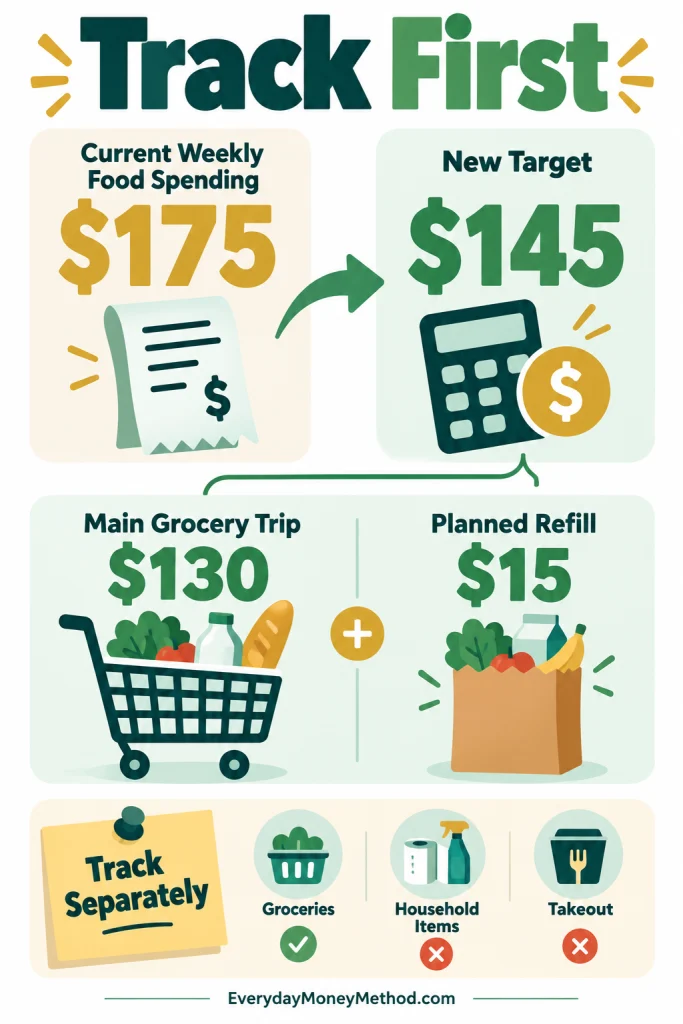
Before choosing a smaller grocery budget, find out what your current one includes. The Consumer Financial Protection Bureau recommends tracking spending for at least two weeks, or up to a month, to understand your spending habits.
Look at receipts, grocery orders, and the small trips between your main shopping days. Those extra stops belong in the total, even when you only went in for a few things.
Separate food from detergent, toiletries, pet supplies, and other items bought at the same store. You still need to budget for them, but this makes it easier to see whether food spending is changing. Keep restaurant meals and takeout in a separate category that you review alongside groceries.
The dollar amounts in the examples below are illustrative. Use your own receipts and local prices when you try them.
Suppose your recent food-only spending averages $175 a week. After looking at the receipts, you decide to test a $145 target because you’ve identified purchases you can change. That might mean $130 for the main trip and $15 reserved for milk, fruit, or another planned refill.
Those numbers illustrate the process. Your household size, food needs, available money, and local prices determine what is workable.
If you budget monthly, remember that a month is longer than four weeks. A $600 monthly food budget works out to about $138 a week on average, using $600 × 12 ÷ 52. Check the actual shopping dates and paydays too, so a month with five weekly trips doesn’t catch you off guard.
How to save money on groceries before you shop
Open the refrigerator before opening the store app.
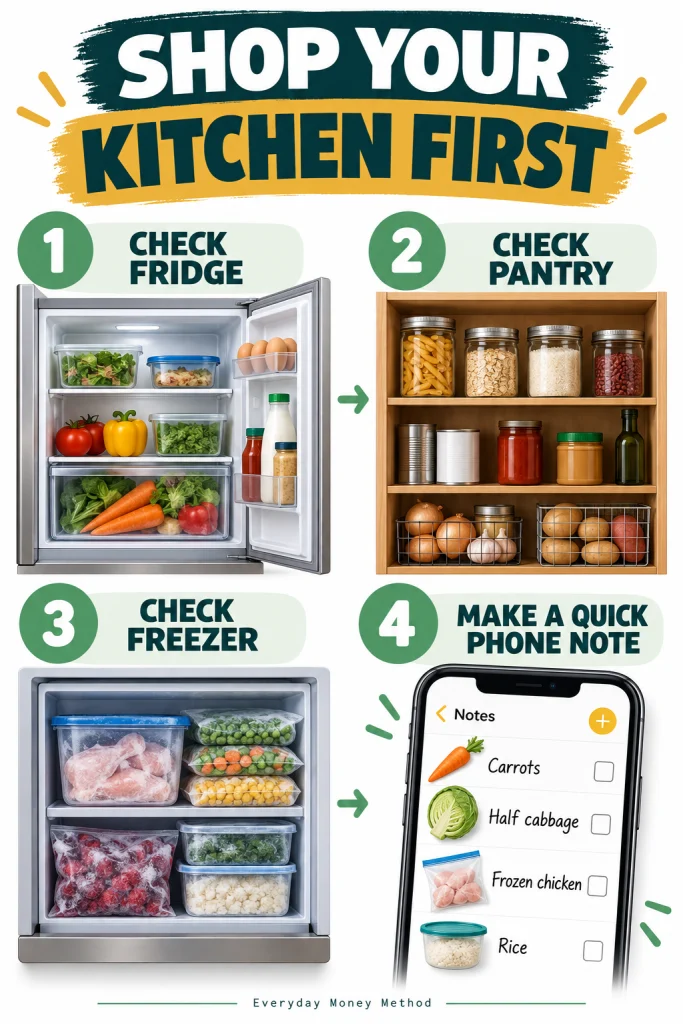
Look for the food that needs attention: the half bag of carrots, the opened yogurt, the cooked meal you could eat for lunch. Then check the pantry and freezer for ingredients that could finish those meals. EPA recommends checking what you already have and planning around food that needs to be used.
Keep a short note on your phone. You don’t need a complete inventory of every spice jar. Something like “carrots, half a cabbage, frozen chicken, rice” is enough to help you choose dinner.
Plan for the week you’re actually going to have
Related reading: Explore our saving money quickly for a complementary approach.
A recipe that needs an hour of chopping belongs on a day when you have that hour. If Wednesday is your busiest evening, give Wednesday an easier dinner.
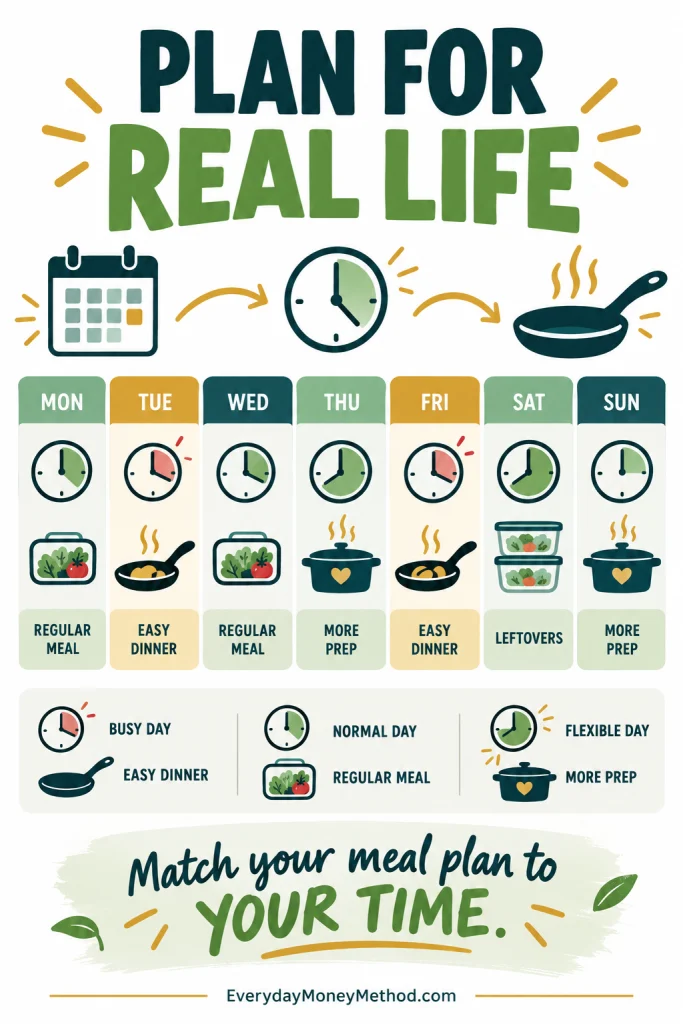
Choose a few familiar meals that fit the time you have. Work with the food already at home, and leave room for leftovers or plans changing.
You might start with four or five dinners instead of designing a complete month. Before finishing the list, add what you need for breakfasts, lunches, snacks, and drinks. Otherwise, a carefully planned dinner menu can still leave you buying lunch because there’s nothing ready to take with you.
Let ingredients show up in more than one meal
Seven unrelated recipes can leave you buying several ingredients you’ll use in only one meal. Look for a few ingredients that work across meals instead.
Here is a five-dinner example showing ingredient overlap. Adjust portions, sides, and the rest of the day’s food for your household.
| Day | Dinner | How the ingredients connect |
| Monday | Black bean rice bowls | Use rice, canned beans, peppers, and onions. |
| Tuesday | Chicken or tofu skillet | Use more of the peppers and onions. Prepare an extra portion of the protein for Wednesday. |
| Wednesday | Chicken or tofu wraps | Use Tuesday’s safely refrigerated protein with tortillas and shredded cabbage. |
| Thursday | Tomato lentil soup | Combine pantry lentils and canned tomatoes with onions and carrots. |
| Friday | Soup and toast | Use Thursday’s safely refrigerated soup and bread from the freezer. |
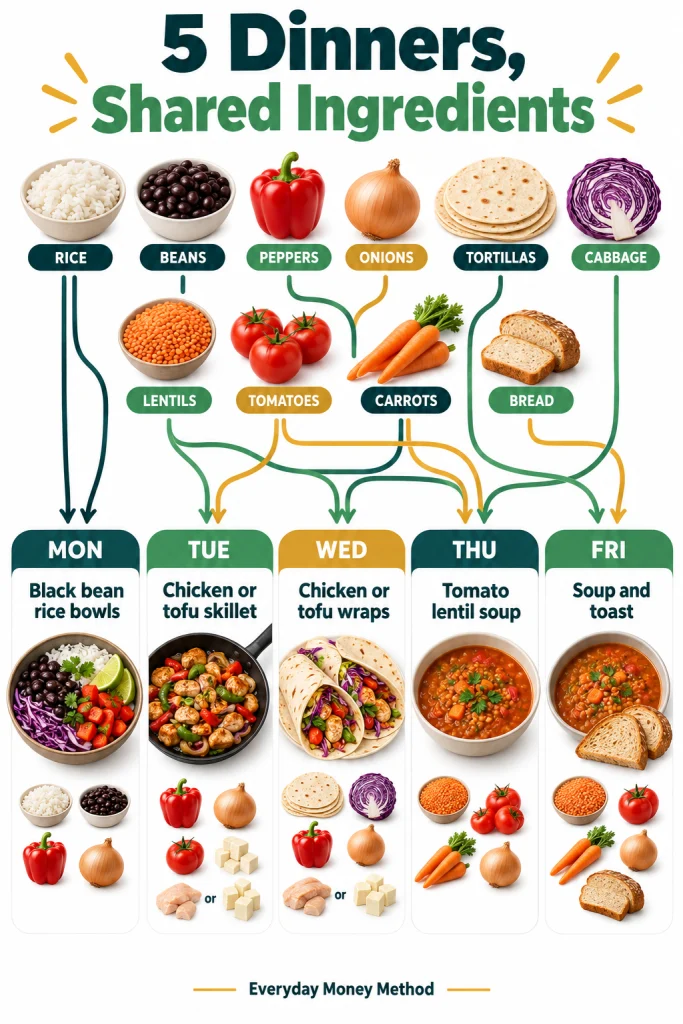
The meals change, while several ingredients carry through. Wednesday also has a head start before the evening gets busy. Refrigerate cooked food promptly and follow the storage limits covered below.
Write a grocery list with quantities and a spending limit
Related reading: Explore our frugal living tips for a complementary approach.
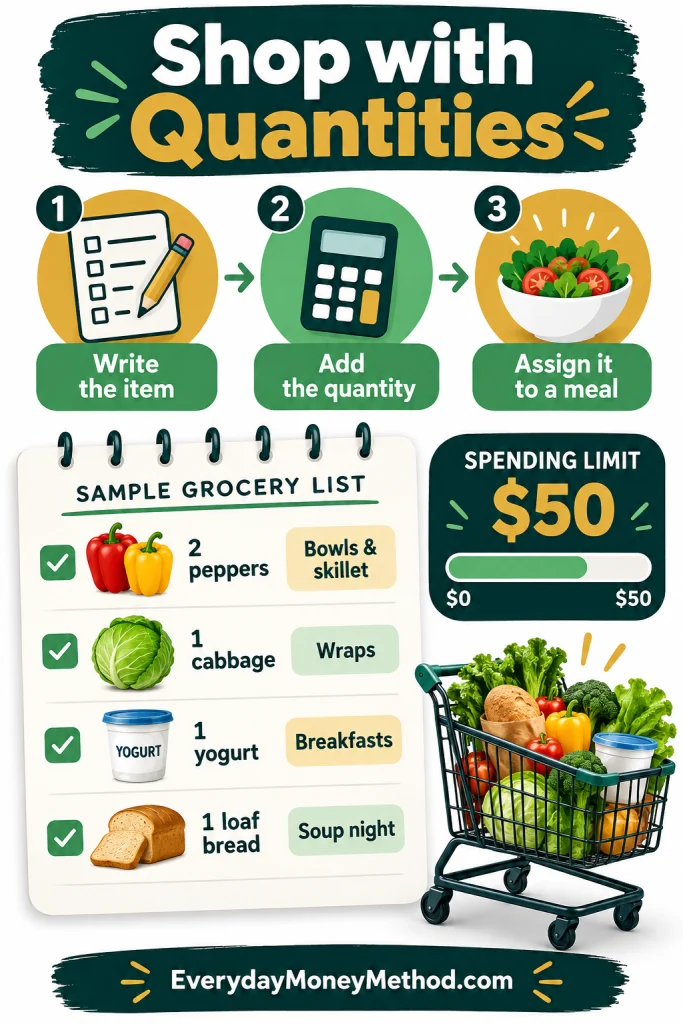
“Vegetables” leaves plenty of room for a cart full of good intentions. “Two peppers for bowls and the skillet” tells you what the food is for.
Write the quantity beside each item. Check recipe amounts against the number of people eating, and subtract what is already at home. EPA specifically recommends tying shopping quantities to the meals you expect to make.
Use recent receipts or the store’s listed prices to estimate the total. In the store, keep a running total on your phone, allowing for applicable taxes or deposits. If the estimate is over budget, adjust while the choices are still in front of you.
You could replace one expensive dinner, choose a lower-priced fruit, or remove an extra snack you hadn’t planned. Keep a favorite item in the budget if it matters to you. A list you’ll willingly follow is more useful than one that assumes you’ll suddenly stop liking your usual food.
Compare unit prices and the amount you will actually use
The package price tells you what comes out of your wallet today. The unit price helps you compare the cost of the same amount of food, such as one ounce or one pound. NIST explains that unit pricing allows comparisons across different package sizes.
When the shelf label doesn’t show a useful comparison, divide the price by the quantity. Use the same measurement for both products.
Consider these sample prices for the same type of yogurt:
| Package | Price | Price per ounce |
| 16 ounces | $2.88 | $0.18 |
| 32 ounces | $4.80 | $0.15 |
The larger tub costs less per ounce. If you’ll finish it, that difference can help.
But suppose you usually eat only 16 ounces before the rest must be discarded. You would pay $4.80 for the 16 ounces you actually eat, or $0.30 per ounce. The smaller tub would cost less for the amount you use.
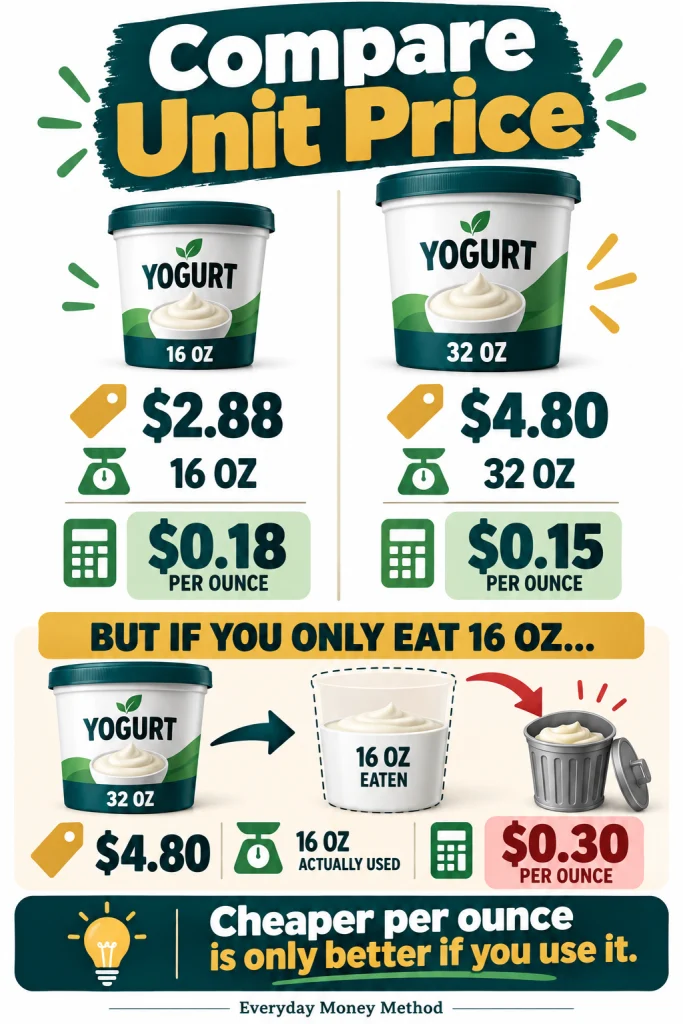
This is why your own habits belong in the comparison. A sale price can’t tell you whether you’ll finish the food.
For bulk purchases, check whether you can afford the upfront price, store the quantity properly, and use it in time. A big bag of a staple you regularly eat may work well. A large package of an unfamiliar food deserves a smaller trial first.
Also compare similar products. The weight of a can may include packing liquid, and bone-in meat includes weight you won’t eat. When the forms differ, consider the usable food and preparation involved alongside the shelf price.
Build some dinners around affordable staples
Look at the ingredients that drive the cost of your usual meals. Could one dinner use beans or lentils? Could another use a smaller amount of meat alongside a plant protein?
Harvard’s Nutrition Source identifies beans and tofu as options for replacing some meat or extending a dish. The cost advantage depends on the products and prices you’re comparing.
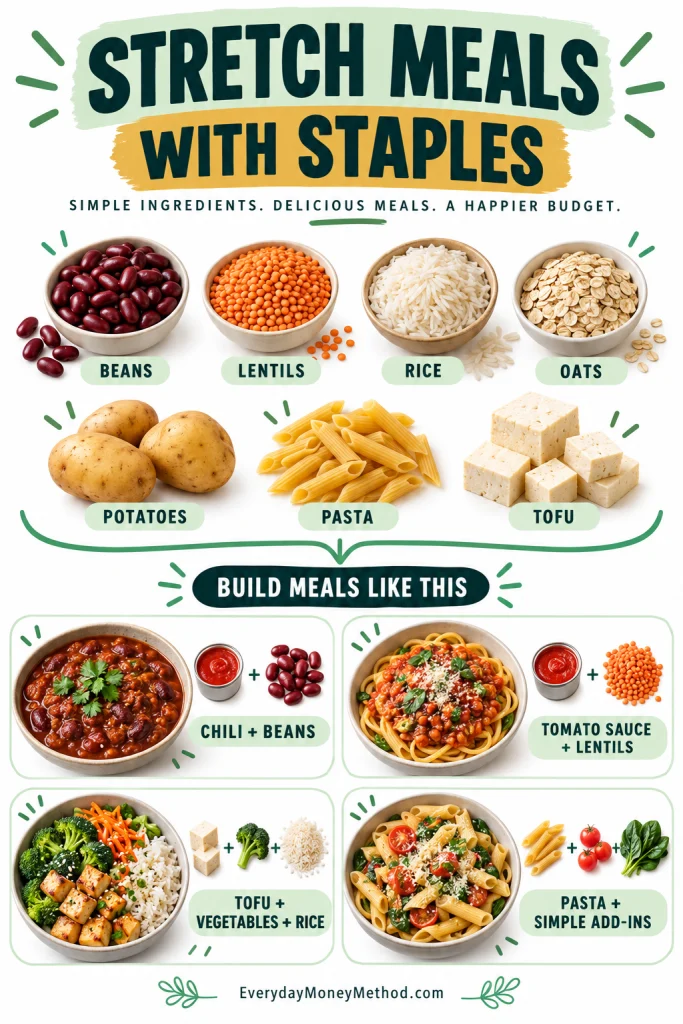
Try a change that fits food you already enjoy. Add beans to a chili, use lentils in a tomato sauce, or make a tofu and vegetable skillet. Rice, oats, potatoes, and pasta can also help turn the ingredients you have into familiar meals.
Think through preparation as well as price. Dried beans can work when you have the time and equipment to cook them properly. Canned beans may be more useful on a night when you need dinner quickly. Compare their cost for a similar cooked amount, since dry weight and ready-to-eat weight aren’t equivalent.
Start with one meal. Buying a cupboard full of “budget staples” that you haven’t learned to use ties up money and creates another cooking task.
Choose produce for when and how you will eat it
Fresh produce makes sense when you’ll eat it while it’s good. Frozen vegetables can be useful when you need a small amount at a time. Canned tomatoes can wait in the pantry for a soup or sauce.
The American Heart Association recognizes fresh, frozen, and canned produce as healthy options. Compare labels, choose lower-sodium vegetables when appropriate, and look for fruit packed in water or its own juice. Plain frozen produce lets you choose the seasonings yourself.
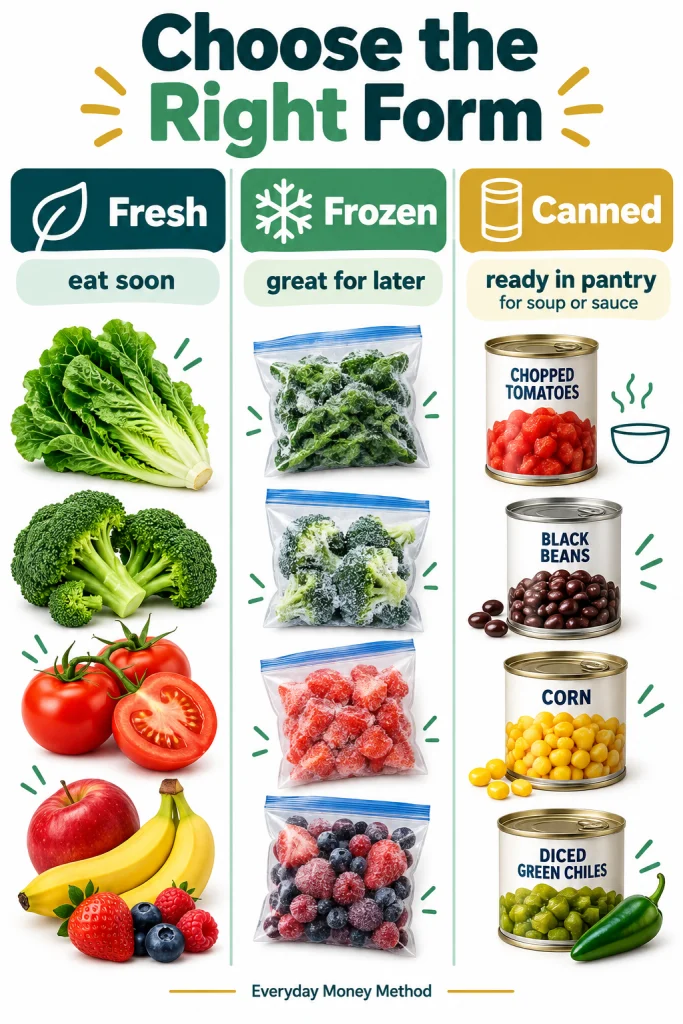
For your next shop, decide when you’ll use each purchase. You might buy fresh greens for tomorrow’s lunch and frozen broccoli for a dinner later in the week. That gives each item a more realistic job.
Check seasonal specials, but compare the actual prices. A local label or a farmers market stall doesn’t tell you whether that particular purchase is the best value for your budget.
If fresh produce repeatedly goes uneaten, change the quantity or form next time. You can buy two pieces of fruit instead of a large bag, or try frozen fruit for the breakfast you already make. The useful purchase is the one that fits your eating habits.
Try store brands one item at a time
Pick a product you buy often and compare the store brand with your usual one. Check the unit price, ingredients, and Nutrition Facts panel. The Academy of Nutrition and Dietetics recommends comparing those labels when considering store brands.
Oats, canned tomatoes, rice, and frozen vegetables are possible starting points. Buy a small amount first and see whether you like it in the meals you make.
Keep the substitutions that work. If one version tastes different enough that nobody uses it, try something else. And compare the final prices each time, since a promotion can change which option costs less.
Preserve any allergy or prescribed dietary requirements when switching products. A lower price doesn’t make an unsuitable ingredient usable.
Make sales and coupons earn their place on the list
A coupon is useful when it lowers the cost of something you need. University of Georgia Extension recommends checking whether you actually need an item before buying it because of an offer.
Suppose your usual acceptable pasta sauce costs $2.50. An equal-sized jar from a different brand costs $4, with a $1 coupon. The discounted jar is still $3, so switching would add 50 cents to this purchase.
Check the required size, quantity, membership conditions, and expiration before relying on a promotion. A multibuy offer may require several items, depending on its terms. Cash back paid later also doesn’t reduce the money you need at checkout today.
Use the same test for markdowns. If you already need the food, the condition is suitable, and you can use or freeze it safely in time, it may fit. If it changes your plan and requires extra purchases, add those costs before deciding.
Compare the whole shopping trip
If you have access to more than one store, compare a small basket of foods you regularly buy. Record the package sizes so the totals mean something. Repeat the comparison occasionally rather than assuming a store is cheaper because of one advertised item.
Then account for getting there. Saving $6 on groceries while spending an extra $5 on transportation leaves $1 before considering your time. Combining a shop with a trip you’re already making may change that calculation.
Pickup can also be worth comparing. The American Heart Association notes that online carts let you watch the running total and set substitution preferences; it advises checking minimum purchases and service fees.
Compare the actual item prices, applicable fees, and any delivery tip or membership cost. Check substitutions too, especially for dietary needs or a firm spending limit.
Choose the option that works with your transportation, schedule, and ability to shop. Keeping one main store and making an occasional planned visit elsewhere may be enough. You don’t need to chase every offer across town.
Keep an easy dinner for the evening that changes
By Wednesday, the meal plan may run into a late meeting, an appointment, or simple exhaustion. Decide on a backup while you’re writing the list.
It could be pasta with jarred sauce and frozen vegetables, beans on toast, or a properly stored frozen portion of a meal you already like. Georgia Extension recommends keeping one or two easy meals available for busy days.
Allow some convenience where it helps you eat the food. Illinois Extension specifically recognizes that selected prepared ingredients or smaller packages can be worth their price when preparation is difficult or food would otherwise be wasted.
For example, an $8 ready-to-cook dinner replacing a $24 takeout order would mean $16 less spent that evening. It would still cost more than a suitable $5 meal you were willing and able to cook. Compare with the choice you’re likely to make.
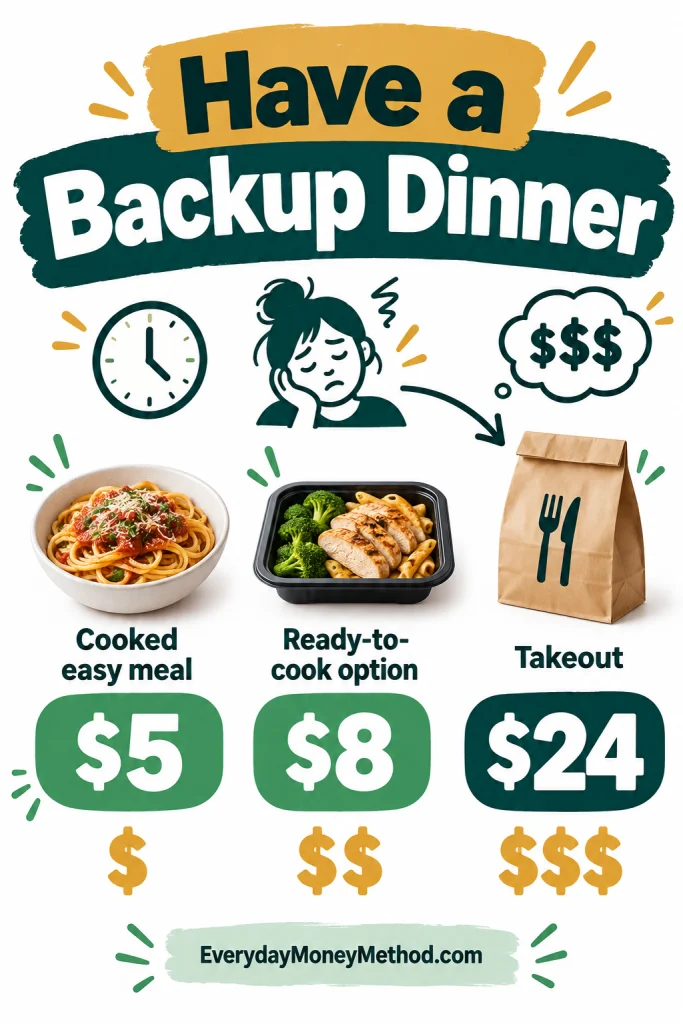
That might mean keeping the shredded cheese, buying the chopped vegetables, or having a microwave meal available. Choose deliberately and check the overall cost and nutrition of the meal.
Put food away with its next use in mind
When the groceries come home, make the next meal easy to find. Keep older suitable items visible, put the food you need to use soon together, and label leftovers with the food and date.
Before freezing an extra portion, decide how you might use it. A container marked “lentil soup, two portions” is easier to include in a future plan than an unmarked tub. Check what freezes well and leave enough room for proper storage.
Food safety sets the limits. FDA recommends keeping the refrigerator at 40°F or below and the freezer at 0°F. Refrigerate perishable food within two hours, or within one hour when the temperature is above 90°F.
FoodSafety.gov lists these refrigerator limits at 40°F or below:
Raw chicken or turkey, and raw ground meat: one to two days.
Cooked meat or poultry leftovers, soups, and stews: three to four days.
If you won’t use a suitable food within its safe window, freeze it promptly while it is still safe. Don’t plan to refrigerate a whole week’s cooked meals without checking the relevant storage guidance.
Understand dates without guessing about safety
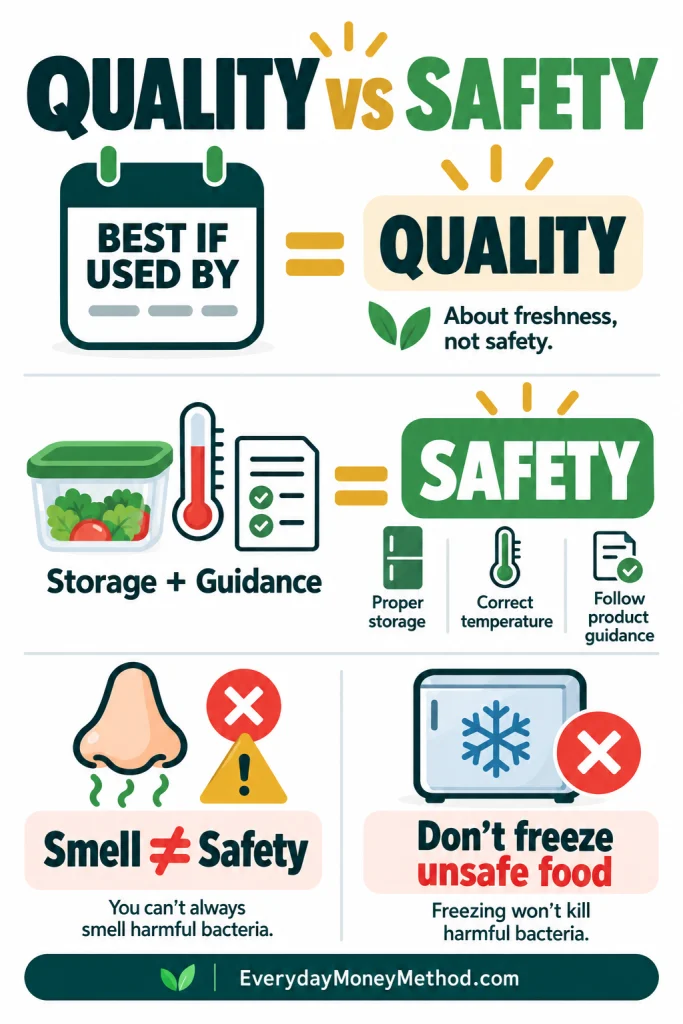
FDA explains that “Best if Used By” refers to quality. Passing that date alone doesn’t tell you whether a food is unsafe, but storage history and product-specific guidance still matter. Infant formula must be used by its use-by date.
Food can contain harmful bacteria even when it looks and smells normal. Don’t use a smell test to overrule storage limits, and don’t try to rescue unsafe food by freezing it.
Check whether the changes lowered your total food spending
After a few shopping cycles, compare the results with where you started. Look at groceries, extra trips, and takeout together. Also notice whether you’re eating through existing pantry supplies that will eventually need replacing.
Return to that $175 grocery baseline and $145 target. Here’s how the weekly comparison might look:
| Food spending | Before | After |
| Main grocery trip | $145 | $130 |
| Smaller grocery trips | $30 | $15 |
| Takeout | $35 | $35 |
| Total | $210 | $180 |
The difference is $30 for that week. Grocery spending fell from $175 to $145, while takeout stayed the same.
Now imagine takeout rose to $65 because the new shopping list didn’t provide enough usable meals. Total spending would be back at $210. That tells you to improve the meal plan before tightening the grocery target again.
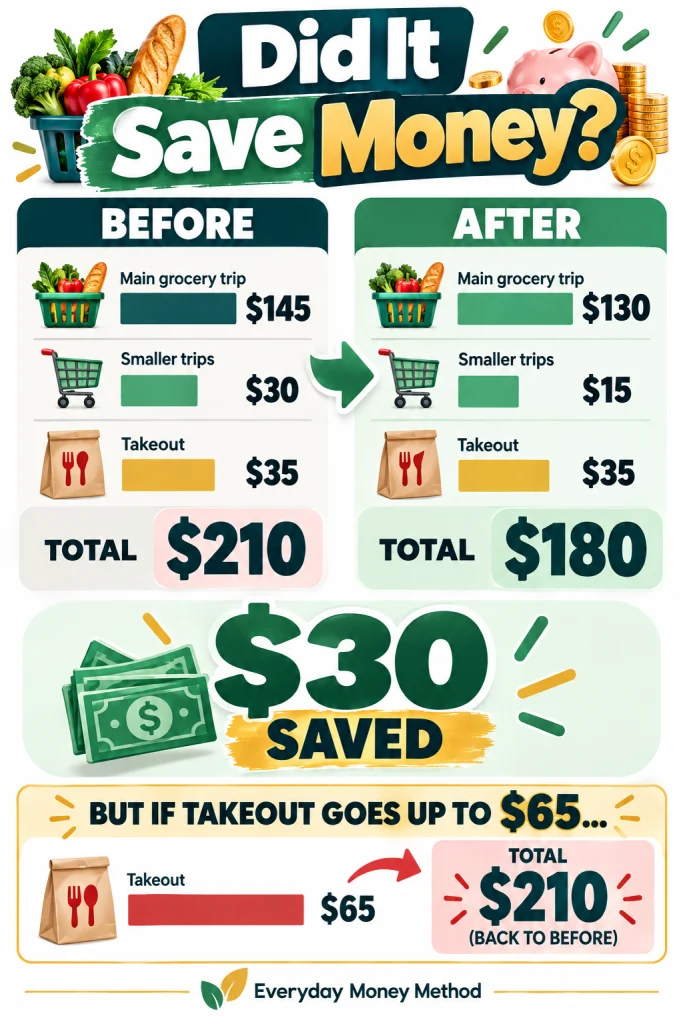
Ask what was left unused, which meal was easy to repeat, and which purchase you missed. Use those answers to change the next list. Give the routine several weeks so an unusually large stock-up trip or a mostly full pantry doesn’t distort the comparison.
Common questions about saving money on groceries
Saving money on groceries for one person
Choose a few ingredients that work in different meals and be selective with perishable package sizes. If you have freezer space, portion suitable extras for later. Smaller packages can make sense when they prevent repeated waste, even at a higher unit price.
For example, cabbage could go into a skillet, a wrap, and a small slaw. You get variety without buying separate vegetables for every dish. Start with amounts you can realistically use.
Choosing a weekly or monthly shopping schedule
Choose a schedule that matches your cash flow, transportation, storage, and how quickly you use fresh food. A monthly purchase of selected staples plus smaller fresh-food trips may work. So may one main weekly shop with a planned refill.
Whichever you choose, give the extra trips a list and a place in the budget. Review the total across the month.
Getting help when your food budget falls short
Look at getting support as well as changing purchases. In the United States, SNAP may help eligible households pay for groceries. Contact your state or local SNAP office for current requirements and application information.
For immediate help, USA.gov lists food pantries and other emergency food resources, including calling 211 to find local assistance. You can seek help while working on your budget. If there isn’t enough money for adequate food, another coupon may not close the gap.
Start with the next dinner and the next shopping list
Before your next trip, find one food you already have and decide how you’ll use it. Choose a few meals that fit the coming week, then write down the missing ingredients and quantities.
As you learn how to save money on groceries, pay attention to what happens after checkout. Which foods became meals? Which ones were still sitting there when you shopped again? Let those answers shape the next purchase. The next time you unpack the groceries, you’ll have a clearer idea of what’s for dinner.
Free Grocery Savings Worksheets
Ready-to-paste article text
Planning your grocery budget is easier when you have a simple place to track what you buy, what you use, and what actually saves money. These printable grocery savings worksheets are designed to help you put the ideas in this guide into practice.
Choose the worksheet that fits what you want to work on right now.
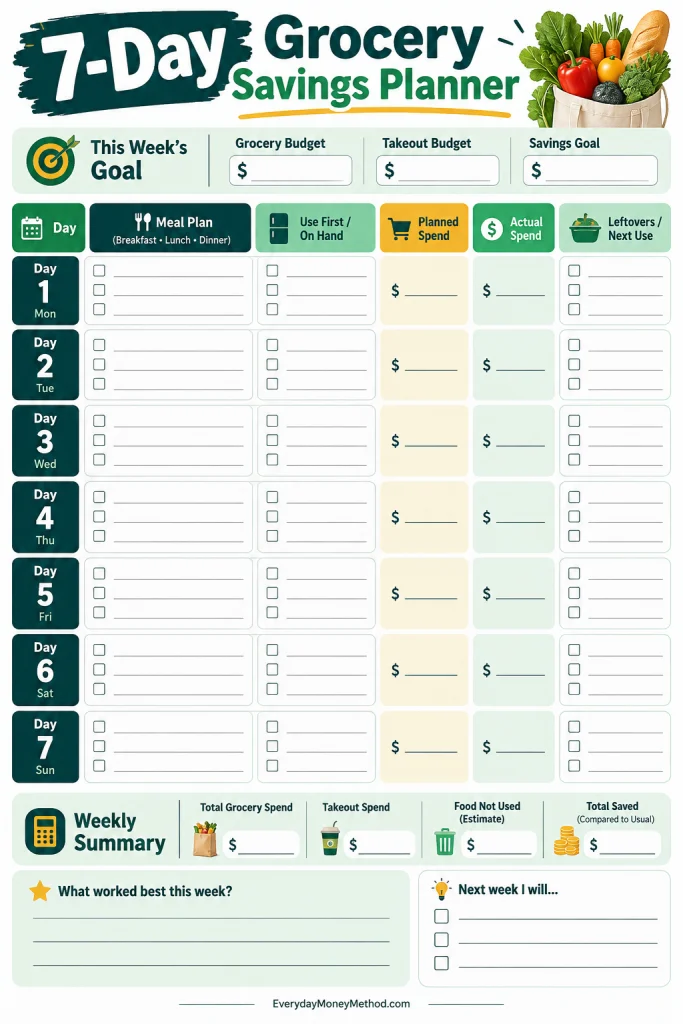
7-Day Grocery Savings Planner
Plan meals for the week, note what you already have, set a grocery budget, and compare planned spending with what you actually spend. Use the weekly summary to see what worked and what you want to change next week.
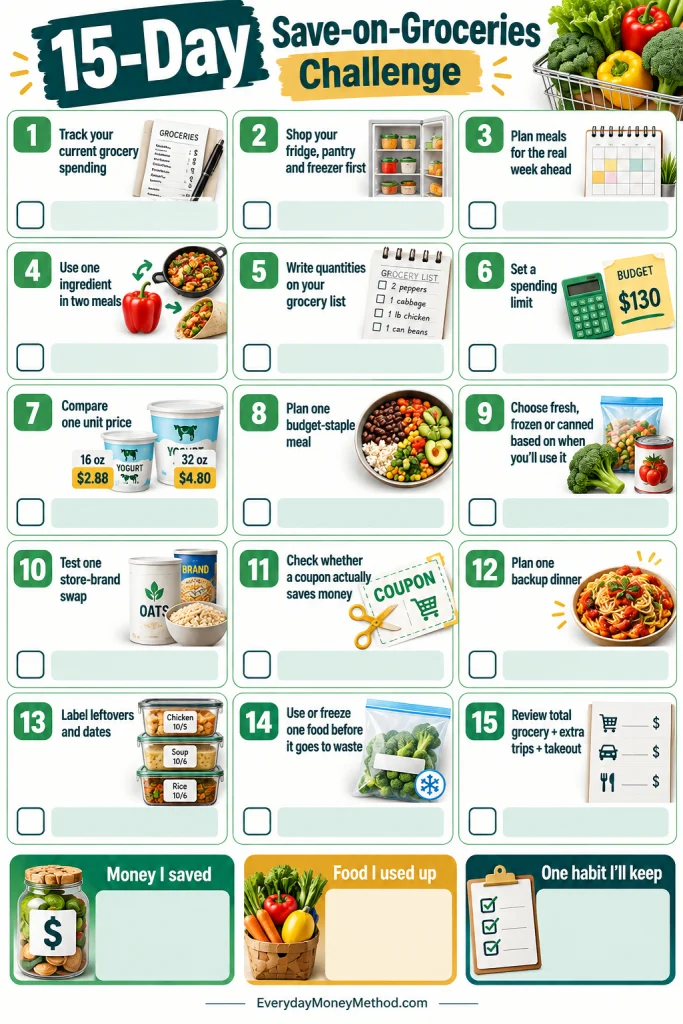
15-Day Save-on-Groceries Challenge
Work through one small grocery-saving action each day. The challenge includes checking your fridge and pantry, planning meals, comparing unit prices, trying store brands, planning a backup dinner, using leftovers, and reviewing your total food spending.
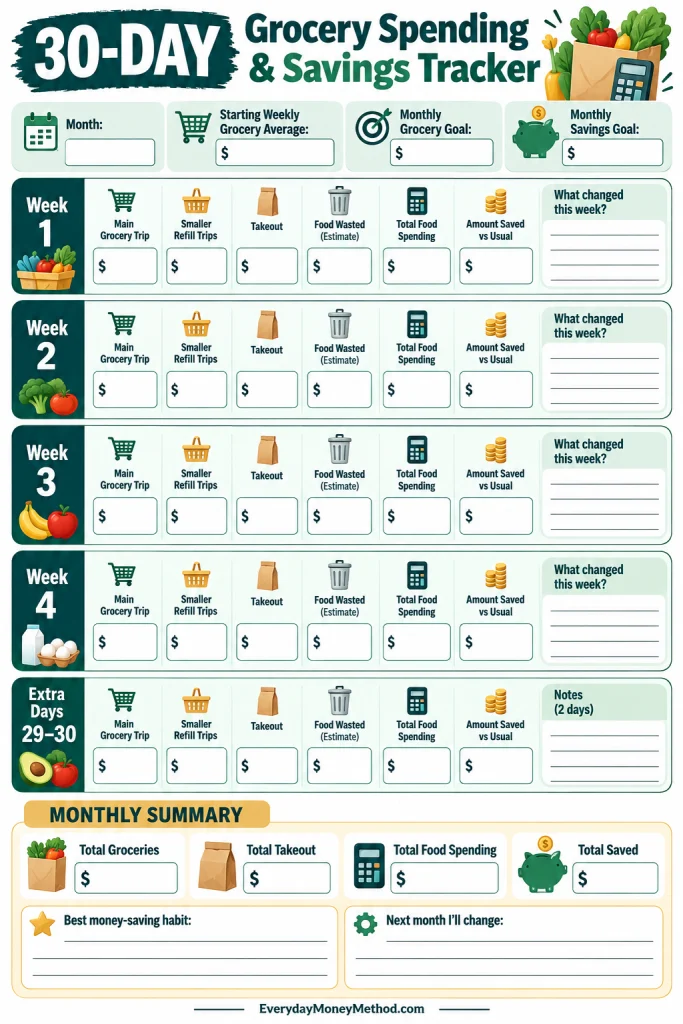
30-Day Grocery Spending & Savings Tracker
Track your main grocery trips, smaller refill trips, takeout, estimated food waste, and total food spending for a full month. At the end of the month, compare the results with your usual spending and identify the habits that helped most.
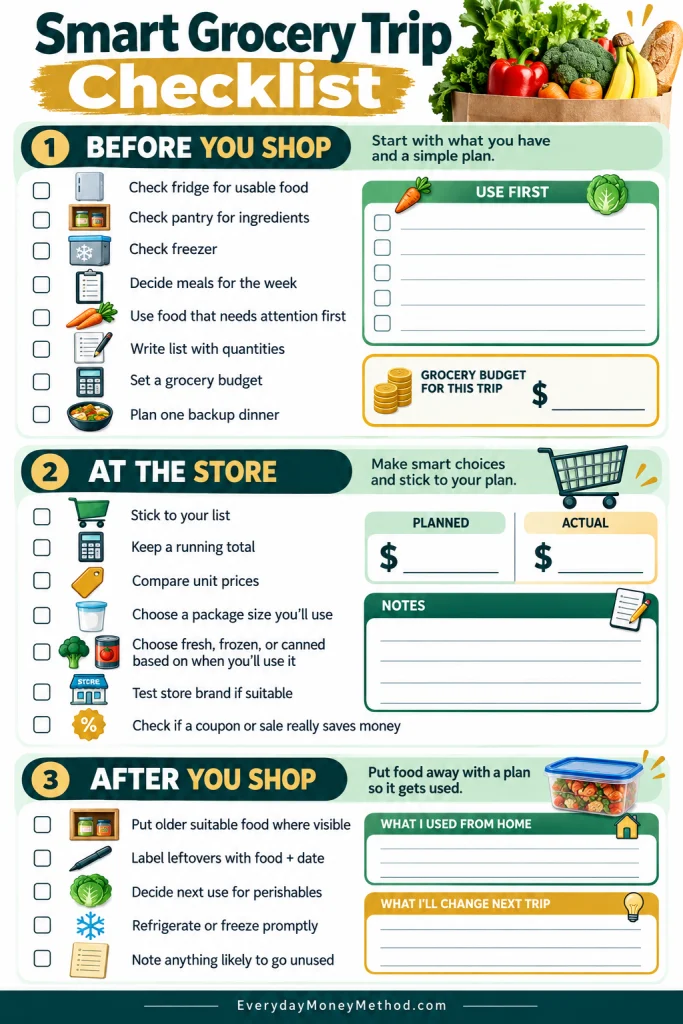
Smart Grocery Trip Checklist
Use this checklist before, during, and after a grocery trip. Check what you already have, make a list with quantities, set a spending limit, compare prices at the store, and put food away with its next use in mind.
Small CTA at the bottom
Start with one worksheet instead of trying to change everything at once. A week of tracking may be enough to show where your grocery plan is working and where a small adjustment could help.
References and further reading
These resources support the general educational topics discussed; individual circumstances and current rules may differ.
Continue learning
monthly budget guide · saving money quickly · frugal living tips · paycheck budgeting guide

Personal finance writer and content creator at Everyday Money Method.
Editorial Policy · Report a correction