
Editorial voice: Monem · Published 2026-11-16 · Article resources updated November 18, 2026
Key takeaways
- Track actual spending before choosing which costs to reduce.
- Prioritize repeatable changes and avoid sacrificing essentials.
- Plan for irregular expenses and monitor your savings progress.
General educational information, not personalized financial advice. Read our Financial Disclaimer.
You can leave the grocery store with everything on your list and still wonder how the total got so high. Then you get home, open your banking app, and find a subscription you forgot you were paying for. Suddenly, saving money feels like a job that comes with homework.
Here’s a better starting point: frugal living is about getting more value from the money you already spend, not making your life as uncomfortable as possible. That can mean a cheaper phone plan, a meal that uses what’s already in the fridge, or deciding that a purchase can wait until next week.
The strongest frugal living tips tend to have three things in common. They address a real expense, fit your actual routine, and don’t cost more time or money than they save. Below are 23 ideas, including examples shared by real people on Reddit and in published personal accounts. Their results are individual experiences, not promises about what you’ll save.
What Does Frugal Living Really Mean?
Related reading: Explore our grocery savings guide for a complementary approach.
Being frugal means spending deliberately. It doesn’t mean never buying coffee, never taking a vacation, or always choosing the cheapest product.
Imagine two people buying winter boots. One buys an inexpensive pair that needs replacing each season. The other pays more for a durable pair that fits properly and lasts several years. The second purchase might be more frugal, even though it costs more today. The decision depends on actual durability, usage, and what each person can afford upfront.

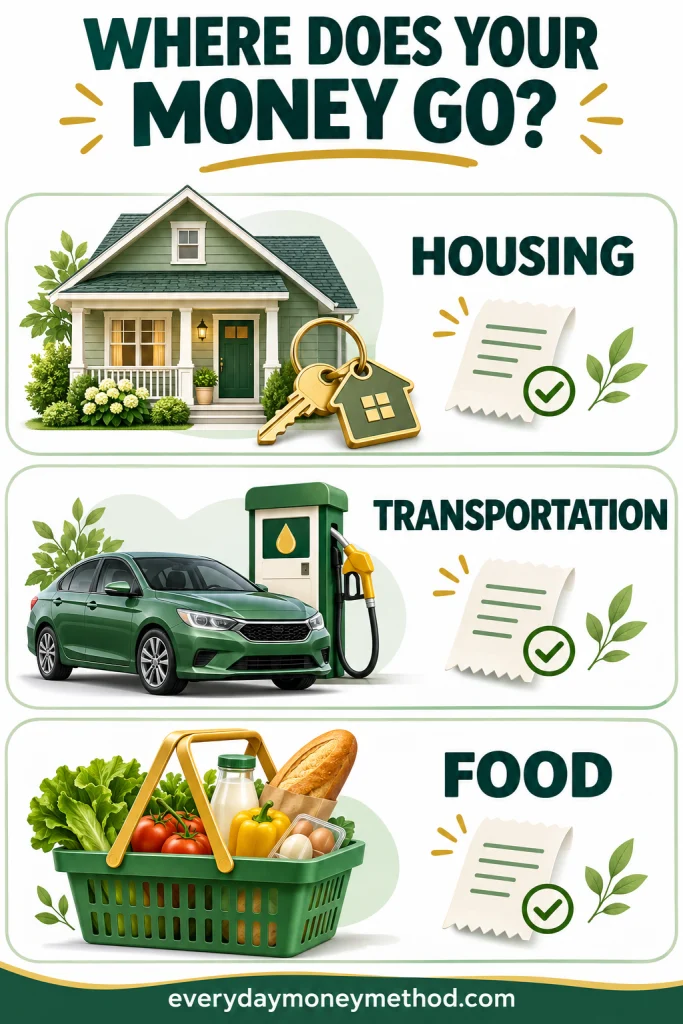
The bigger picture matters too. In the U.S. Bureau of Labor Statistics’ 2024 Consumer Expenditure Survey, housing and transportation together made up just over half of average household spending. That doesn’t describe every family, but it explains why improving a major recurring expense can matter more than skipping the occasional treat.
Start With the Money You Already Spend
1. Track every purchase before deciding what to cut
Related reading: Explore our saving money quickly for a complementary approach.
If you’ve ever thought, “I don’t buy anything extravagant, so where does my paycheck go?” start with the numbers rather than a stricter set of rules.
For 30 days, record bills, groceries, delivery fees, convenience-store stops, purchases made through apps, and anything paid in cash. Sort them into a few practical groups: housing, transportation, food, debt payments, subscriptions, and everything else. Then compare the total with what actually came into your account. Consumer.gov recommends using real income and expense records to build a budget you can revise as you learn where your money goes.
A real Reddit example: In an r/Frugal discussion, user u/antsam9 said they tracked every dollar for two months, including bus rides and small purchases. They discovered that their normal spending was $400 a month higher than their base income. Regular overtime had concealed the gap. Their account is self-reported, but the lesson is useful: you can’t fix a shortfall you haven’t measured.
2. Put your three biggest expenses at the top of the list
Pull up your rent or mortgage, transportation costs, and grocery spending. Look at the total cost of each, not just the most visible payment.
For example, a car’s real cost includes insurance, gas, maintenance, registration, and possibly parking. A cheaper apartment may not save you much if commuting becomes dramatically more expensive. A budget review is more useful when it shows those connections instead of treating every expense as an isolated number.
You may not be able to change your housing arrangement right now. That’s fine. The point is to spot your largest changeable expenses first, even if you work on them gradually. The biggest number isn’t automatically the easiest cut.
3. Give irregular expenses a place in your monthly budget
Related reading: Explore our monthly budget guide for a complementary approach.
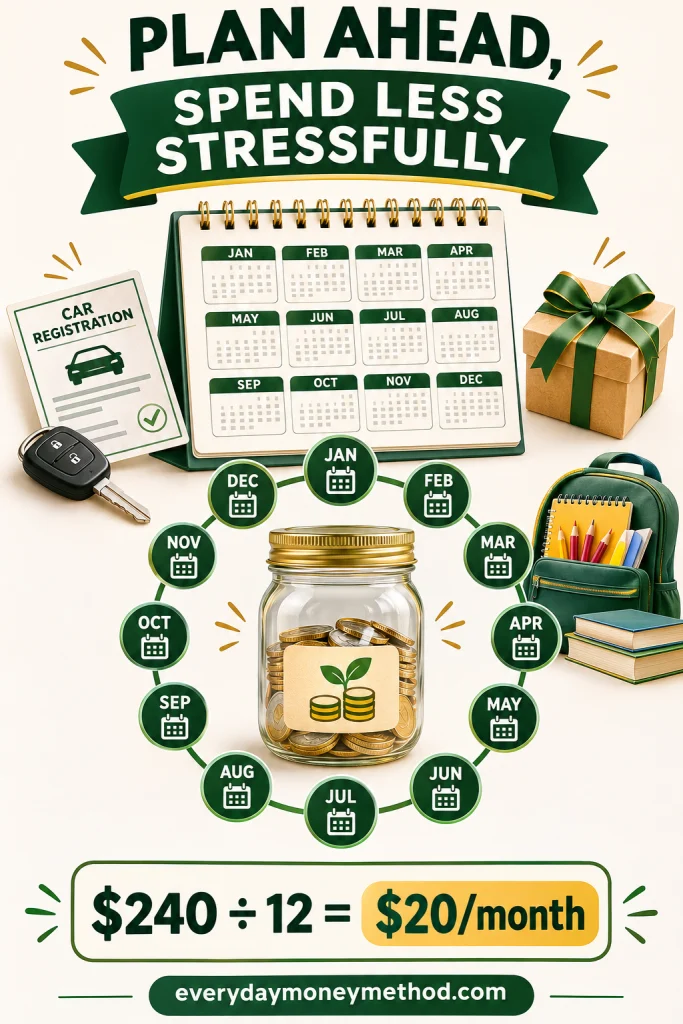
Car registration is not an emergency simply because it happens once a year. Neither are most holiday gifts, school supplies, or routine vehicle maintenance.
List the predictable expenses that don’t arrive monthly. Divide an estimated annual cost by 12 and set aside what you can each month. If you expect to spend $240 on a recurring annual expense, that’s a hypothetical $20 a month to plan for, not a surprise $240 charge later.
If money is tight, start with the nearest upcoming expense rather than trying to fund every category immediately. A plan that works with your next paycheck beats a perfect spreadsheet you can’t follow.
4. Move a manageable amount into savings automatically
Once you know when bills are due, consider a small automatic transfer to a separate savings account. Even $5 or $10 per payday can make the habit easier to maintain. America Saves recommends automatic saving as a way to make contributions more consistent.
But there’s an important catch: don’t automate a transfer that could leave you short on rent, food, or another essential payment. Start with an amount you can spare, time it around paydays, and adjust when income changes. The Consumer Financial Protection Bureau also emphasizes making emergency saving fit your cash flow.
Frugal Living Tips for Food and Groceries
5. Shop your kitchen before you shop the supermarket
Open the fridge, freezer, and pantry before making a list. Find the food that’s already been paid for, especially anything that needs to be used soon.
Maybe there’s half a bag of rice, a can of beans, carrots, and frozen chicken. Instead of starting from an entirely new recipe, build one or two dinners around those ingredients and buy only what’s missing. The EPA specifically recommends checking what you have, planning around it, and buying quantities you’re likely to use to reduce wasted food.
A useful trick is to designate a visible “eat first” area in your fridge. It saves you from rediscovering spoiled ingredients three days after buying replacements.

6. Try reverse meal planning instead of planning seven perfect dinners
Traditional meal planning asks, “What do I want to cook this week?” Reverse meal planning asks, “What do I already have, and what’s reasonably priced?”
Utah State University Extension recommends using your existing ingredients and sale items to shape the menu, then purchasing only the gaps. If chicken is on sale and you already have rice and vegetables, you might plan stir-fry one night and soup another.
Keep the plan realistic. If Wednesday is your busiest day, that’s probably not the night for a complicated new recipe. Budget Bytes makes a similar point: meal planning works best when it reflects the time and energy you actually have.

7. Turn leftovers into tomorrow’s easy meal
A dinner you don’t finish can become lunch, part of an omelet, or a filling for a wrap. Cooked beans can go into soup. Roasted vegetables can go into pasta. A small amount of chicken can stretch further in a rice bowl than as the centerpiece of another full dinner.
Food safety still comes first. The FDA advises keeping refrigerators at 40°F or below and freezers at 0°F, refrigerating perishable foods promptly, and handling leftovers properly. Don’t gamble with spoiled or improperly stored food to save a few dollars.
8. Compare unit prices, not just package prices
The giant box isn’t always the bargain. Compare price per ounce, pound, or count using the shelf label. If a 12-ounce item costs $3 and an 18-ounce version costs $4, the unit prices are 25 cents per ounce and about 22 cents per ounce, respectively.
But that comparison only matters if you’ll use the larger package before it goes bad. A lower price per ounce doesn’t help if half the food ends up in the trash. Utah State University Extension specifically recommends unit-price comparison alongside careful shopping lists.

9. Test store brands one item at a time
You don’t have to switch every grocery item overnight. Start with products where the brand difference matters least to you: canned tomatoes, flour, oats, frozen vegetables, or basic cleaning supplies.
Real shoppers interviewed or featured by Consumer Reports illustrate why it’s worth experimenting. Angel Micarelli of Massachusetts reported regularly buying Trader Joe’s almonds because they were cheaper in her comparison. Karen Iseminger of Pennsylvania said she actually preferred a store-brand cookie to the national-brand version. Their preferences are personal, and prices vary by store and time, but they show that a cheaper alternative doesn’t automatically mean a worse experience.
10. Buy in bulk only when the total cost makes sense
Bulk shopping can be helpful for shelf-stable staples and household goods you routinely use. It can also tie up cash, crowd your storage space, and encourage overbuying.
Before buying, ask three questions: Is the unit price lower? Will I use it all? Can I afford the larger total today without putting essentials at risk?
If you live alone or have limited storage, sharing a large package with a trusted neighbor or friend may be more practical than maintaining a miniature warehouse in your kitchen.
11. Pack lunch, but include the hidden costs of getting it
Here’s an unexpectedly good lesson from Reddit. A Canadian hospital worker posting as u/whatsup2382 said they used to drive home during lunch to make food, thinking they were saving money. Then they realized the extra trip was increasing fuel use. Their solution was to bring lunch to work, eat there, and keep coffee supplies at the office.
That’s the kind of frugal thinking that makes a difference: measure the whole decision. If packing lunch takes five minutes the night before, it’s probably manageable. If your version of “saving” requires an extra drive across town, the math may tell a different story.
12. Keep two or three cheap, low-effort meals available
Sometimes delivery happens because everyone is tired and there’s nothing ready. You can reduce that temptation by stocking meals you genuinely like that require little effort.
Try frozen homemade soup, pasta with canned tomatoes, bean-and-cheese quesadillas, or rice with frozen vegetables and eggs. These are examples, not a prescribed diet; adapt for allergies, nutrition needs, food preferences, and local prices.
The goal isn’t to cook everything from scratch. It’s to give yourself an easy alternative on the evening when motivation disappears.
Lower Your Monthly Bills Without Losing What Matters
13. Audit subscriptions every three months
Streaming, cloud storage, workout apps, digital tools, and free trials can quietly become permanent expenses. Check bank and card statements, Apple or Google subscriptions, and your email for renewal notices.
Money expert Clark Howard described discovering that his household was paying for the same streaming service through two different billing arrangements, one of them via Roku. His team recommends reviewing subscriptions quarterly to catch duplication and forgotten charges.
You don’t have to cancel everything. Keep the subscriptions you actually use. Downgrade, rotate, or cancel the ones that no longer earn their place. If you cancel, follow the provider’s process and keep confirmation; the FTC warns that trial and automatic-renewal terms deserve close attention.

14. Check whether your phone and internet plans still fit
Maybe you signed up for unlimited data when you commuted every day but now work from home. Perhaps your internet provider’s promotional rate expired months ago.
Review your usage and compare the total ongoing price, including equipment, taxes, fees, and the rate after any promotion. Also check network coverage and contract terms before switching. A low advertised monthly price isn’t a saving if the service doesn’t work where you need it.
For eligible U.S. households, the federal Lifeline program may help lower the cost of qualifying phone or internet service. Eligibility and program rules matter, so check the official program rather than assuming everyone qualifies.
15. Re-shop insurance without accidentally reducing protection
Car and home insurance premiums can change even when your situation seems the same. Request quotes before renewal, but compare the same liability limits, deductibles, and major coverage details.
The National Association of Insurance Commissioners advises consumers to compare policies carefully and understand what they cover. The lowest premium isn’t necessarily the best deal if it leaves you exposed to a much larger expense after a claim.
Also ask whether you’re eligible for discounts based on your driving pattern, bundling, safety equipment, or other qualifying factors. Confirm the actual final price, not a hypothetical discount.
16. Make small energy changes before buying expensive gadgets
Start with what costs little or nothing: adjust heating and cooling when appropriate, use window coverings strategically, maintain filters according to the system instructions, and switch frequently used bulbs to efficient LEDs as old ones wear out. ENERGY STAR identifies several low- and no-cost household efficiency measures.
If you rent, focus on changes permitted by your lease. And don’t make the house unsafe or uncomfortable to hit an arbitrary thermostat number. The FTC recommends looking at both the operating cost and the upfront cost before investing in heating or cooling equipment.
17. Reduce unnecessary trips, not just the price of gas
Combining errands into one route, walking for nearby tasks when safe, and carpooling where workable can reduce driving. The U.S. Department of Energy’s FuelEconomy.gov recommends planning and combining trips as practical fuel-saving measures.
Before switching your commute to a bus, train, bicycle, or rideshare, compare the true costs, travel time, accessibility, and reliability. There is no universal cheapest option. The Reddit hospital worker who switched from driving home for lunch to packing food is a reminder that one extra trip can erase part of an otherwise sensible saving.

18. Look at housing changes with a full-cost calculator
Housing is often a major expense, but moving isn’t automatically the answer. Security deposits, movers, commute changes, utility costs, lease penalties, and the time involved can eat into the apparent savings.
One Reddit commenter in a frugality discussion reported a substantial drop in monthly rent after moving into income-restricted housing. That is one person’s self-reported experience, with no currency or location verified. Such housing depends on local availability, eligibility, and waiting lists.
If moving isn’t realistic, you can still review renewal terms, consider a compatible roommate where lawful and safe, or look for relevant rental or utility assistance. You are not failing at frugality because an unaffordable housing market is bigger than your grocery-list habits.
Spend Less on Shopping and Everyday Stuff
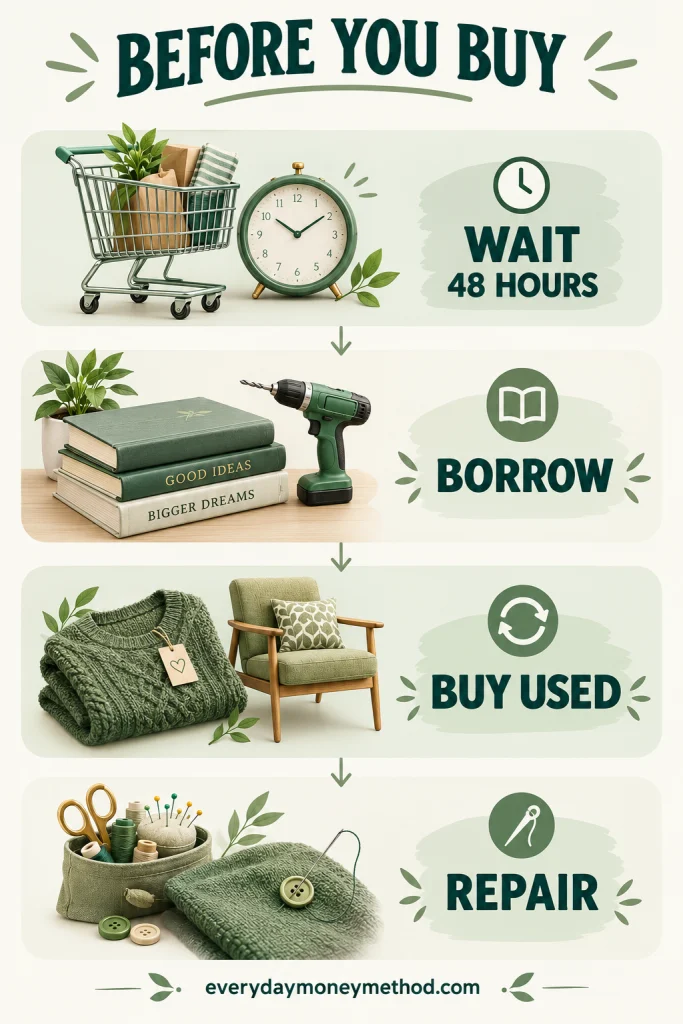
19. Give nonessential purchases a 48-hour waiting period
The easiest purchase to save money on is sometimes the one you never make.
Reddit user u/PurpleFit550 described adding tempting Amazon items to a cart and waiting a day or two. After the initial urge faded, they often realized they didn’t want the items anymore. The same poster reported deleting delivery and social-shopping apps and cutting more than $30 in monthly entertainment subscriptions. These are their personal results, but the technique is easy to test.
For nonurgent purchases, save the item to a list instead of checking out. If you still want it later, compare the full price, return terms, and whether you can afford it. A waiting period is not appropriate for urgent essentials or necessary repairs.
20. Make impulse shopping a little less convenient
If a store’s emails constantly trigger purchases, unsubscribe. If social media shopping links are your weak spot, remove saved payment details or hide the app. If a shopping trip becomes entertainment, replace it occasionally with something that doesn’t end at a checkout counter.
You don’t need to rely on willpower every time an ad appears. Make your default environment easier to navigate. Experian and Bankrate both discuss controlling spending triggers and shopping behavior as part of everyday saving strategies.
21. Borrow or buy used before paying full price
Some things are worth owning new. Others are needed once a year.
Before buying a specialty kitchen tool, a ladder, a children’s costume, or a book you’ll read once, see whether a library, friend, tool library, neighborhood sharing group, or reputable secondhand shop can help. Check condition, hygiene, safety, and any return policy before accepting used goods, especially items with safety standards or product recalls.
In an r/Frugal conversation, one commenter explained that their library loaned DVDs and Blu-rays, while others mentioned audiobooks and free family events. What libraries offer differs by location, but checking your own library’s website can uncover benefits you already support through local taxes.
22. Repair what makes sense, then buy for cost per use
Sewing a loose button or replacing a simple, accessible part can extend an item’s life. iFixit provides free repair guides, and Repair Café describes community events where volunteers help visitors assess and repair everyday belongings. Availability and any costs for parts vary.
But not every repair is economical or safe. Don’t take on hazardous electrical, gas, structural, or vehicle-safety work without proper expertise.
The same logic applies when replacing something. Writer Alyssa Gautieri described gradually switching from certain disposable household products to reusable alternatives, including washable cloths and food-storage containers. It’s her personal approach, not proof that every reusable product pays for itself. The best choice depends on its price, durability, cleaning costs, and how much you actually use it.
Make Frugality Sustainable
23. Keep inexpensive pleasures on purpose
A budget without room for enjoyment can become difficult to maintain. You don’t need to give up every restaurant meal, hobby, or personal-care service to call yourself frugal.
In one Reddit discussion, a commenter said skipping professional nail appointments saved money but also meant giving up something that helped them feel like themselves. Other users argued that spending on what genuinely matters, when affordable, can still be frugal. That’s a valuable counterpoint to blanket “cut everything” advice.
Try a simple rule: cut hard on what you barely notice, spend thoughtfully on what you deeply value. Free community events, library activities, walks with friends, potluck dinners, and a planned small treat can all belong in the same sensible life.
What Could These Frugal Living Tips Save? A Realistic Example
There is no reliable single dollar amount that everyone can save. Income, household size, location, existing habits, and prices change the answer. But here’s how a few realistic changes might add up in a hypothetical household:
| Change | Assumption | Per four-week period |
| Bring lunch three days a week | $9 net savings per lunch × 3 days × 4 weeks | $108 |
| Cancel one unused subscription | $18 monthly charge | $18 |
| Switch to a comparable phone plan | $25 lower all-in monthly bill | $25 |
| Combined | If all three changes stick | $151 |
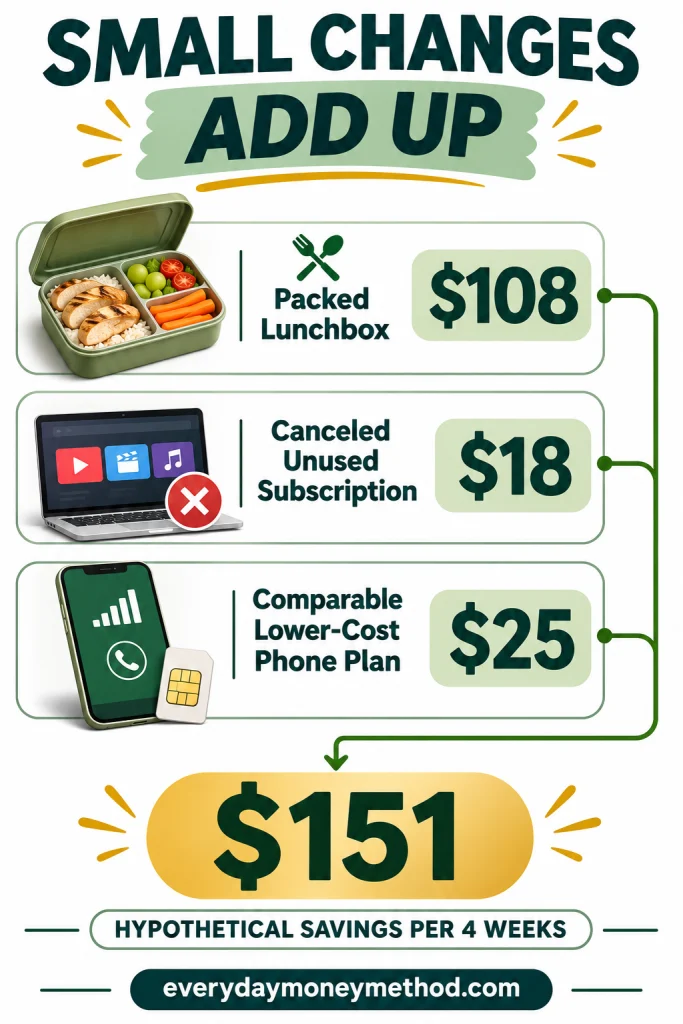
That’s $1,812 over twelve four-week budgeting periods in this simplified example. Those periods cover 48 weeks, not a full 52-week year. Actual results depend on the weeks you work, what meals cost, plan prices, and whether the changes stick. It also assumes the $9 lunch difference already includes the cost of ingredients, so groceries aren’t counted twice.
If your lunch is already homemade, your phone plan is inexpensive, or you don’t have subscriptions, you won’t find these particular savings. The point is to calculate your own three changes rather than copy someone else’s budget.
When Frugal Living Isn’t Enough
There is a point at which the numbers are the problem, not the habits. If rent, food, medication, transportation to work, and minimum required payments consume your income, more extreme couponing may not solve the gap.
Prioritize housing, necessary utilities, food, essential healthcare, and transportation needed for daily life. Avoid unsafe shortcuts, including skipping necessary medication, food-safety rules, or insurance protection. Contact lenders or service providers early if you may miss a required payment. For U.S. households, USA.gov lists financial hardship resources, and the National Foundation for Credit Counseling offers nonprofit credit-counseling information.
If expenses still exceed income after practical adjustments, investigate benefits, debt-support options, or ways to increase income that fit your circumstances. Frugality is a useful tool, but it cannot manufacture money that isn’t there.
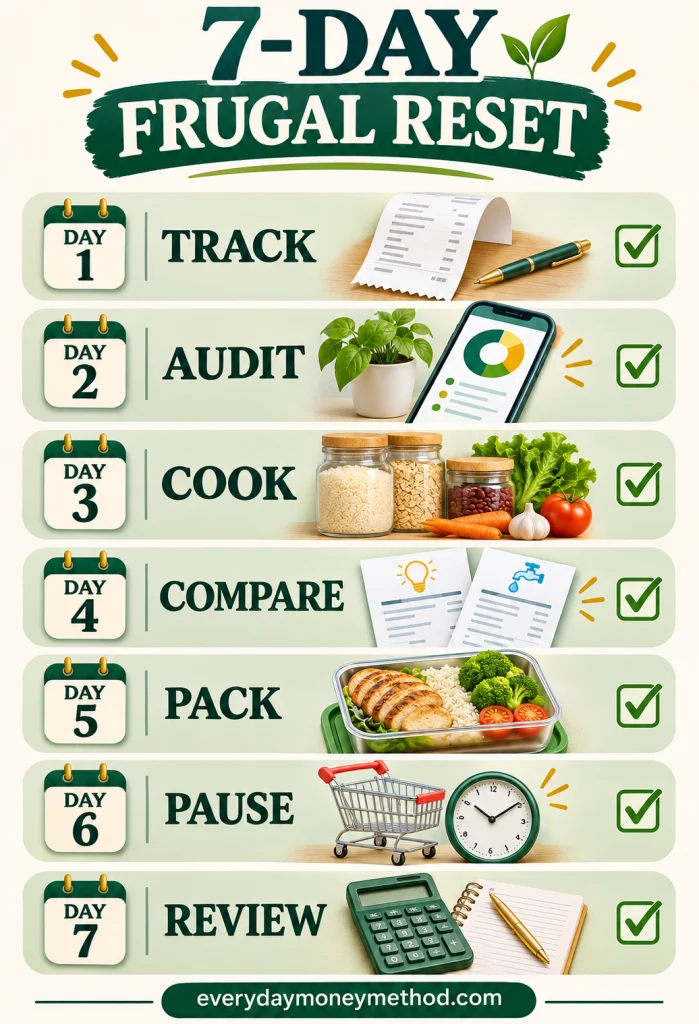
A Simple Seven-Day Frugal Living Reset
Instead of trying all 23 ideas this weekend, test a short routine:
Day 1: Review the past month’s transactions and find your three biggest spending categories.
Day 2: Check subscriptions, renewal dates, and overlapping services.
Day 3: Make two meals using food you already own.
Day 4: Compare your phone, insurance, or another recurring bill on equal terms.
Day 5: Prepare lunch or a snack for tomorrow and calculate the actual price difference.
Day 6: Find one upcoming purchase you can borrow, buy used, repair, or delay.
Day 7: Add up any changes that genuinely reduced your expenses, then choose one habit to keep next week.
If you don’t save anything during the first week, you’ve still gathered useful information. Maybe the grocery budget is already efficient and your main issue is rent. Maybe a bill needs renegotiating. A useful plan should reveal that, not push you to make pointless cuts.
Frequently Asked Questions About Frugal Living
Is frugal living the same as being cheap?
No. Frugal living focuses on value and tradeoffs. The cheapest choice may cost more over time if it breaks quickly, wastes resources, or creates expensive problems. Spending a reasonable amount on a reliable item or meaningful activity can fit a frugal lifestyle.
What are the best frugal living tips for beginners?
Start by tracking spending, checking recurring bills, planning a few meals around what’s already in your kitchen, and adding a short pause before nonessential purchases. Those steps require little upfront spending and help you identify where more specific changes would matter.
Does buying in bulk always save money?
No. Look at the unit price, how much cash the purchase requires, storage limits, and whether you’ll use everything. Buying six items you don’t need isn’t saving money simply because each one is discounted.
Can I live frugally without giving up everything fun?
Yes. Choose a few pleasures you care about and plan for them. The goal is to stop paying for things that add little value, not to turn life into a punishment.
How can I be frugal when my income barely covers necessities?
Start with the full cost of essentials, investigate available assistance, and ask providers about hardship options if you’re behind. In a budget with no discretionary room, the most useful next step may be income support, debt counseling, or a housing solution rather than further small spending cuts.
The Bottom Line
Frugal living becomes more manageable when it stops being a contest to spend the least. The question is whether a purchase, service, or habit is worth what it costs you.
Open your latest bank statement. Choose one recurring charge to investigate, one food item to use before it goes bad, and one purchase you can postpone. That’s enough for a starting week. Once you can see what changes in your actual numbers, the next decision gets easier.
References and further reading
- Consumer.gov — Making a budget
- CFPB — Spending tracker and cutting expenses
- Illinois Extension — Spending resources
These resources support the general educational topics discussed; individual circumstances and current rules may differ.
Continue learning
grocery savings guide · saving money quickly · monthly budget guide · emergency fund guide

Personal finance writer and content creator at Everyday Money Method.
Editorial Policy · Report a correction