
Editorial voice: Monem · Published 2026-10-03 · Article resources updated November 18, 2026
Key takeaways
- Check credit reports for mistakes and dispute inaccuracies.
- Focus on timely payments and manageable credit balances.
- No action guarantees a particular score increase.
General educational information, not personalized financial advice. Read our Financial Disclaimer.
You make your credit card payment, check your score, and wonder why the number barely moved. Figuring out how to build and improve your credit score gets easier when you understand the information behind that number.
Start with accurate credit reports, payments made on time, and credit card balances you can manage. If you have little credit history, a carefully chosen account can help you establish it. If past problems are holding you back, preventing new missed payments matters more than chasing a quick fix.
You can build credit without paying credit card debt. The goal is a payment routine that fits your budget and creates a dependable record over time.
Understand what your credit score measures
Related reading: Explore our debt payoff guide for a complementary approach.
A credit report is the record of your credit accounts and how you have managed them. A credit score is a number calculated from information in that report to estimate how likely you are to repay as agreed. Lenders can use it when deciding whether to approve an application and what terms to offer.
You have multiple credit scores. FICO and VantageScore have different models and versions, and Equifax, Experian, and TransUnion may hold different information. The calculation date matters, too. That is why the score in a banking app may differ from the one a lender uses.
Most consumer scores range from 300 to 850. For base FICO Scores, 670 to 739 is labeled good, 740 to 799 is very good, and 800 to 850 is exceptional. These are reference bands; lenders set their own approval requirements.
The five main FICO score factors
FICO describes these categories and their general importance for the overall population. The percentages can vary with your credit profile and should not be applied to every scoring model.
| Factor | General FICO importance | What it considers |
| Payment history | 35% | Whether you paid credit accounts as agreed |
| Amounts owed | 30% | Debt levels, revolving utilization, and other balance measures |
| Length of credit history | 15% | The ages of your oldest, newest, and average accounts |
| New credit | 10% | Recent applications and newly opened accounts |
| Credit mix | 10% | Your experience with different types of credit |
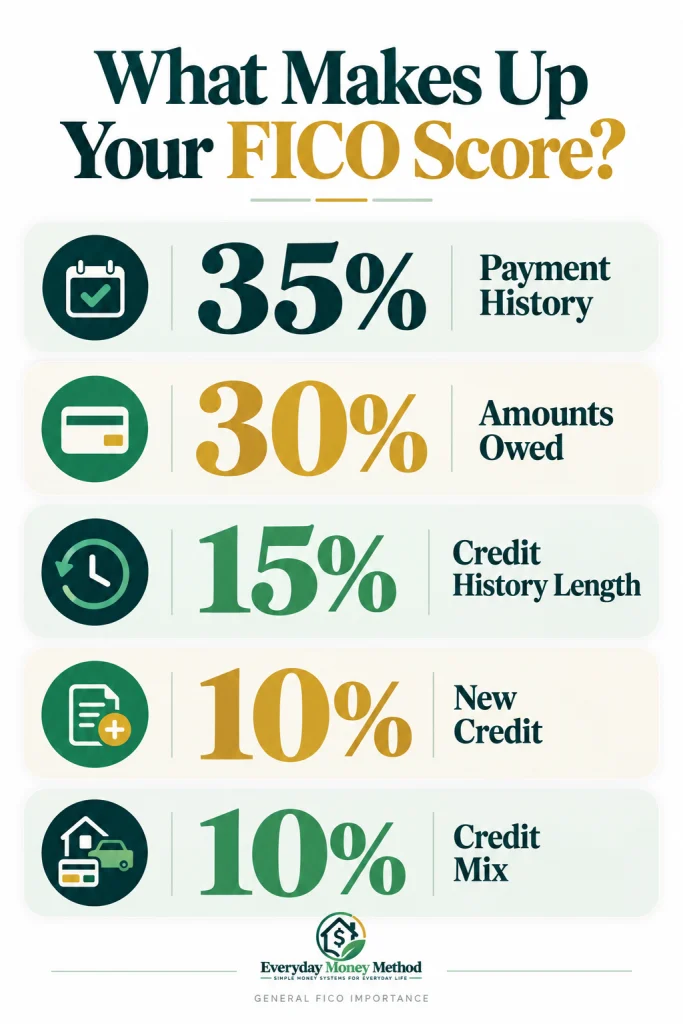
Credit utilization is one part of amounts owed. It does not represent that entire 30% category.
Choose a starting point that fits your situation
Related reading: Explore our monthly budget guide for a complementary approach.
Use this table to decide where to put your attention first.
| Your situation | A useful first move |
| You have little or no credit history | Review your reports, then compare one affordable way to establish reported payment history |
| You pay on time but have high card balances | Build a payoff plan and check which balances your issuers report |
| You have overdue accounts | Contact the creditor about bringing the account current or arranging affordable payments |
| Your report shows accounts or late payments that are wrong | Gather evidence and dispute the specific errors |
| You already have good credit and plan to borrow | Check the lender’s requirements before making account changes |
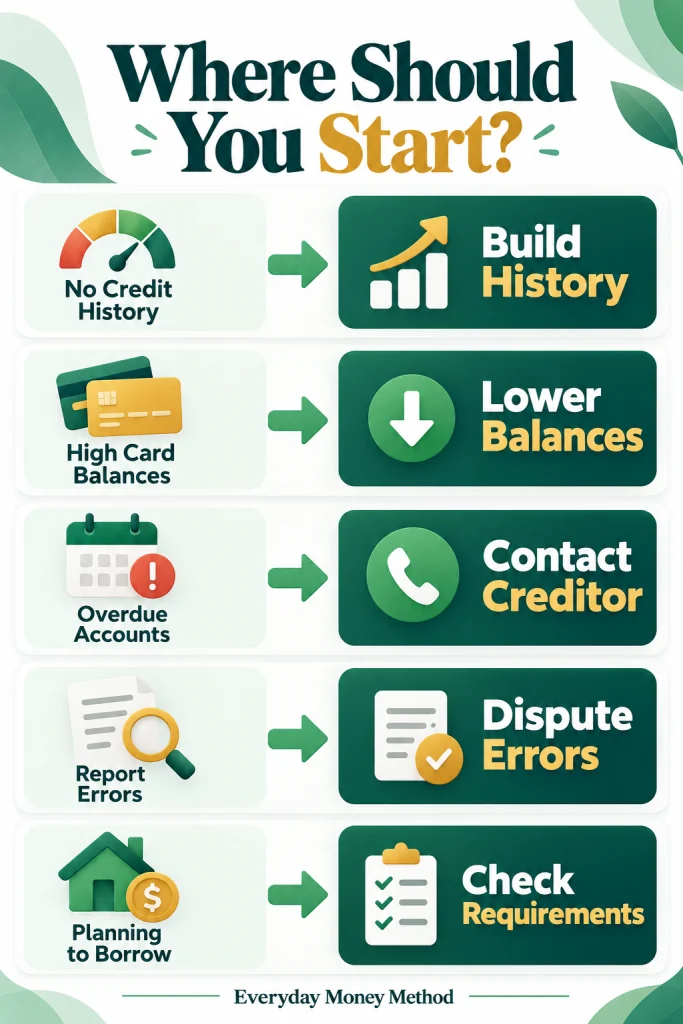
Having no score does not mean you have a score of zero. It can mean a scoring model does not yet have enough information about you. People who primarily use cash or debit cards may have limited credit histories even when they manage their money carefully.
How to build and improve your credit score
1. Check all three credit reports
Related reading: Explore our paycheck budgeting guide for a complementary approach.
Start at Annual Credit Report Website. The three nationwide bureaus currently provide a free credit report from each bureau every week through this official site. This weekly program is separate from the annual free-report entitlement under federal law.
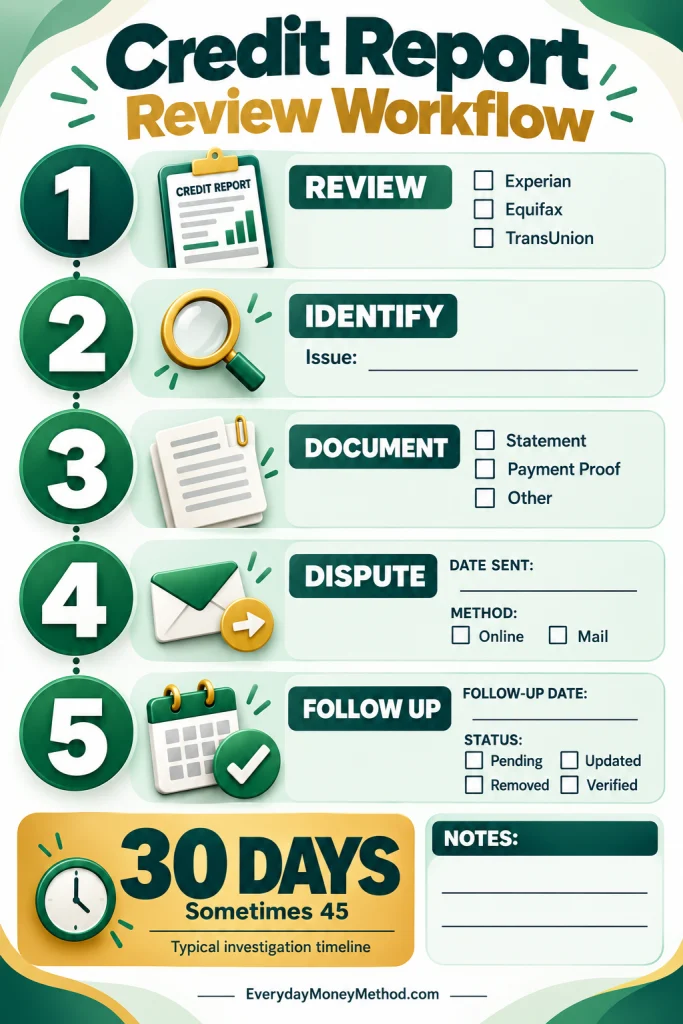
Review all three because they may contain different information. Look for unfamiliar accounts, incorrect balances or limits, payments wrongly marked late, and duplicate entries that appear inaccurate. A collection account and its original creditor account can both appear, so two related entries are not automatically an error.
Checking your own report or score does not lower your score. These checks are soft inquiries. Also, a free credit report does not necessarily include a credit score; your bank or card issuer may offer a score separately.
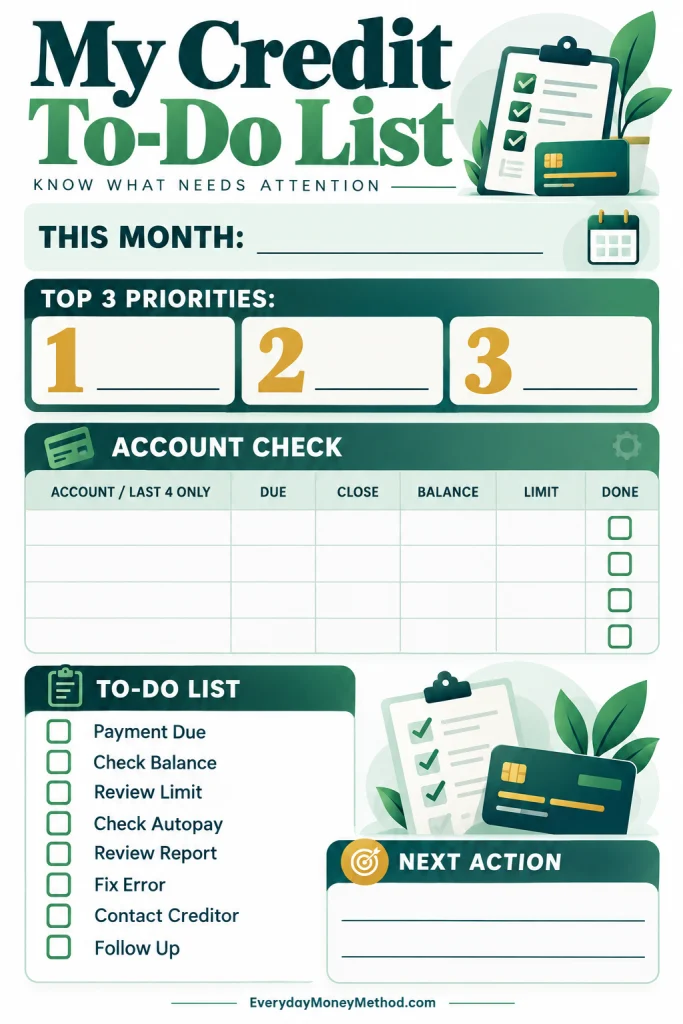
Save your reports and make a short list of anything that needs attention. You will have a clearer plan when you can name the problem.
2. Dispute real errors with supporting documents
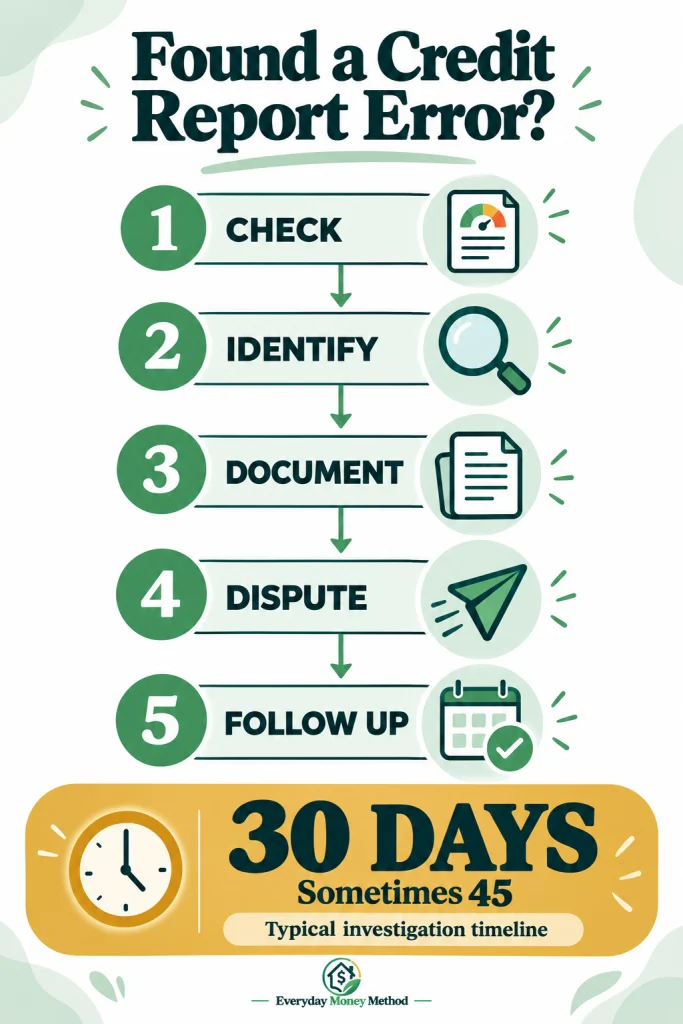
If you find an error, contact each credit bureau showing it and the company that supplied the information, sometimes called the data furnisher. That company might be a lender or collection agency.
Explain exactly what is wrong, identify the account, and ask for a correction. Include copies of documents that support your position, such as payment confirmations or an account statement. Keep the originals and a record of what you submitted.
Credit bureaus generally have 30 days to investigate, although some investigations can take 45 days. That is an investigation timeline, not a promise that an item will disappear or your score will rise by a particular date.
Disputing inaccurate information is free. Avoid blanket disputes of accurate negative accounts just because you want them removed.
3. Set up a payment routine you can afford
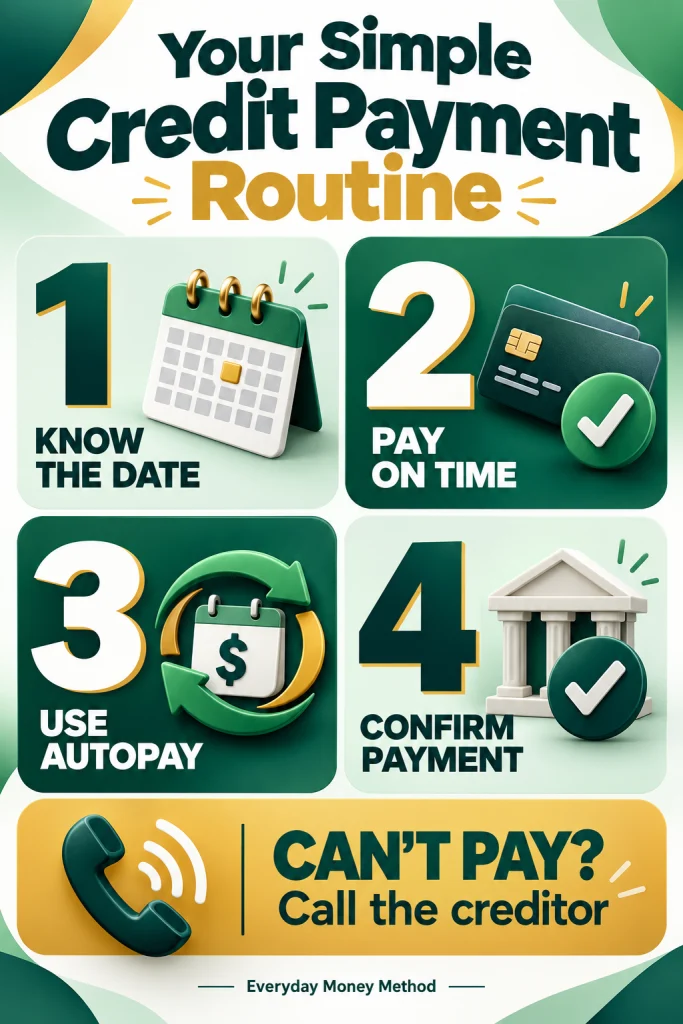
Pay at least the required minimum by the due date on each current credit account. If you can afford to pay your credit card statement balance in full, make that your regular goal.
Autopay can help, but choose the setting deliberately. Minimum-payment autopay and statement-balance autopay do different jobs. Read the confirmation so you know the amount, the payment date, and when the first automatic payment will occur. Until then, make sure the next bill is covered.
Keep enough money in the paying account and confirm that payments go through. Autopay itself earns no special scoring benefit; its value is helping you avoid missed payments. If your income varies, reminders and a weekly bill check may be easier to manage than a large automatic withdrawal.
If you already missed a payment, act promptly. A payment generally is not reported as delinquent to the nationwide bureaus until it is at least 30 days overdue, but fees can apply sooner. This reporting timing does not extend your payment deadline.
If you cannot make the required payment, contact the creditor. Explain what you can afford and ask about temporary assistance. For an overdue account, ask what is required to bring it current; paying only a normal monthly minimum may not do that. Ask how any arrangement will be reported and get the terms in writing.
4. Lower your reported credit card balances
Your credit utilization ratio compares the balance reported on a credit card with its credit limit. Scoring models can consider utilization on individual cards and across your cards together.
Utilization = reported balance ÷ credit limit × 100.
Here is a hypothetical example for a card with a $1,500 limit:
| Reported balance | Credit limit | Utilization |
| $900 | $1,500 | 60% |
| $300 | $1,500 | 20% |
| $100 | $1,500 | About 6.7% |
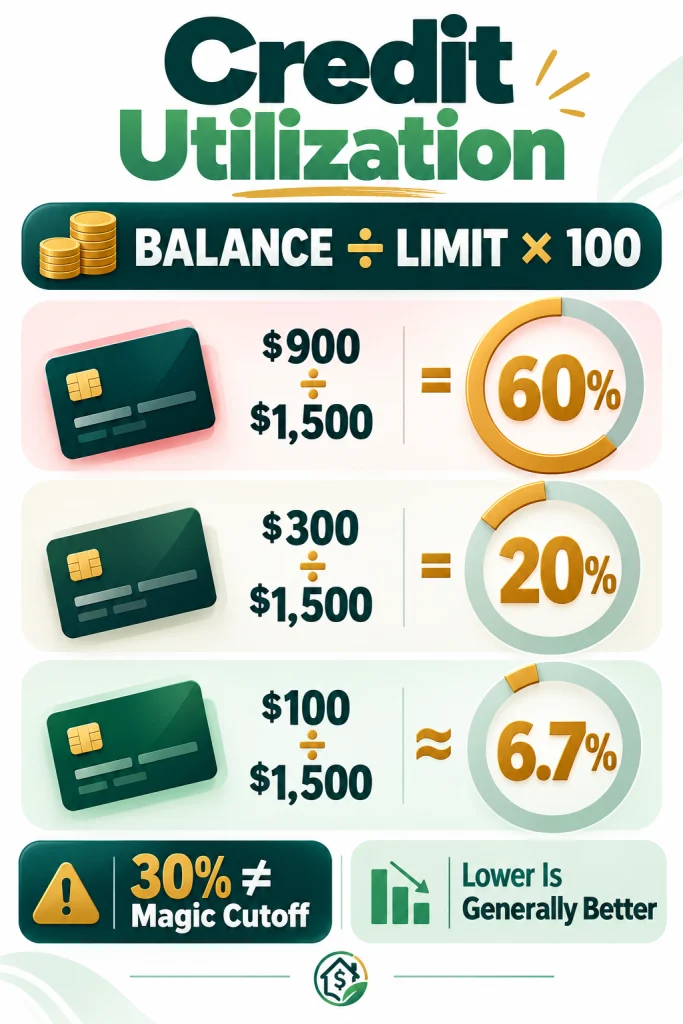
You may have heard that staying below 30% is enough. FICO says 30% is not a universal cutoff where your score suddenly drops. Generally, lower utilization is better, and keeping reported utilization below 10% can help. Neither number guarantees a particular score.
If your balances are high, start with a reduction you can sustain. Cover required payments across your accounts, then direct affordable extra money toward debt. Avoid draining money needed for housing, food, or the next round of bills just to reach a percentage.
A credit limit increase can also lower the ratio if it is approved, reported, and your balance stays the same. For example, a $300 balance is 30% of a $1,000 limit and 15% of a $2,000 limit. Before requesting an increase, ask whether the issuer will make a hard inquiry. A larger limit is useful only if it fits how you manage spending.
5. Learn the difference between your closing date and due date
These dates answer different questions. The statement closing date ends a billing cycle. Your statement balance is the amount owed at that point. Your current balance can include later purchases and payments. The due date is the deadline for the required payment on that statement.
Issuers commonly report balances around the end of a billing cycle, although practices vary. Because reporting may happen before your payment is due, your report can show a balance even when you pay your statement in full every month.
A purchase grace period lets you avoid on purchases when you meet your card’s full-payment conditions. Check your terms, especially if you carried a balance from the previous month.
Suppose, as a hypothetical example, your statement closes with a $120 balance. You later make a $40 purchase, bringing your current balance to $160. The newer $40 generally belongs to the next statement. If your purchase grace period applies, paying the $120 statement balance in full by its due date avoids on those statement purchases.
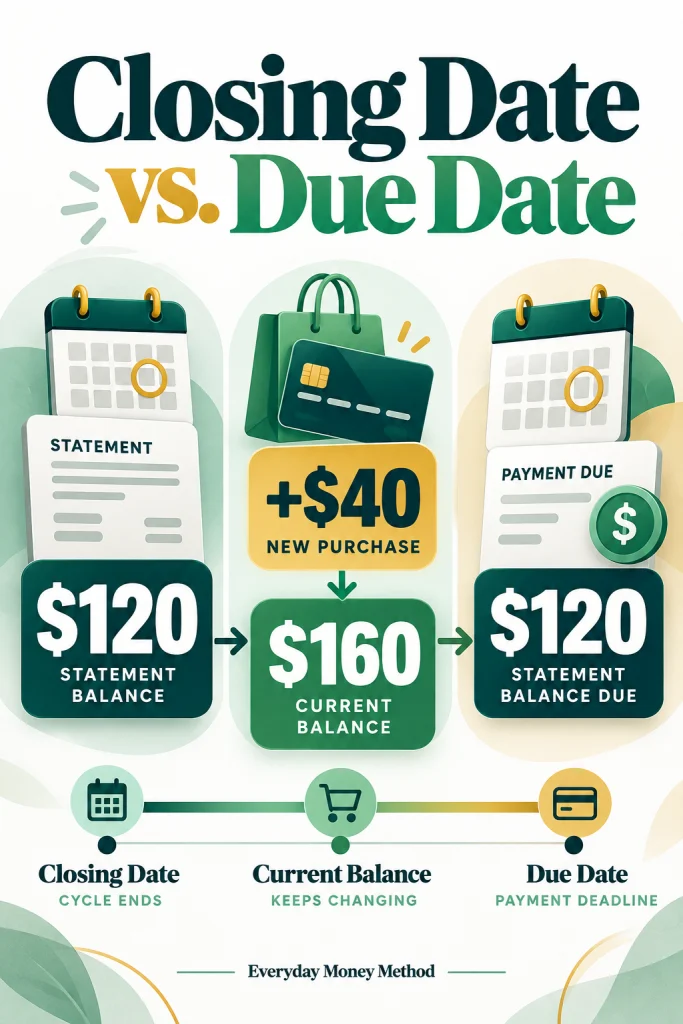
If high reported utilization is an issue, an extra payment before the issuer reports may help. You can ask the issuer about its reporting schedule. There is no need to follow a special biweekly routine unless that timing helps your cash flow.
You do not need to leave debt unpaid to build credit. A small reported balance and a balance carried past the due date are different things. If you have lost your grace period, or use cash advances or balance transfers, check the account terms because debt rules differ.
6. Keep older accounts when they still work for you
Keeping a manageable card open can preserve available credit. Closing it may increase utilization on your remaining cards if they have balances.
Closing an older account does not immediately erase its history. FICO and VantageScore can consider closed accounts for age-related factors while those accounts remain on your reports. Accounts closed in good standing can stay for up to 10 years.
Still, you do not need to keep every card forever. An annual fee or a strong temptation to overspend may make an account worth closing. If the fee is the problem, ask whether a change to a card without an annual fee is available and how it would affect the existing account.
Keep monitoring any card you leave open, even if you rarely use it. Your budget and ability to manage the account belong in this decision.
7. Apply for new credit selectively
A new application can create a hard inquiry, and opening an account can affect your credit history. Apply because an account serves a clear purpose and you can manage it.
When a card issuer offers prequalification, check whether it uses a soft inquiry. Prequalification can help you assess an option, but it does not guarantee approval, and a full application may involve a hard inquiry.
Rate shopping for a mortgage, auto loan, or student loan has special treatment under FICO. Depending on the version, qualifying inquiries for the same type of loan within a 14- to 45-day window can be grouped as one. FICO does not apply that same grouping to multiple credit card applications.
If you plan to apply for a mortgage soon, ask your lender before opening or closing accounts or requesting a limit increase that may require a hard inquiry. The right timing depends on your application and the lender’s requirements.
How to build credit when you have little or no history
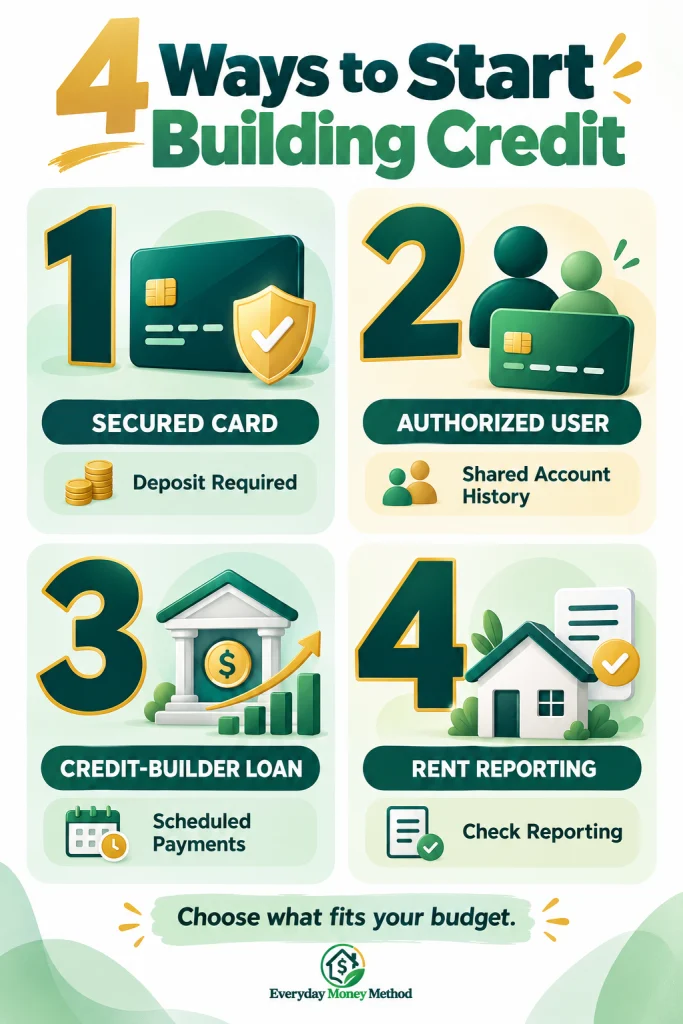
Choose an option you can afford and understand. You don’t have to open every type of account in this section.
Consider a secured credit card
A secured card requires a security deposit held as collateral. It still has a monthly bill, and the deposit does not replace your payments. Approval is not guaranteed just because you can provide a deposit.
Before applying, compare the deposit requirement, annual and other fees, and whether the issuer reports to all three bureaus. Ask how the deposit can be returned and whether you can eventually move to an unsecured card.
For a simple routine, put one small expense you already budget for on the card and pay the statement in full. You do not need to add a new subscription to create a credit-building habit.
Become an authorized user if the arrangement is suitable
A trusted person may add you as an authorized user on their credit card. The account may help your credit if the issuer reports it for you and it is managed well. High balances or missed payments can also hurt.
Before agreeing, confirm the reporting policy and discuss spending permissions. The primary cardholder remains responsible for the account. Treat this as a shared financial arrangement that needs clear expectations.
Compare a credit builder loan carefully
With a typical credit-builder loan, money is held in an account while you make scheduled payments, then becomes available under the loan’s release terms. The lender reports your payment history.
Compare the total cost, including fees, which bureaus receive reports, when you can access the money, and what happens if you cannot continue. Payments need to fit comfortably within your budget. Late or missed payments can damage the history you are trying to build.
A credit-builder loan can be useful for some people with limited history. Adding an installment loan merely to improve credit mix is usually unnecessary, especially if you already have accounts reporting positive payments.
Check whether rent reporting offers useful value
Ask your landlord whether your rent payments are reported. If they are not, a reporting service may be an option, but compare any fees first.
Before paying for rent or utility reporting, ask which bureaus receive the information and which scoring models can use it. Reporting does not guarantee an immediate increase in the score a particular lender uses.
Also distinguish credit reporting from mortgage underwriting. Some mortgage evaluations can use verified rent payments from bank records with your permission. That process does not automatically add those payments to your credit reports or change your credit score.
How to rebuild after late payments or collections
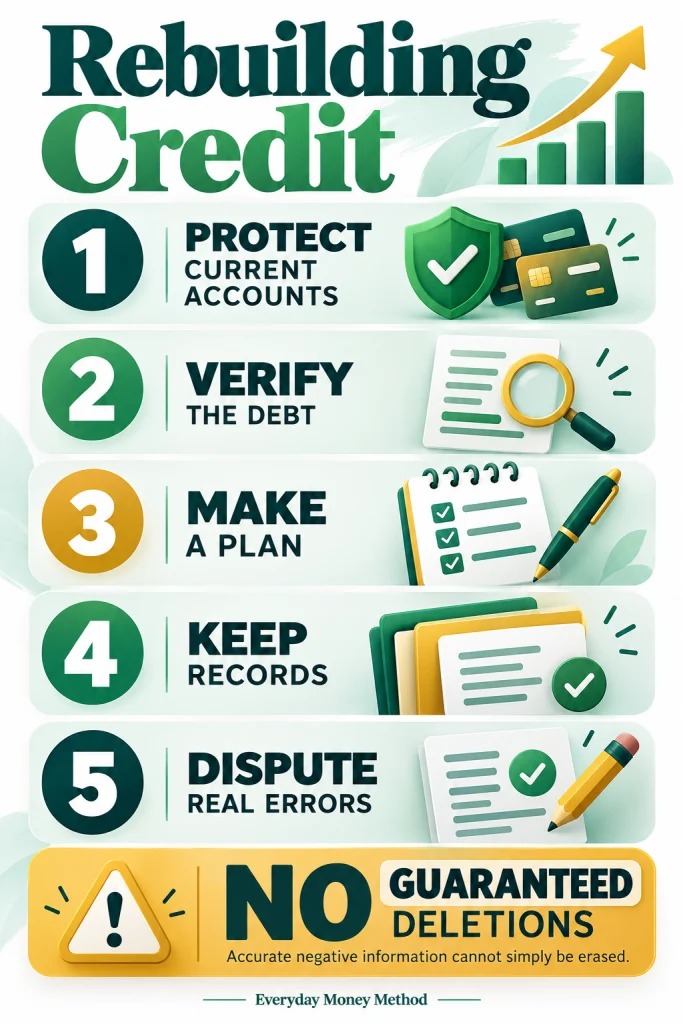
If you are rebuilding, start by protecting your current accounts from further missed payments and working out what you can realistically afford. Opening another account will not solve an ongoing payment shortfall.
For a collection account, verify the debt and amount before agreeing to a resolution. Keep written records. For very old debt, speak with a consumer-law attorney or legal-aid office in your state before making a payment or promise to pay, because either can restart the time limit for a lawsuit in some states. That lawsuit deadline is separate from how long the debt can appear on a credit report.
Paying a collection does not automatically delete it. Its score effect also depends on the model: FICO Score 9 and the FICO Score 10 suite disregard paid third-party collections, while other versions can treat them differently. Do not assume that paying an outside collector removes an original creditor’s negative history.
Treat promises of guaranteed deletion with caution. Accurate, current negative information cannot simply be erased by a credit-repair company. You can dispute genuine errors yourself.
Check medical collections under their separate rules
Medical collections have different reporting policies. The three nationwide bureaus exclude medical collections paid in full and medical collections with an initial reported balance below $500. Unpaid medical collections generally have a one-year waiting period from the original delinquency before appearing. Some states have additional protections.
This is separate from the CFPB rule that would have broadly restricted medical debt on credit reports. A court vacated that rule on July 11, 2025. An older headline about the rule is not a reliable basis for assuming all medical debt has disappeared.
Get help when the payments do not fit
A reputable nonprofit credit counselor can help review your budget and repayment options. Ask about credentials, services, and any setup or monthly fees in writing. Nonprofit status does not mean every service is free or that a debt management plan is right for everyone.
Avoid services that promise a specific score increase, tell you to dispute information you know is accurate, or offer a new credit identity. Those promises can create more problems while costing you money.
How long improving your credit score takes
The timeline depends on what needs to change. A lower reported card balance and recovery from repeated late payments are different situations.
| What you are working on | What to expect |
| Lowering reported card balances | A score may respond after the lender sends updated information and the score is recalculated; the change is not necessarily immediate |
| Correcting an error | Bureau investigations generally take 30 days and sometimes 45; the result and any score effect depend on the facts |
| Establishing a first FICO Score | The report generally needs an account at least six months old and an account reported within the past six months; one account can meet both conditions |
| Recovering from negative history | New positive history and time can help, but the size and speed of improvement vary with the full report |
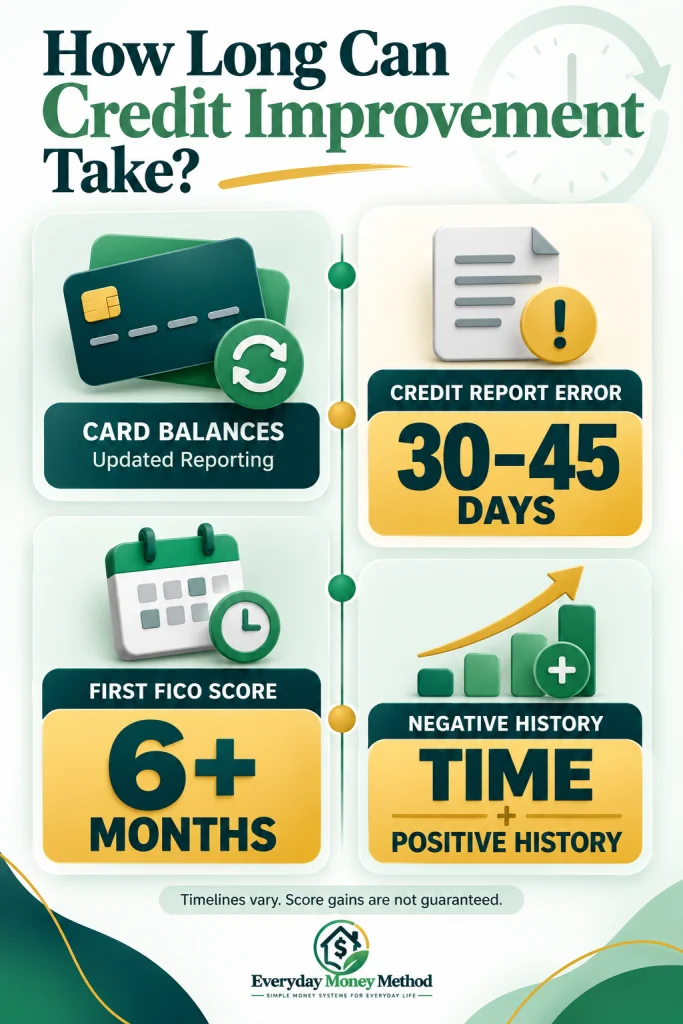
The reporting and investigation timelines above are process expectations, not guaranteed score gains.
VantageScore can score some files with less history than conventional FICO models, so one score may become available before another. An available score does not guarantee approval.
Most negative information can remain on a report for about seven years, and some bankruptcies can remain for up to ten. That does not mean you must wait for every negative item to disappear before your credit can improve. Recent behavior and the rest of your report still matter.
Some newer models, including FICO Score 10 T, also consider balance trends over time. That makes a sustainable payment pattern more useful than treating one low-balance month as a complete reset.
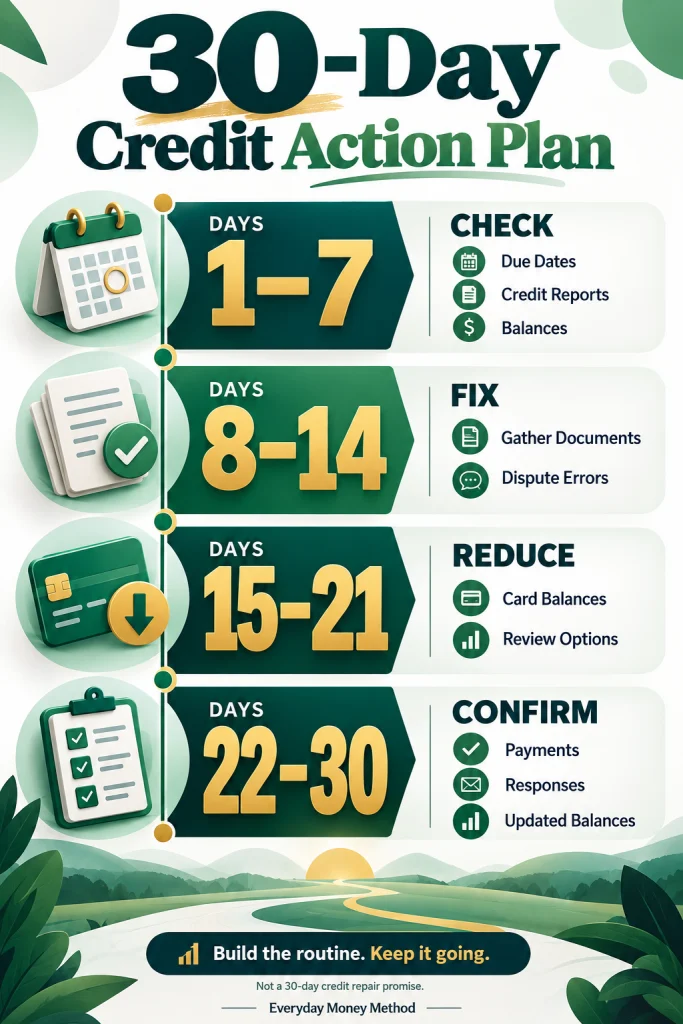
A practical plan for the next 30 days
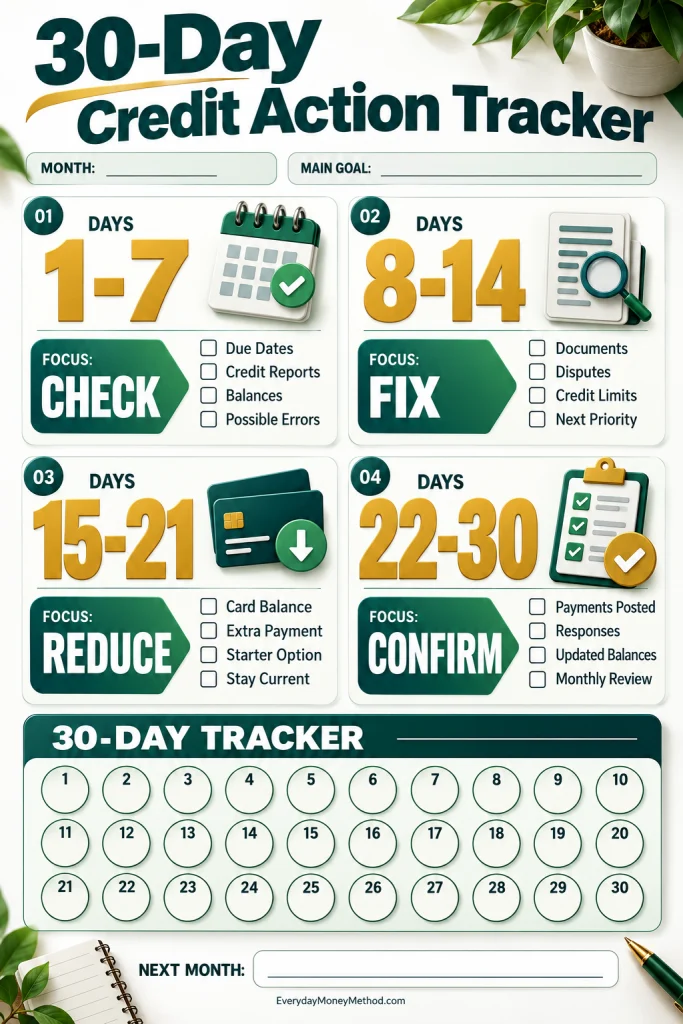
Use the next month to put the process in place while continuing to meet payment deadlines throughout. This schedule is an organizing suggestion, not a promise to repair your score in 30 days.
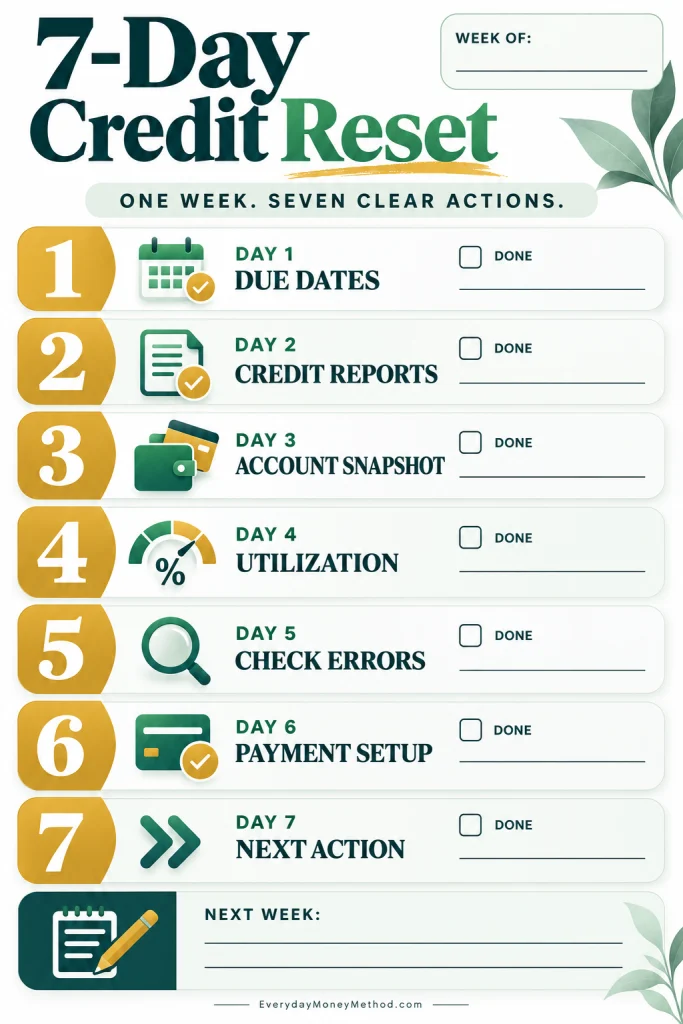
Days 1 to 7: Check upcoming due dates, cover required payments, and confirm that reminders or autopay are active. Obtain all three reports and list balances, limits, and possible errors. Contact creditors promptly about overdue or unaffordable payments, and address suspected fraud.
Days 8 to 14: Gather supporting documents and submit disputes where needed. Review balances against credit limits and choose the next issue to work on.
Days 15 to 21: Choose an affordable amount to put toward card debt. If you have no useful payment history, compare a suitable starter option. If you already have enough accounts to manage, focus on those.
Days 22 to 30: Confirm payments posted, check dispute responses, and review any updated balances. Set a recurring monthly review so the routine continues.
For tracking, compare the same scoring model from the same bureau when possible. Record the score’s date and the factors listed with it. A number from a different model may not show whether your original score improved.
Common credit building questions
Does paying off a loan ever lower your score?
It can, depending on how closing the loan affects the information the model evaluates. That does not make keeping an unnecessary loan a good financial choice. Paying off debt reduces an obligation; taking another loan just to chase the previous score can add avoidable costs.
Does a higher income automatically improve your score?
Income is not a direct input to standard credit scores, although lenders may consider it separately when evaluating whether you can repay. More income can help you pay down debt, but the raise itself does not automatically add score points.
Can you build credit with an ordinary debit card?
Ordinary debit-card spending generally does not establish reported borrowing history. A debit card uses money in your bank account. A product that separately adds credit-building or payment-reporting features needs its own evaluation.
What should you do if an account is not yours?
If you suspect identity theft, visit https://www.identitytheft.gov/ for recovery guidance and dispute fraudulent entries. Consider a free credit freeze with each of the three bureaus to make it harder to open new accounts in your name. A freeze does not lower your score, and it does not by itself remove existing fraudulent information.
Start with one action you can repeat
Choose the step that addresses your biggest current obstacle: review a report, fix an error, call a creditor, or make your next payment easier to remember. Then check whether your routine leaves enough money for the rest of your bills.
Learning how to build and improve your credit score is most useful when it leads to manageable borrowing and fewer financial surprises. Start with the next payment and the next accurate entry on your report. Give those habits time to become a record you can build on.
References and further reading
These resources support the general educational topics discussed; individual circumstances and current rules may differ.
Continue learning
debt payoff guide · monthly budget guide · paycheck budgeting guide · emergency fund guide

Personal finance writer and content creator at Everyday Money Method.
Editorial Policy · Report a correction