
Editorial voice: Monem · Published 2026-09-29 · Article resources updated November 18, 2026
Key takeaways
- Choose a savings target and timeline that match your income.
- Review recurring costs and avoid cutting essential protection.
- Use extra income and one-time savings to build a buffer.
General educational information, not personalized financial advice. Read our Financial Disclaimer.
You get paid, cover a few bills, buy groceries, and check your balance. Somehow, the money you meant to save is already spoken for.
When you need breathing room quickly, another tip about skipping coffee may not be much help. You need to know which expenses you can change, when those changes will affect your balance, and how to keep the money from disappearing into something else.
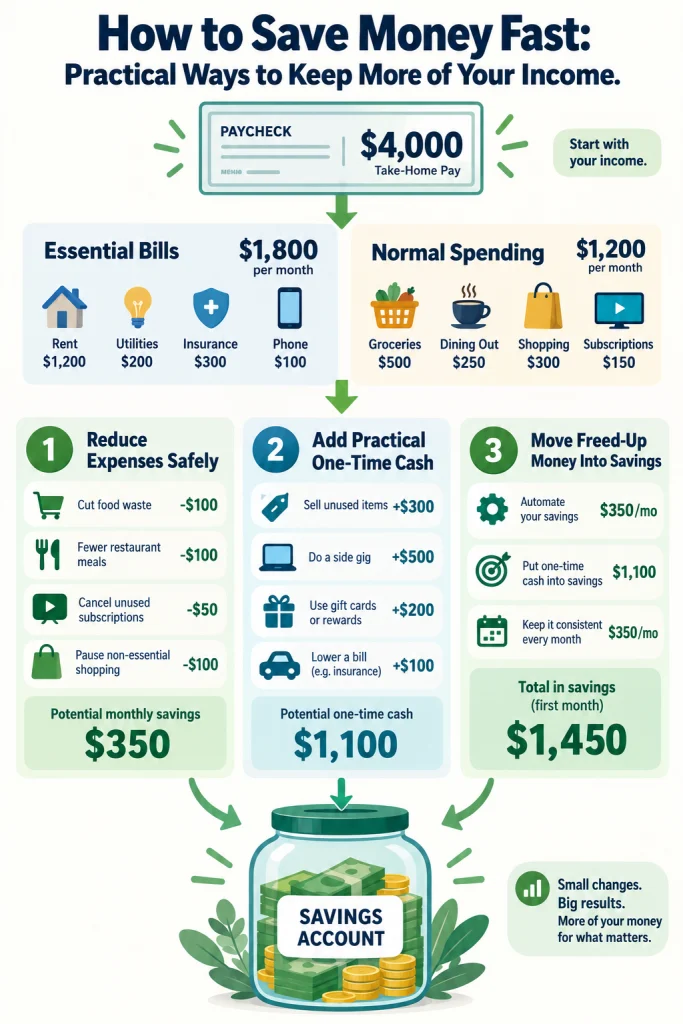
To save money fast, start with expenses you can reduce safely, add one-time cash where practical, and move the money you actually free up into savings. A budget gives you the starting point: income, expenses, and the difference between them.
The goal is not to make life miserable for a month. It is to keep more of your income without creating a bigger problem later.
How to Save Money Fast: Give Your Goal a Number and a Deadline
Related reading: Explore our monthly budget guide for a complementary approach.
“Save more” leaves you with a good intention. “Set aside $500 over the next four weeks” gives you something you can plan around.
Divide your target by the number of weeks or paychecks available. A $500 goal over four weeks means $125 per week. The same goal across two paychecks means $250 from each.
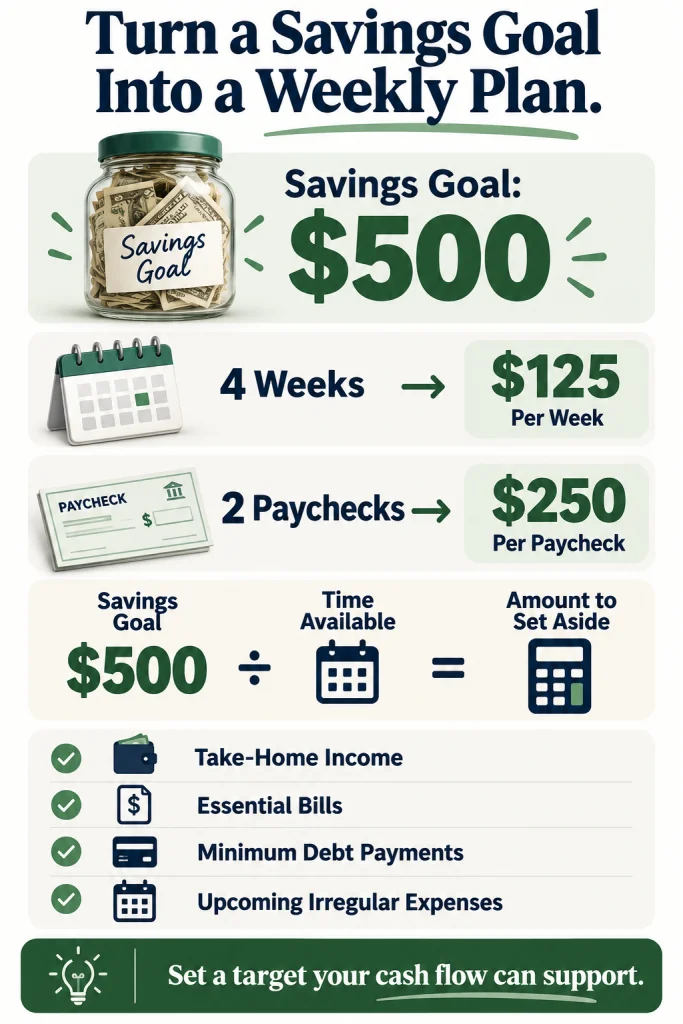
Then check what is actually available. Write down your expected take-home income, essential bills, minimum debt payments, and money needed for upcoming irregular expenses. Consumer.gov recommends listing income and expenses, subtracting expenses from income, and checking actual spending against the plan.
Do not treat the entire checking-account balance as spendable. Some of it may already belong to next week’s rent or groceries.
If the numbers do not support your deadline, change the target, find additional resources, or extend the timeline. A smaller funded goal is more useful than an ambitious one that requires borrowing.
Start With the Money You Are Already Spending
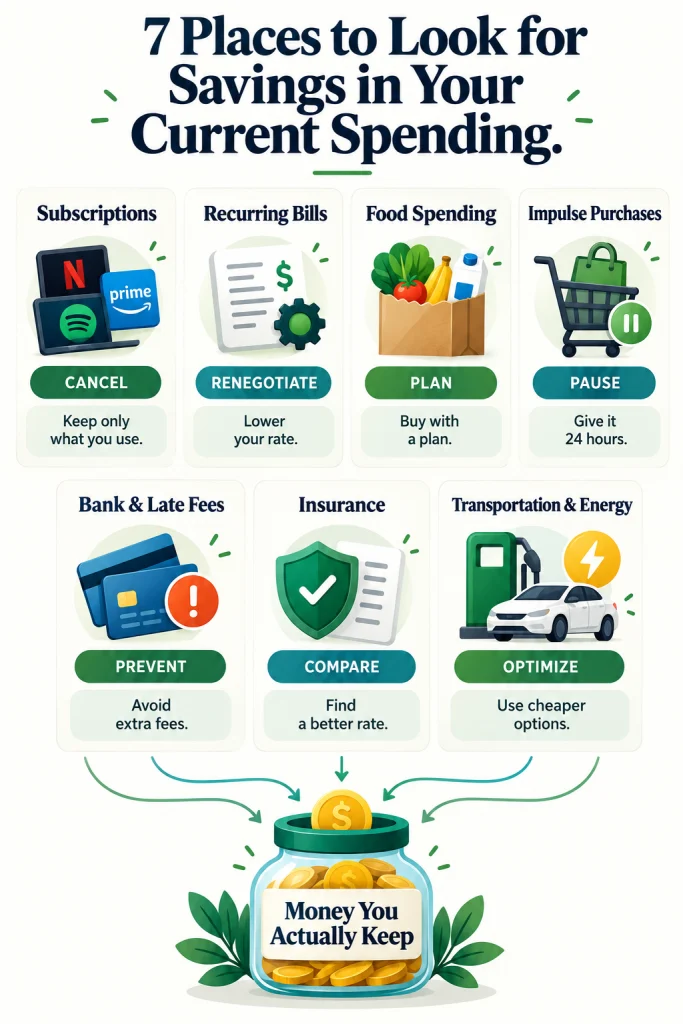
1. Cancel Subscriptions You Would Not Choose Again Today
Related reading: Explore our grocery savings guide for a complementary approach.
Review the last one to three months of bank and credit card transactions. Look for streaming services, apps, memberships, delivery subscriptions, and other repeat charges. Check renewal emails for annual expenses that a short statement review might miss.
For each subscription, ask: Would I sign up for this today at its current price?
Follow the provider’s cancellation process, save the confirmation, and check later statements. The FTC recommends keeping cancellation records and watching for continued charges. Uninstalling an app is not a substitute for completing its subscription cancellation process.
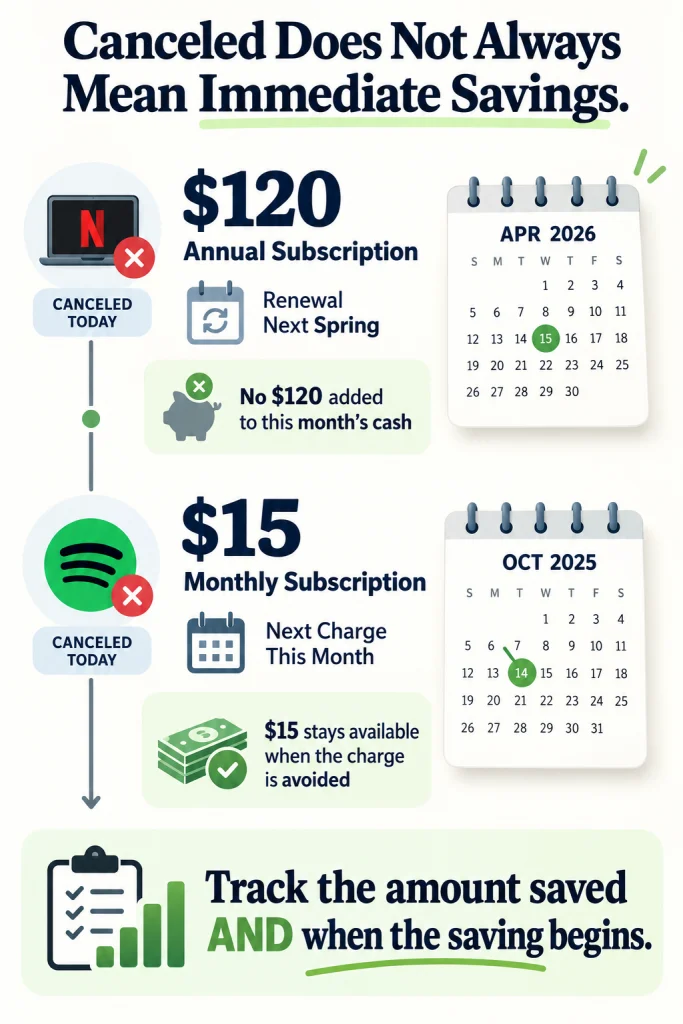
Watch the timing, too. Canceling a $120 annual renewal scheduled for next spring does not put $120 in your account this month. Canceling a $15 monthly service before its next charge can leave that $15 available when the charge would have occurred.
Record both the amount and the date you expect the saving to begin.
2. Renegotiate One Recurring Bill
Choose a phone, internet, or TV bill and compare the service you use with what you pay for. Lower-cost plans and competing providers are worth checking before you accept another renewal at the same price.
Here is a simple script:
“I’m reviewing my monthly expenses. What is the lowest total price you can offer for the service I need? Please include equipment charges, fees, and the price after any promotion ends.”
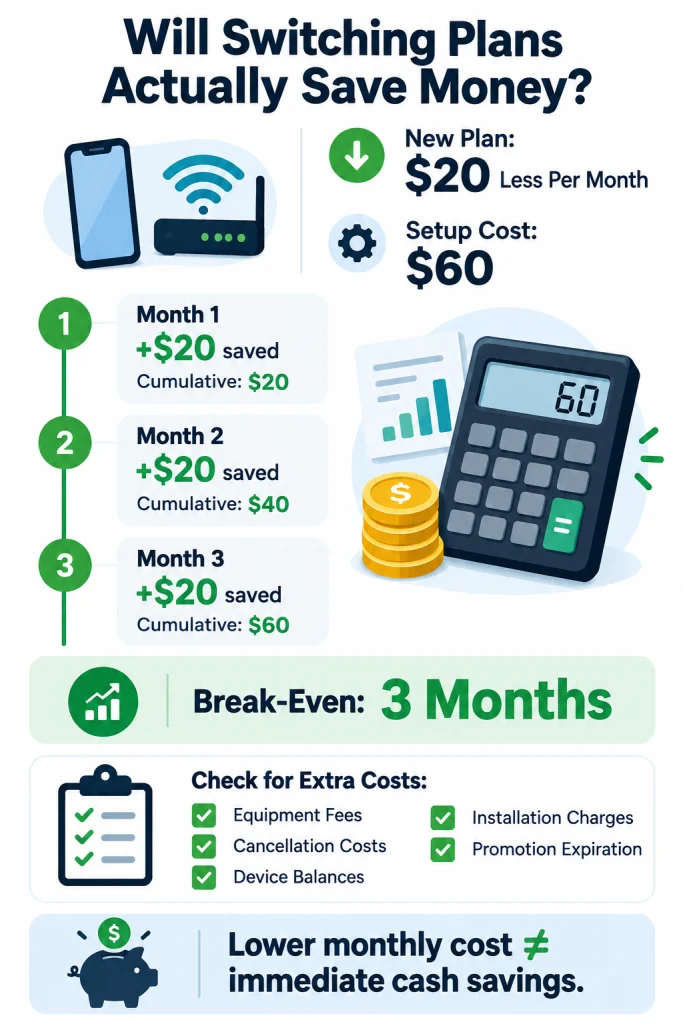
Before switching, check coverage, cancellation costs, device balances, installation charges, and the new billing start date. Ask for the offer in writing.
Suppose an alternative costs $20 less per month but requires a $60 setup payment. Ignoring other differences, the setup cost uses up three months of savings. That may still be worthwhile, but it is not an immediate cash win.
Prioritize changes that lower your actual upcoming bill without requiring a large payment first.
3. Lower Your Food Spending Without Planning an Impossible Menu
Related reading: Explore our emergency fund guide for a complementary approach.
Start with what you already have. Check the refrigerator, freezer, and pantry before making a shopping list. The EPA recommends planning meals around existing ingredients and buying amounts you can realistically use.
Plan for your actual week, not a version of yourself who cooks an elaborate dinner every night. Choose a few easy meals, account for nights you will eat elsewhere, and leave room for leftovers.
A useful shopping list might turn into three dinners instead of three unrelated shopping trips: rice bowls, a simple soup, and eggs with vegetables and toast. Adapt the meals to your dietary needs and what your household will eat.
Keep the comparison honest. In a hypothetical example, replacing a $35 takeout order with a $12 home meal saves $23, not $35. Making that swap four times frees up $92.
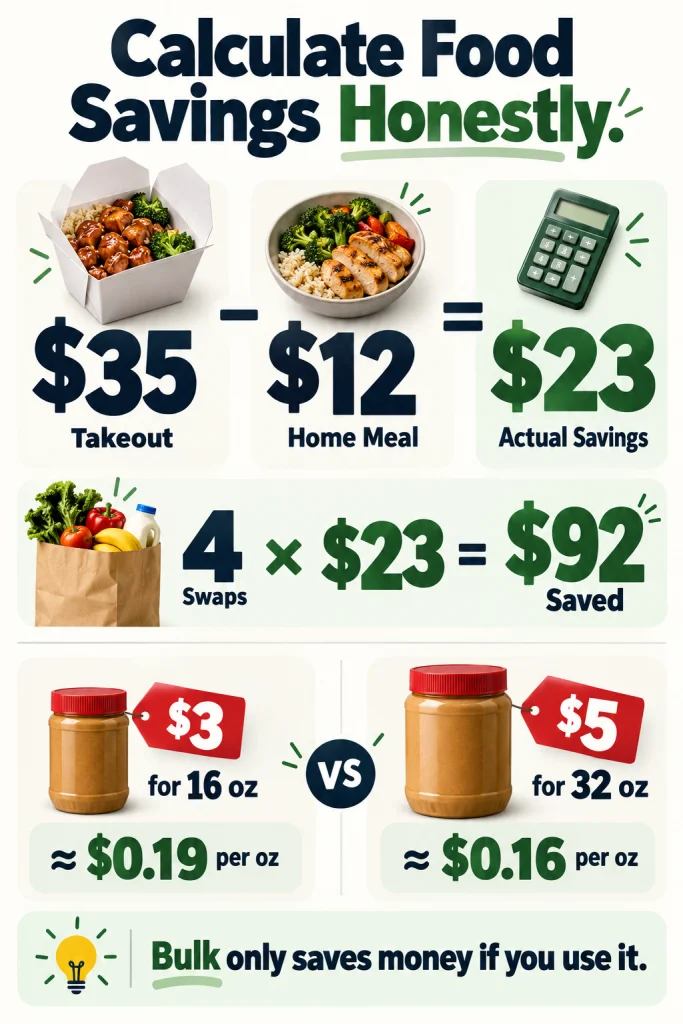
Compare unit prices when package sizes differ. A $3 package containing 16 ounces costs about 19 cents per ounce. A $5 package containing 32 ounces costs about 16 cents per ounce. The larger package has the lower unit price, but buying it only makes sense if you can afford the upfront cost and use the food.
The EPA makes the same practical distinction about bulk shopping: buying more is not a saving if the extra food goes to waste.
4. Put a Pause Between Wanting Something and Buying It
For a nonessential purchase, try a 24- or 48-hour waiting period. Write the item and price in a note, then leave the purchase unfinished. America Saves recommends a waiting period and reducing marketing emails as practical spending controls.
Use the pause to ask whether you need the item, already own something that works, or would still choose it without the sale banner.
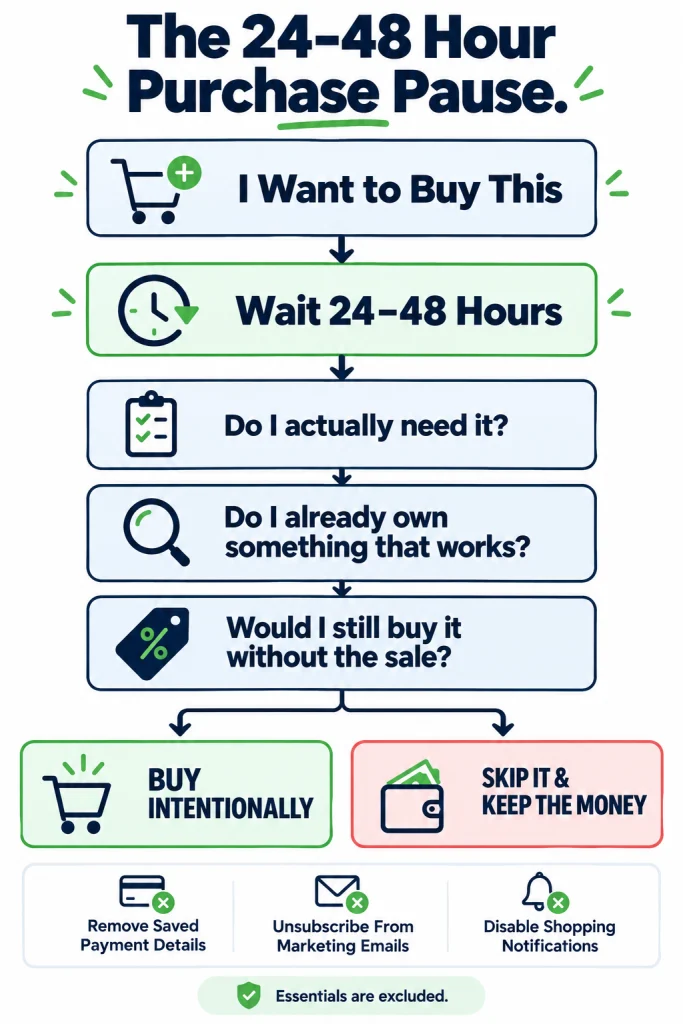
You can also remove saved payment details and shopping notifications. The point is not to make necessary purchases difficult. It is to give yourself a moment to decide instead of completing checkout automatically.
For a broader reset, try a week without discretionary shopping. Keep food, medicine, transportation, and other essentials outside the challenge.
Only count purchases you genuinely eliminate. Moving Saturday’s shopping trip to next Friday does not create lasting savings.
5. Stop Avoidable Fees From Taking the Money Back
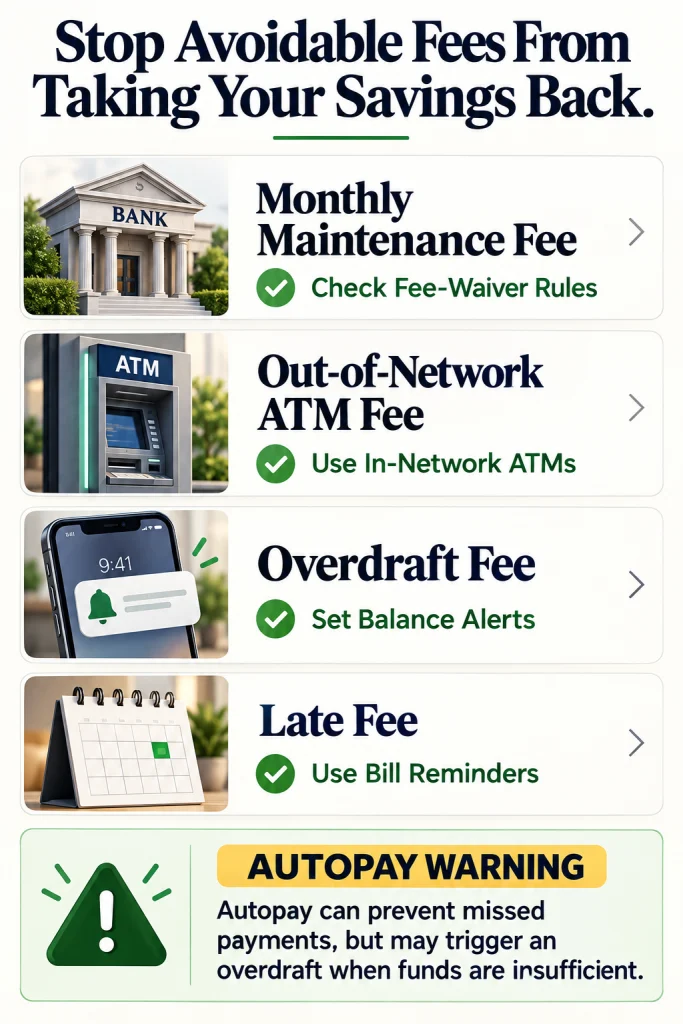
Check statements for maintenance charges, out-of-network ATM fees, overdrafts, and late fees. Ask what would eliminate a recurring fee or whether a recent fee can be waived. Do not assume the request will be approved.
Use balance alerts and bill reminders. Automatic bill payments may help avoid missed due dates, but they need enough money behind them to avoid overdrafts.
For uneven income, reminders and a bill calendar may be more useful than putting every payment on autopilot.
Also avoid buying a paid budgeting tool solely to solve a problem you can handle with your existing banking app, a spreadsheet, or a notebook.
6. Compare Insurance Without Giving Up Protection You Need
When shopping for auto insurance, compare equivalent coverage, limits, and deductibles. The Insurance Information Institute recommends getting multiple quotes and considering more than price, including the insurer’s service and financial strength.
Ask about discounts that fit your circumstances and compare the total cost of bundled policies against separate policies.
Be careful with a higher deductible. It may lower the premium, but you need enough money available to pay your share of a covered claim. A lower monthly bill is not much comfort if the new deductible is unaffordable.
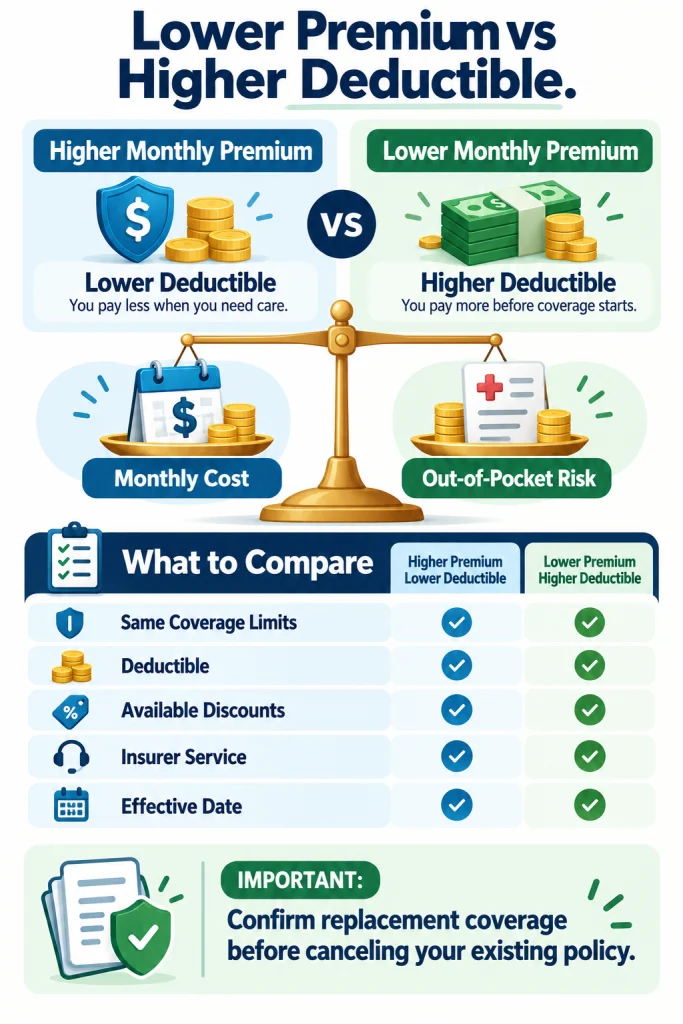
Do not cancel existing coverage before confirming the replacement’s effective date. Treat a coverage change as a risk decision, not just another subscription cancellation.
7. Try No-Cost Transportation and Energy Changes First
Before buying something advertised as an energy saver, look at changes that cost nothing.
For driving, avoid unnecessary aggressive acceleration, hard braking, and excessive idling when safe to do so. FuelEconomy.gov identifies driving habits as one factor affecting fuel use.
At home, review the heating and cooling schedule you already use. ENERGY STAR explains how thermostat scheduling can reduce unnecessary heating or cooling. Keep settings appropriate for your equipment, climate, health needs, and anyone else in the home.
Measure the effect on later bills rather than assuming a particular saving. A new device or appliance belongs in a separate cost-and-payback decision, especially when the immediate goal is to keep cash available.
Add One-Time Cash When Spending Cuts Are Not Enough
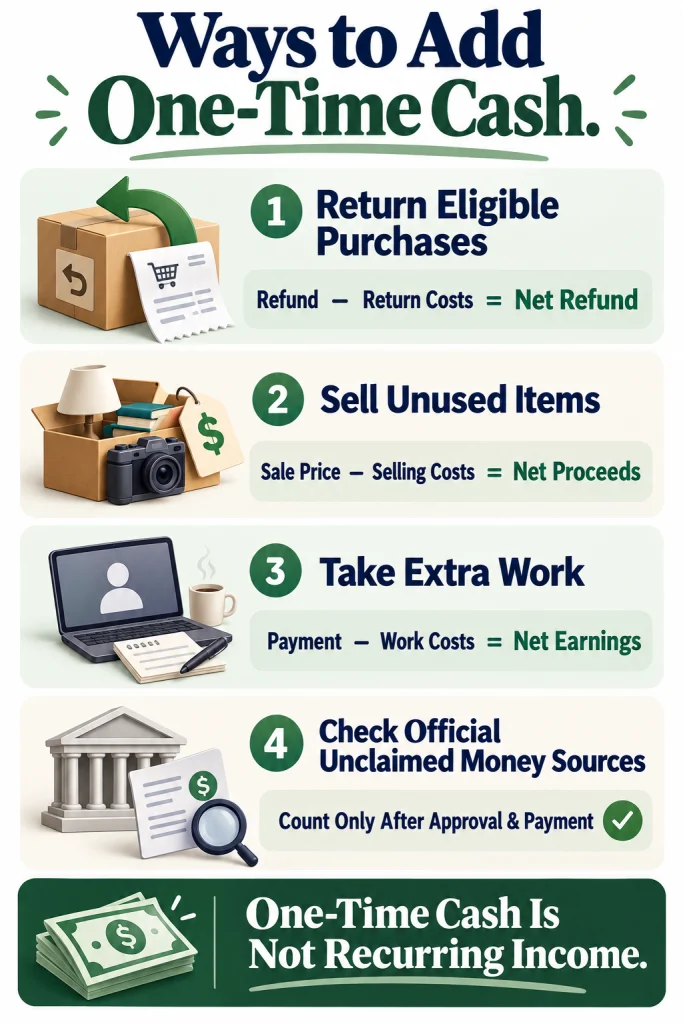
8. Return Eligible Purchases You Do Not Need
Check for unused purchases that are still within the seller’s return policy. Find the receipt, confirm the item’s eligibility, and check for return shipping or restocking costs before sending anything back.
Count the net refund only after it is processed. Store credit is not the same as cash you can move into savings, and a refund applied to an outstanding credit card balance should not also be counted as cash in your bank account.
The useful question is not “How much did I originally spend?” It is “How much will this return actually make available, and when?”
Do not buy something else simply because a refund makes the account balance look larger.
9. Sell Items You Can Comfortably Live Without
Look for unused furniture, electronics, hobby equipment, or other belongings that are worth the effort of selling. Start with a few items rather than trying to turn the entire house into a resale project.
Compare realistic asking prices, describe the condition honestly, and work out what you will keep after fees, shipping, and other selling costs.
For example, a $100 sale with $15 in selling costs leaves $85 before any applicable taxes. Count only the amount you can actually keep.
Remember that selling an item turns an existing possession into cash. It is not recurring income, and it does not automatically increase your net worth. Avoid selling essential work tools or something you would soon need to replace.
10. Choose Extra Work Based on What You Keep
Consider work you can do with skills and equipment you already have. Depending on your circumstances, that could mean an available extra shift, tutoring, cleaning, repairs, or a small freelance assignment.
Before committing, calculate the costs of doing the work. Include transportation, supplies, platform charges, additional childcare, and any other expenses that apply.
For a hypothetical job paying $150, $30 in expenses leaves $120 before taxes. That is a more useful starting figure than the advertised payment.
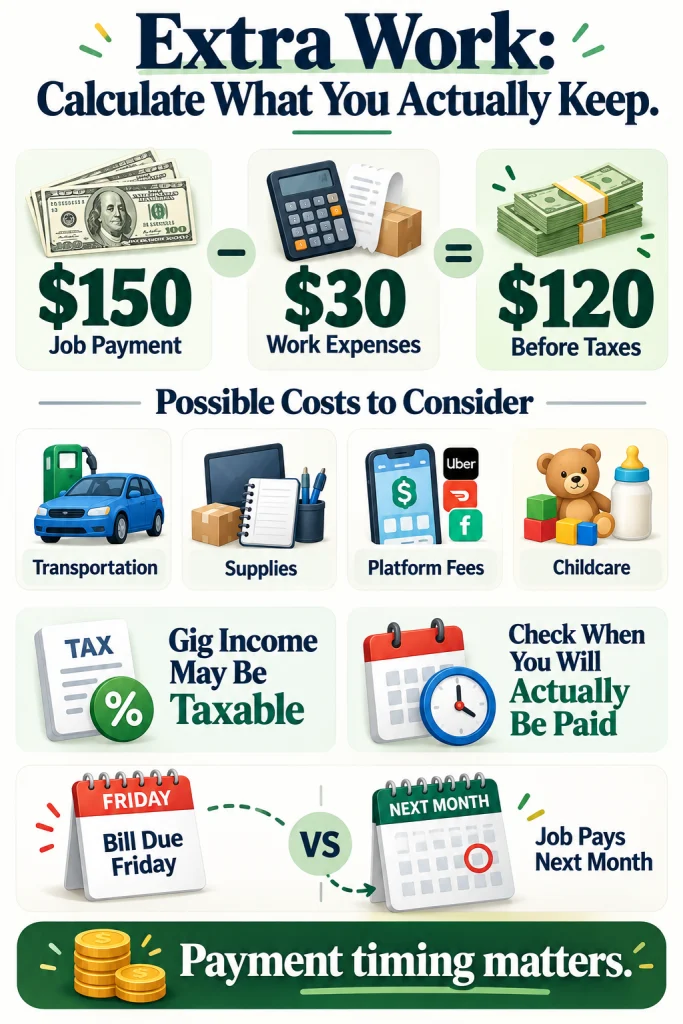
The IRS says gig income can be taxable even when it is temporary, paid in cash, or not reported to you on an information return. Keep records and account for the taxes that apply to your situation.
Check the payment date, too. Work paid next month cannot fund a bill due this Friday.
11. Check Official Sources for Unclaimed Money
An old account, uncashed payment, or other forgotten money may be held by a state unclaimed-property office. USA.gov recommends searching the states where you have lived and explains that there is no single database covering every type of unclaimed money.
Use official state resources rather than treating a promotional message as proof that money is waiting for you.
This is worth checking, but do not include a possible claim in your budget before it is approved and paid. It is a potential one-time recovery, not a dependable quick payout.
Make Sure the Money Stays Saved
12. Move the Amount You Actually Free Up
Once a lower bill takes effect or sale proceeds arrive, decide how much is genuinely available after upcoming obligations. Move that amount into a separate savings account rather than leaving it mixed with everyday spending money.
For regular income, a small automatic transfer after payday can help. For variable income, review what has cleared and what is due before making a transfer. The CFPB recommends watching checking-account balances so automatic savings do not cause an overdraft.
A transfer is not another source of savings. If canceling a subscription frees up $20 and you transfer that $20, you saved $20, not $40.
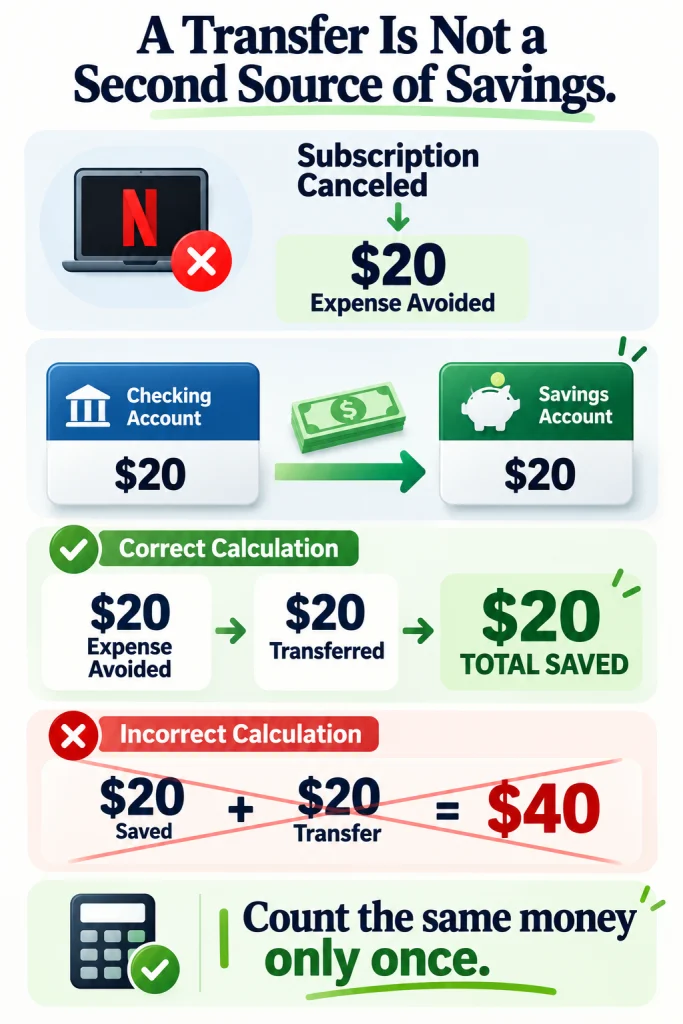
Name the goal clearly, such as “Emergency Buffer” or “Car Repair Reserve,” so you know what the money is meant to do.
13. Plan for Expenses That Are Irregular but Predictable
An annual renewal or six-month insurance payment may not appear in every monthly statement, but it still belongs in your budget. Bank of America’s budgeting guidance recommends accounting for expenses that occur regularly even when they are not monthly.
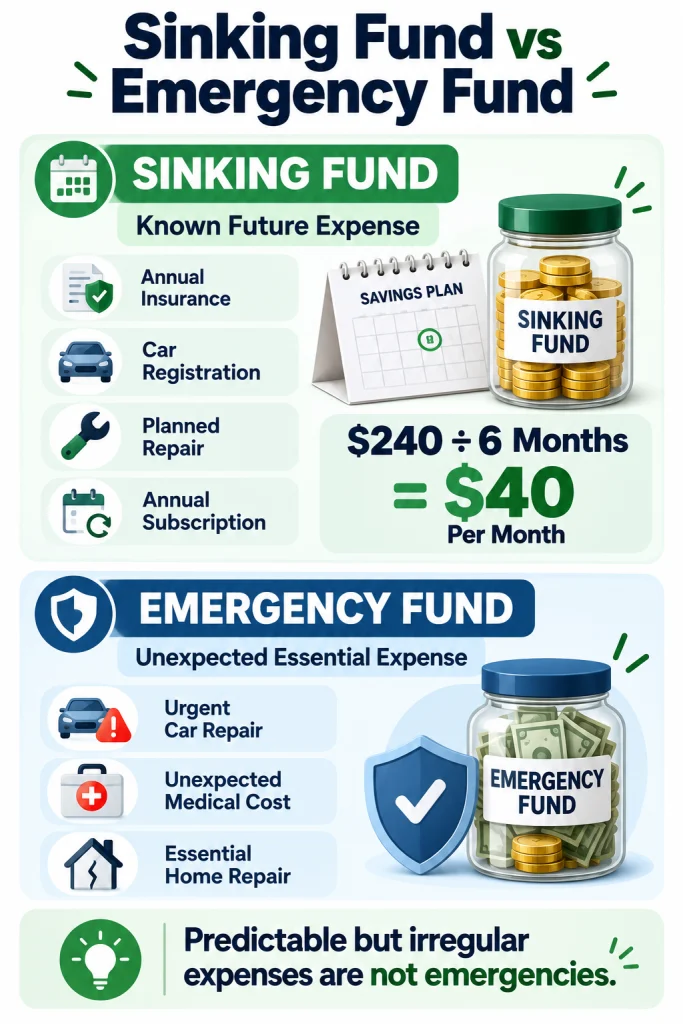
A sinking fund is money set aside gradually for one of those known costs. It is different from an emergency fund for something you could not reasonably plan for.
If a $240 bill is due in six months and you have nothing reserved, set aside $40 per month. That is not extra free cash: it is money with an upcoming job.
Keeping these amounts separate gives you a clearer view of how much you have actually built toward your new savings goal.
What Saving $500 in 30 Days Could Look Like
You do not have to find the entire amount in one category. Here is a hypothetical mix of spending reductions and one-time cash.
| Action | Amount available within 30 days | Type |
|---|---|---|
| Cancel subscriptions before their next charges | $30 | Recurring expense reduction |
| Lower a phone bill, with the change effective this month | $20 | Recurring expense reduction |
| Reduce total food spending after accounting for replacement meals | $100 | Spending reduction |
| Eliminate nonessential purchases rather than postpone them | $75 | Spending reduction |
| Sell unused belongings after costs and any applicable taxes | $175 | One-time cash |
| Receive eligible refunds into your bank account, after return costs | $100 | One-time cash |
| Total | $500 | $225 in cuts plus $275 in one-time cash |
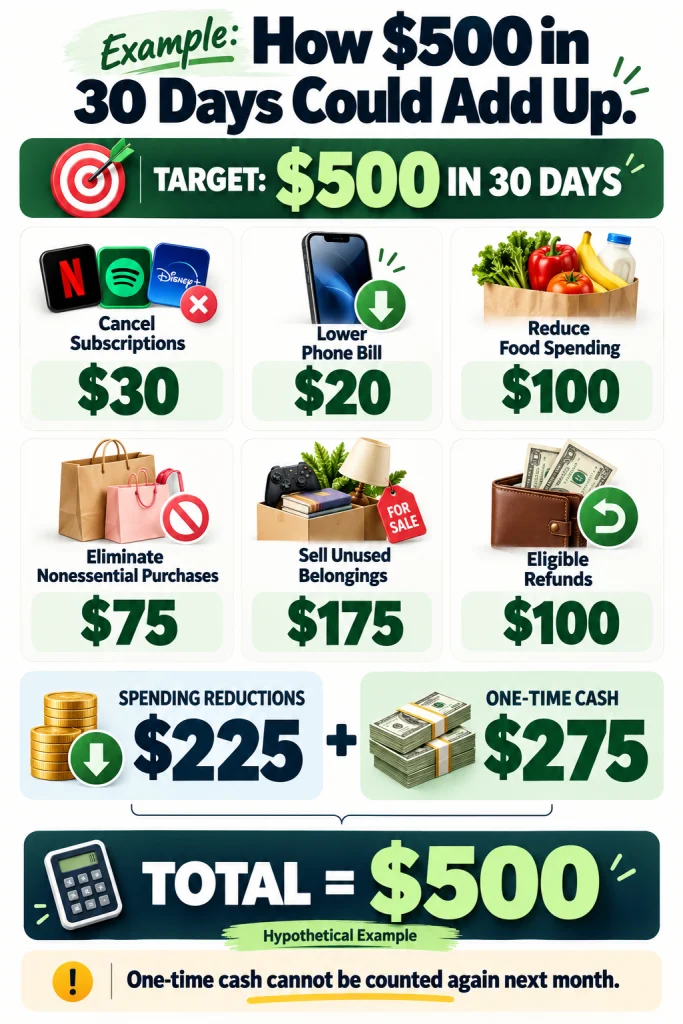
This example assumes the changes happen in time, the refunds and sale payments arrive, and the money is not needed to cover an existing shortfall.
The following month is different. You cannot count the same $175 sale or $100 refund again. The $225 in spending reductions is repeatable only if the lower bills remain in place and the food and shopping changes continue.
At the end of the month, compare your result with actual transactions. Money moved into savings while equivalent new debt piles up elsewhere does not tell the full story.
What if You Are Already Living Paycheck to Paycheck?
There may not be an unused membership or a large dining budget to cut. When essential expenses exceed income, stricter rules alone do not close the gap.
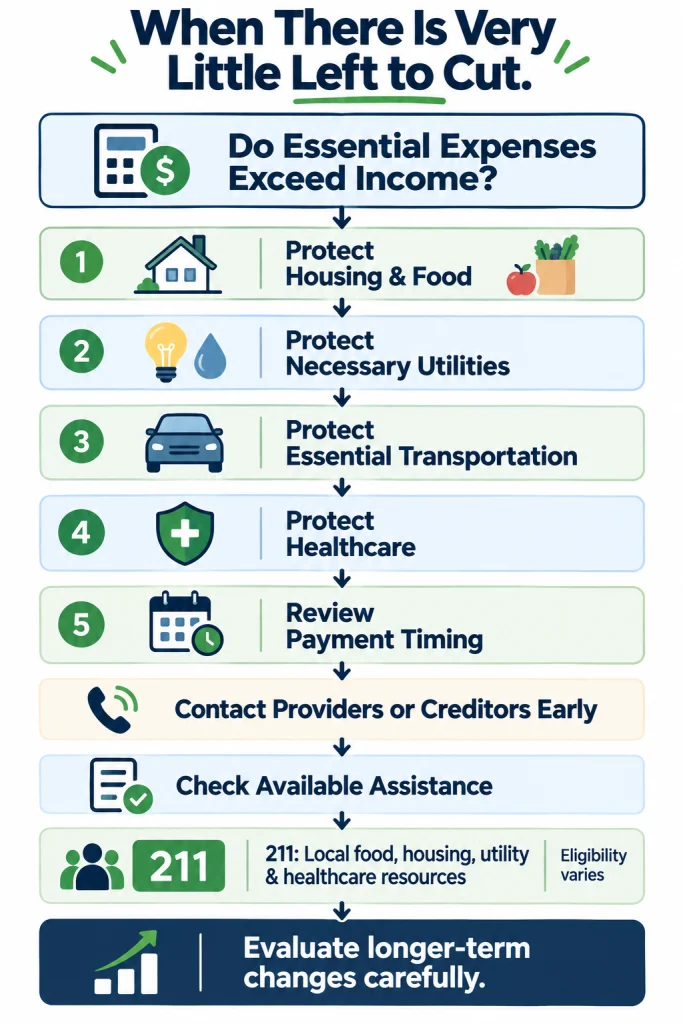
Start by protecting housing, food, necessary utilities, essential transportation, and healthcare. Review payment timing and contact providers or creditors about options before assuming you have to handle every shortfall alone. Check the terms of any arrangement rather than treating a delayed payment as a forgiven bill.
In the United States, 211 can connect you with local resources for food, housing, utilities, and healthcare. Available programs and eligibility vary.
Do not stop prescribed treatment to reach a savings target. Ask a pharmacist or clinician whether an FDA-approved generic is an appropriate lower-cost option. The FDA says approved generics must meet its standards for equivalence to their brand-name counterparts.
Longer-term changes to income, housing, or transportation may deserve attention, but calculate their costs and practical consequences. Moving, for example, is not an instant saving just because the new monthly rent is lower.
When there is room to save again, choose an amount you can sustain. Your first target does not have to match someone else’s.
Should You Save Money or Pay Off Debt First?
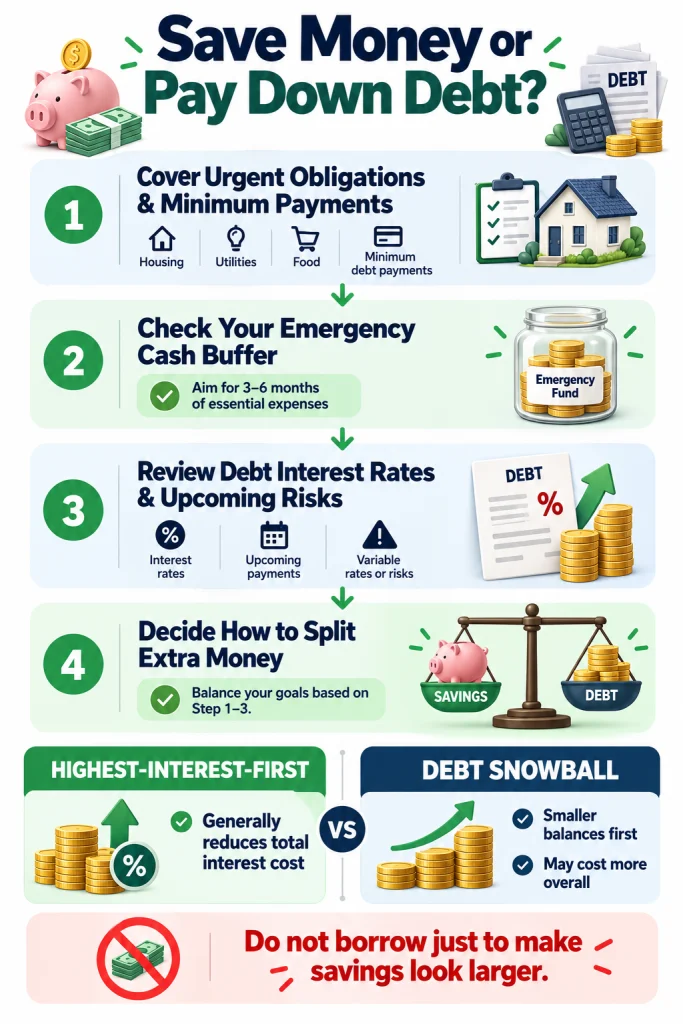
The decision is not always either-or. Consider whether you have any cash available for an unexpected essential expense, which bills are at risk, and what your debt costs.
The CFPB notes that the appropriate emergency fund depends on your circumstances and that even a small reserve can help. There is no single starter amount that fits every household.
After addressing urgent obligations and maintaining required minimum payments, use any extra money to make steady progress on one debt at a time. The CFPB outlines different debt repayment strategies, including the debt snowball method, which focuses on paying off smaller balances first to achieve quicker wins and maintain motivation. Choose an approach that fits your monthly budget and supports consistent progress toward becoming debt-free.
A reasonable plan may combine a modest cash buffer with extra payments on expensive debt. The balance depends on income stability, upcoming risks, and the terms of what you owe.
Do not borrow money just to make a savings account look better. Keep track of cash reserves and debt together.
Frequently Asked Questions
Can I Save $1,000 in a Month?
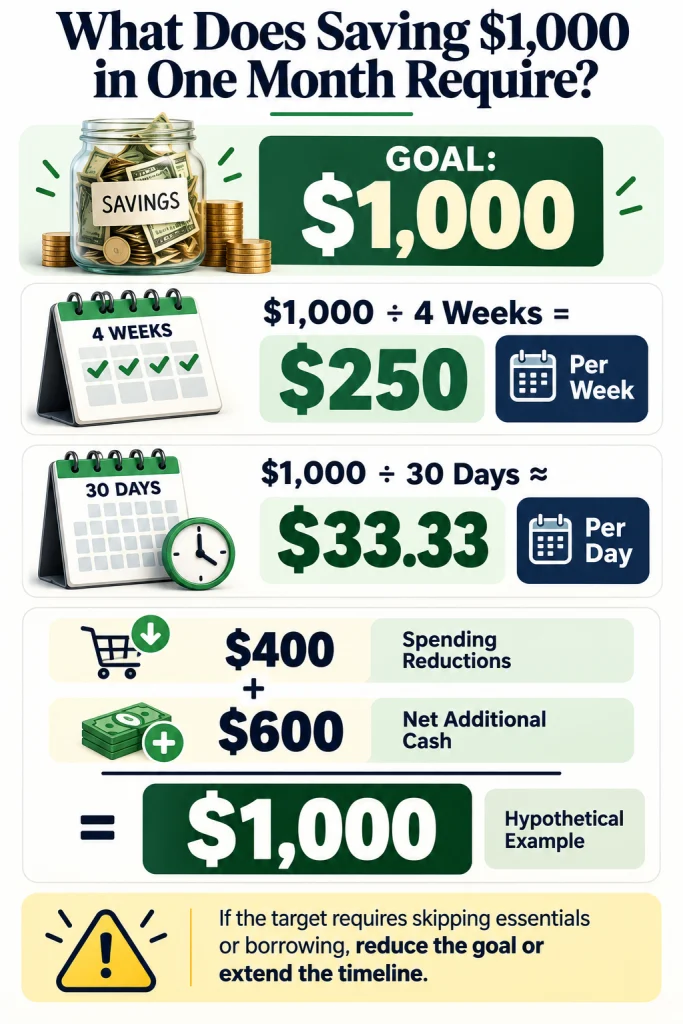
You would need to set aside an average of $250 across four weeks, or about $33.33 per day across a 30-day month. Whether that is possible depends on your starting surplus and additional money you can genuinely free up.
For example, $400 in spending reductions plus $600 in net additional cash reaches the target. Those are hypothetical amounts, not an expectation. If reaching them would mean missing essentials, use a smaller goal or a longer deadline.
Where Should I Keep Money I Am Saving for the Near Term?
Look for an accessible savings account with terms that suit your balance and withdrawal needs. Compare account fees, minimum balance requirements, transfer times, deposit insurance, and ease of access. Choose an account that keeps your money secure, allows convenient withdrawals, and supports your savings goals without unnecessary costs or restrictions.
Fidelity’s emergency-savings guidance emphasizes liquidity and avoiding investments that could lose value when you need the money. MyCreditUnion.gov explains that eligible deposits at federally insured credit unions are protected within insurance limits, while investments such as stocks and mutual funds are not share-insured.
Money needed for an imminent bill or emergency reserve should not depend on a speculative investment rising in value.
Do I Need to Save 20% of My Income?
No fixed percentage is a useful starting requirement for everyone. Work from your essential costs, income, debt, and deadline rather than forcing the budget to fit a rule.
For a hypothetical take-home income of $2,000, saving 5% means $100, while saving 20% means $400. Choose what your cash flow can support and review it when bills or income change.
Start With One Change You Can Complete Today
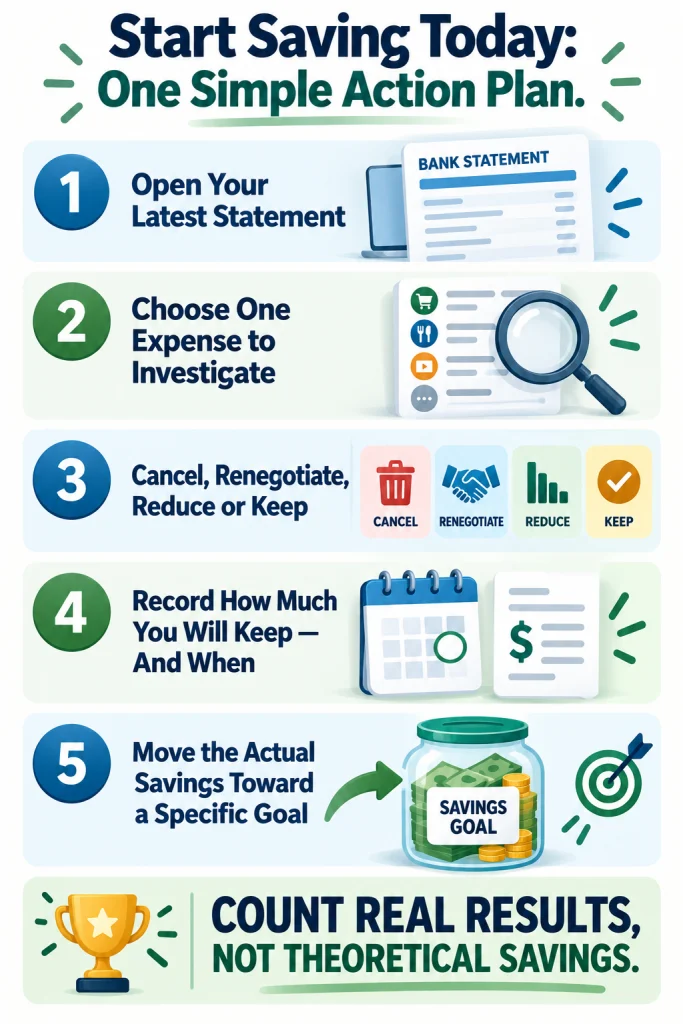
Open your latest statement and choose one expense to investigate. Cancel it, renegotiate it, or decide that it is essential and move to the next one.
Write down the amount you expect to keep and when it will become available. When it does, give it a specific purpose.
Learning how to save money fast is not about completing every idea on a list. Start with a change that fits your situation, count the result honestly, and build from money you can actually keep.
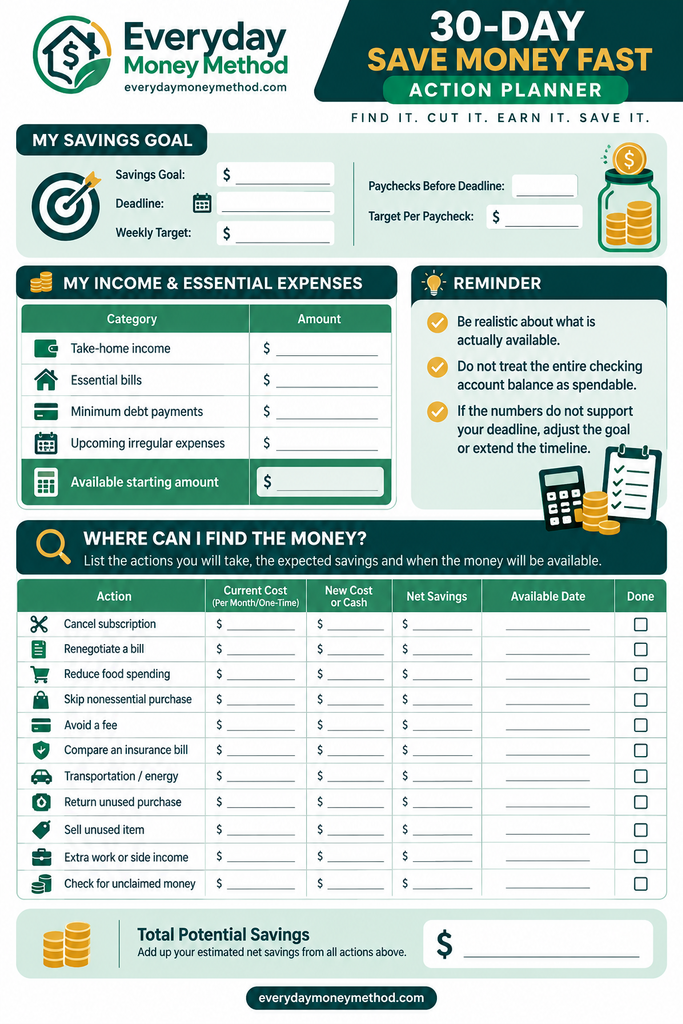
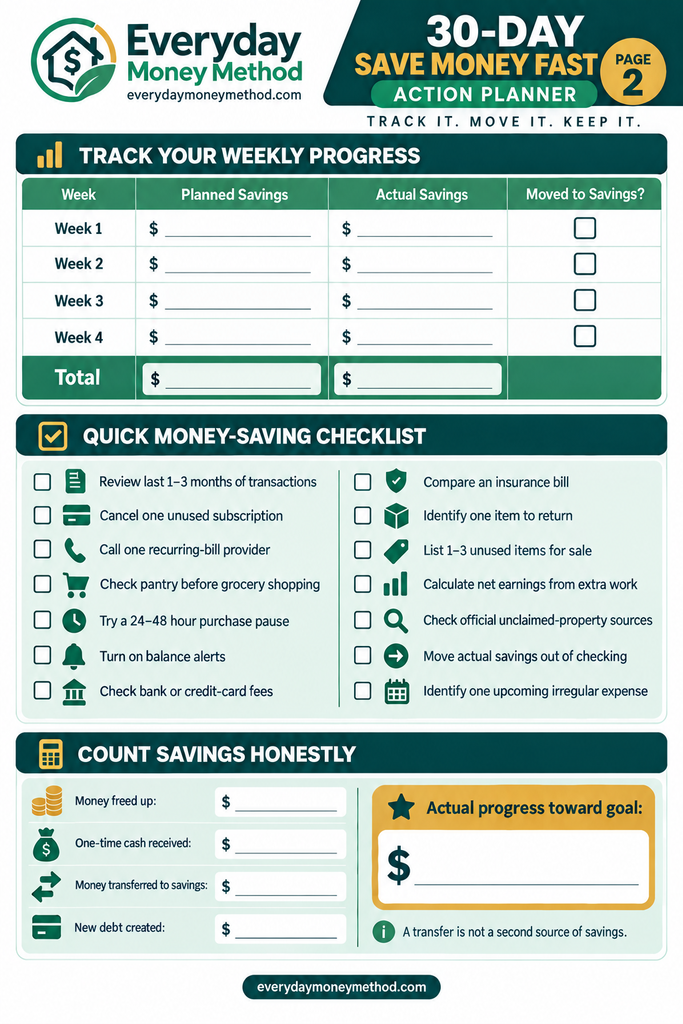
Free 30-Day Save Money Fast Action Planner
Use this 2-page printable to set a savings goal, find realistic ways to cut expenses or add extra cash, and track how much you actually save over the next 30 days.
References and further reading
These resources support the general educational topics discussed; individual circumstances and current rules may differ.
Continue learning
monthly budget guide · grocery savings guide · emergency fund guide · frugal living tips

Personal finance writer and content creator at Everyday Money Method.
Editorial Policy · Report a correction