
Editorial voice: Monem · Published 2026-10-25 · Article resources updated November 18, 2026
Key takeaways
- Set aside money for unexpected expenses in a dedicated reserve.
- Choose a target based on essential spending and income stability.
- Start with a manageable amount and replenish savings after use.
General educational information, not personalized financial advice. Read our Financial Disclaimer.
The refrigerator stops cooling on a Thursday. You have groceries inside, bills scheduled to come out of checking, and another week until payday. Suddenly, a repair that wasn’t in your budget needs money right now.
That’s exactly the kind of problem an emergency fund is meant to solve.
To build an emergency fund, start with a small, reachable savings goal, keep the money separate from everyday spending, and add to it regularly. Once you’ve saved your first $500 or $1,000, work toward a larger cushion based on your essential monthly expenses. You don’t have to reach the final number before your savings begin helping you.
Here’s how to make that plan work when you have ordinary bills, competing priorities, and a budget that doesn’t always behave.
What Is an Emergency Fund, and Why Do You Need One?
Related reading: Explore our monthly budget guide for a complementary approach.
An emergency fund is money you set aside specifically for unexpected, necessary expenses or a sudden loss of income. It isn’t money left over in checking after the bills are paid. It has a separate job: helping you handle a financial disruption without immediately needing to borrow.
Think about two different kinds of surprises.
One is a sudden expense: an urgent dental treatment, a major car repair, or replacing a refrigerator that can no longer keep food safe. The other is an income emergency: losing your job, having your work hours cut, or being unable to work for a period of time.
A few hundred dollars might help with the first. The second could require months of rent, groceries, transportation, and other necessities.
This isn’t a rare concern. In the Federal Reserve’s 2025 household survey, published in May 2026, 55% of U.S. adults reported having savings set aside to cover three months of expenses. The same report found that 63% said they would pay a hypothetical $400 emergency with cash, savings, or a credit card paid in full at the next statement. Those aren’t the same thing as having $400 sitting in a savings account, but they illustrate why an accessible financial buffer matters.
How Much Money Should You Save in an Emergency Fund?
The familiar recommendation is three to six months of essential living expenses. That is a useful longer-term target, not an entrance requirement. Fidelity and other financial educators recommend starting with a smaller amount and building toward that range.
There are two numbers worth figuring out: your first milestone and your eventual goal.
First, aim for $500 or $1,000
Related reading: Explore our saving money quickly for a complementary approach.
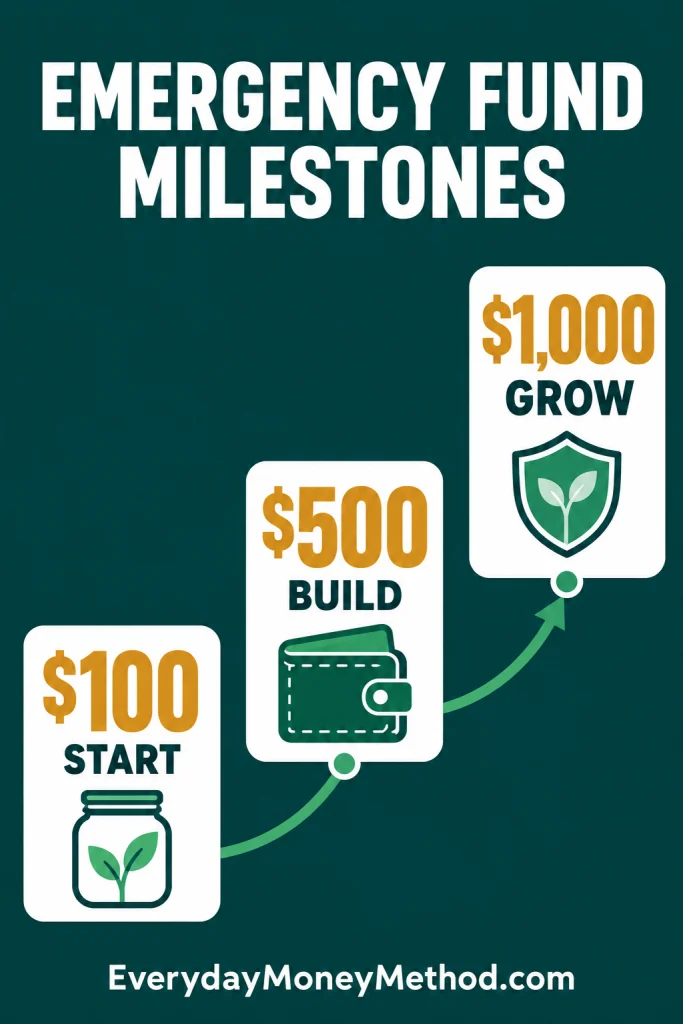
If you have nothing set aside, $10 is a beginning. Then you might aim for $100, followed by $500, and eventually $1,000. America Saves specifically encourages beginners to focus on their first $500 because it’s a more approachable starting point than several months of expenses.
These amounts aren’t magic. If a minor emergency in your life typically costs more, adjust your starter goal. If putting away $500 would take a long time, pick $100 first. A small fund can still prevent a manageable problem from immediately becoming a borrowing problem.
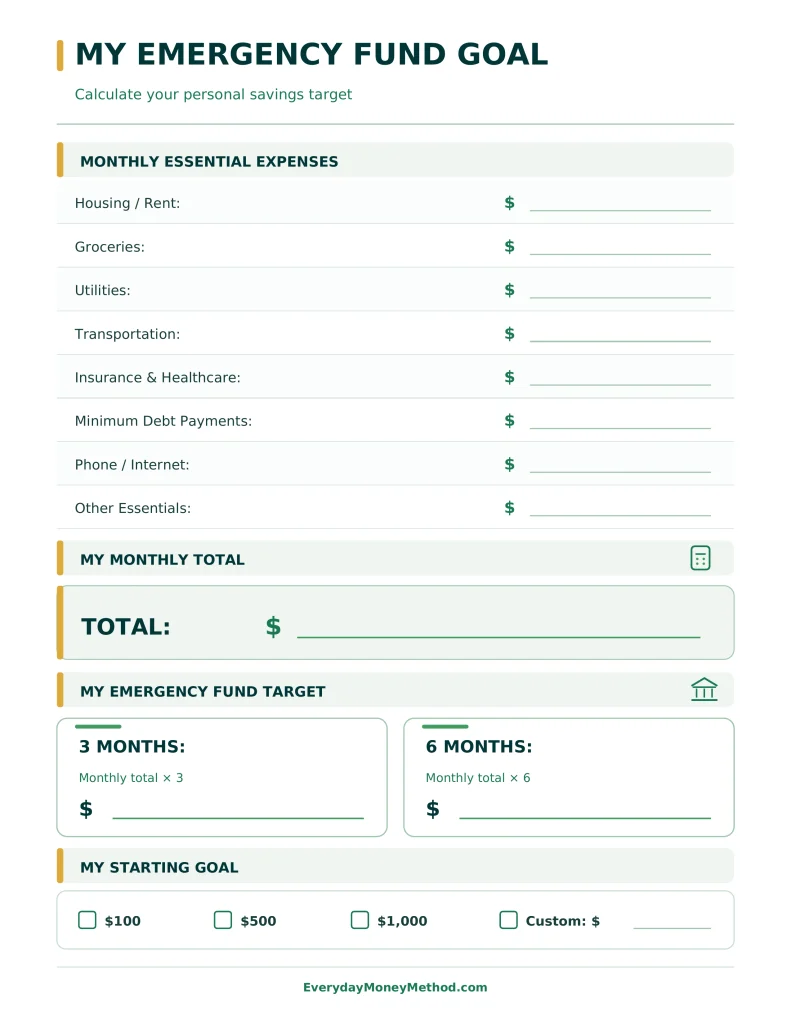
Then calculate three to six months of necessities
Here’s the part many beginners get wrong: you generally calculate your emergency fund from expenses, not your salary.
Suppose you bring home $3,400 per month but need only $2,500 to cover your essential bills. Your target is based on that $2,500, with adjustments for your own risks, rather than automatically multiplying $3,400 by six.
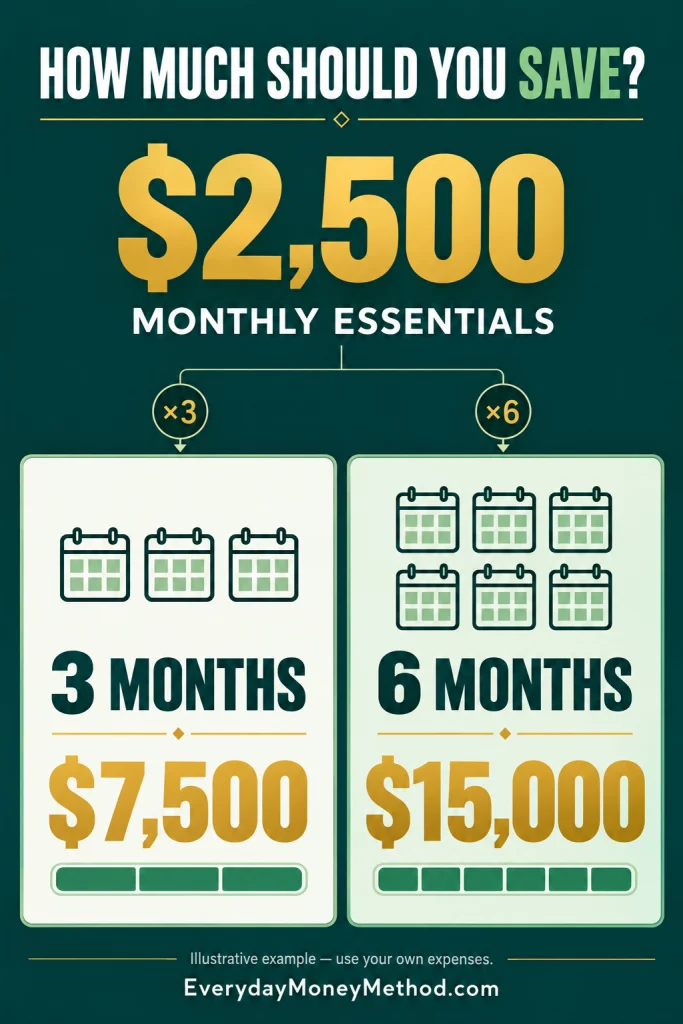
Here is a hypothetical monthly budget to show the math:
| Essential expense | Monthly amount |
|---|---|
| Rent | $1,200 |
| Groceries and basic household supplies | $400 |
| Utilities | $200 |
| Transportation | $250 |
| Insurance and necessary health costs | $250 |
| Minimum debt payments | $150 |
| Phone and essential connectivity | $50 |
| Total essential monthly expenses | $2,500 |
Using that total:
- One month of essentials: $2,500
- Three months: $7,500
- Six months: $15,000
These are illustration amounts, not national spending averages or the amount every household should save. Include what your household actually needs, such as childcare, prescriptions, insurance deductibles, or essential pet care. Exclude expenses you could reasonably pause during an income interruption, such as vacations or optional subscriptions.
Is three months enough, or should you save six?
Related reading: Explore our paycheck budgeting guide for a complementary approach.
Three months may be a reasonable initial long-term target if your income is fairly stable, your essential costs are manageable, and you have few people relying on that income. Six months or more may be worth considering if your pay fluctuates, you support dependents, have higher health risks or costs, or might need longer to replace lost work.
You can change the target as your life changes. A new rent payment, baby, career change, or second household income can change what an adequate cushion looks like.
How to Build an Emergency Fund Step by Step
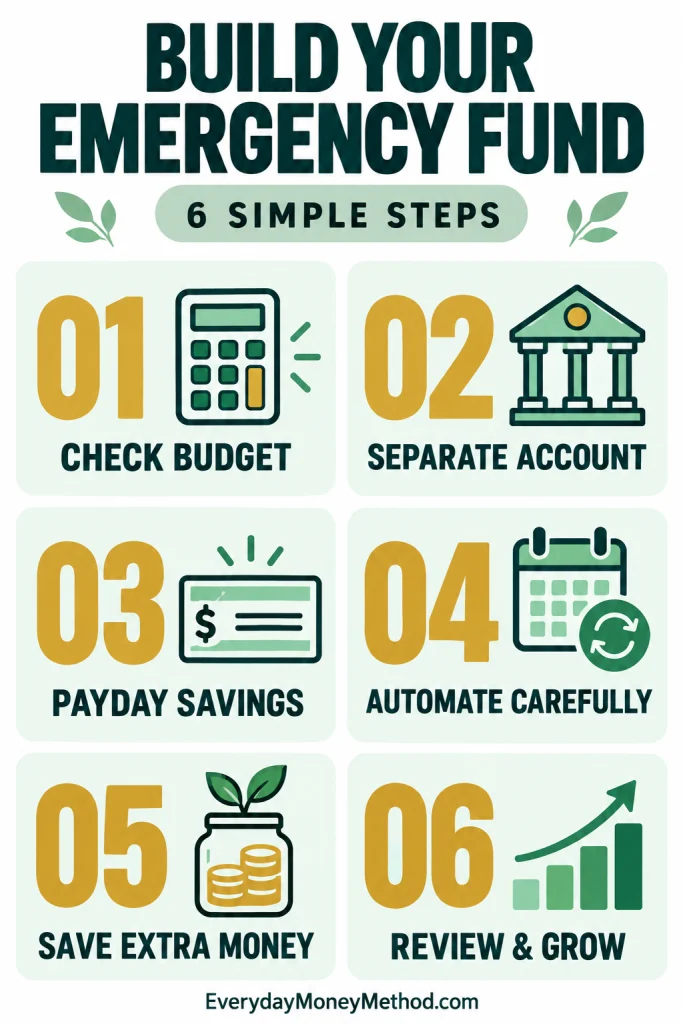
1. Find a savings amount your budget can actually spare
Before deciding to save $200 a month, check whether $200 is available.
Look at the last month or two of income and transactions. Write down what came in, what must be paid, and which expenses vary. If your budget says you have $180 left but you regularly spend another $150 on forgotten bills or household needs, you don’t have $180 available for savings.
Start with the amount left after realistic essentials and required payments. Maybe it’s $15 each payday. Maybe it’s $60 a month. Maybe this month has no surplus at all. The Consumer Financial Protection Bureau recommends reviewing cash flow, including when money arrives and bills leave, rather than looking only at the monthly total.
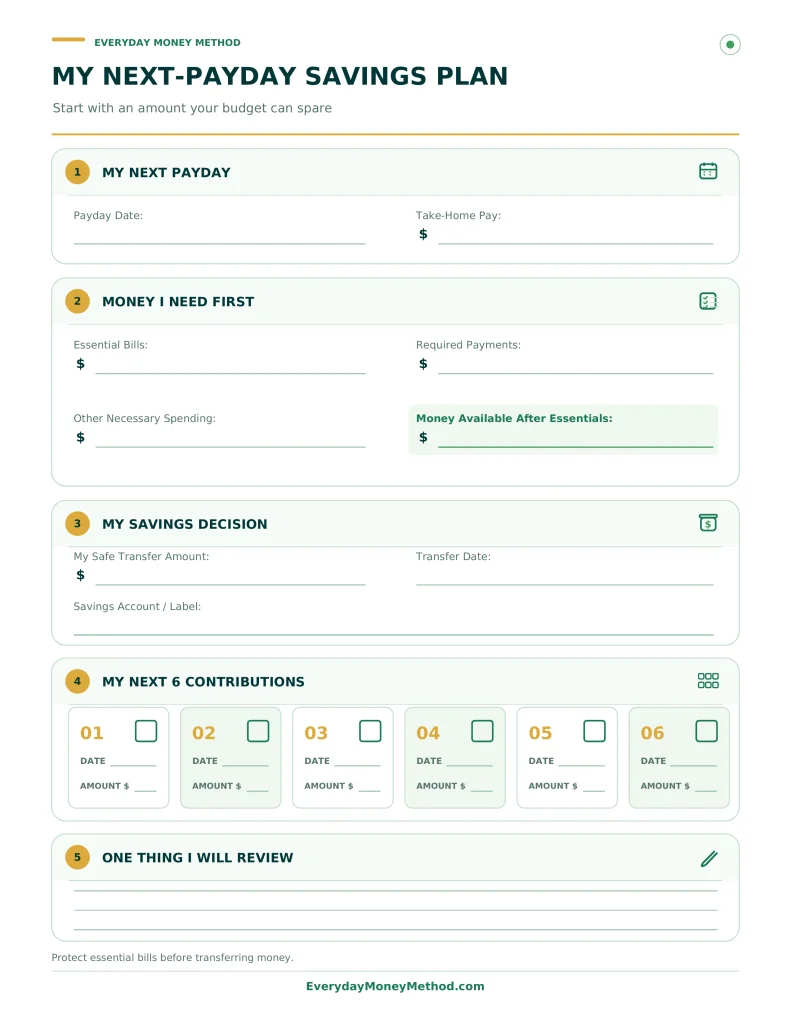
Try this: Choose one amount you could transfer on your next payday without risking rent, groceries, or a negative account balance. You can increase it after the first month if your budget supports it.
2. Open a Separate Savings Account
When your emergency money sits in the same account as everyday spending, the balance can be misleading. You see $900, but perhaps $700 already belongs to rent and the electric bill.
A separate savings account gives your emergency fund its own space and makes it easier to track your progress without mixing savings with everyday expenses.
Choose a secure account that allows you to access your money when an emergency happens. Before opening an account, review any monthly fees, minimum balance requirements, withdrawal restrictions, transfer limits, and available deposit insurance.
Also, consider how quickly you can move money into your everyday spending account when needed.
The main goal is to keep your emergency savings safe, separate, and easily accessible whenever an unexpected expense arises.
For U.S. savers, check that the bank is FDIC-insured or that the credit union is federally insured by the NCUA. Standard deposit insurance is generally $250,000 per depositor or member, per insured institution, per applicable ownership category, subject to the rules for that category.
A savings account is usually a simpler home for a beginner’s emergency fund than stocks, cryptocurrency, or money you must sell at a potentially bad time. Certificates of deposit (CDs) may impose early-withdrawal penalties, and money market mutual funds are not the same as insured money market deposit accounts. Your first priority here is access and protection, not maximum investment returns.
3. Make the savings amount match your paycheck
You don’t need to wait until the end of the month and hope money remains.
If you’re paid every two weeks, choose a transfer amount for each paycheck. If you’re paid weekly, save weekly. Put the transfer on the calendar just like a bill, except you’re paying your future self.
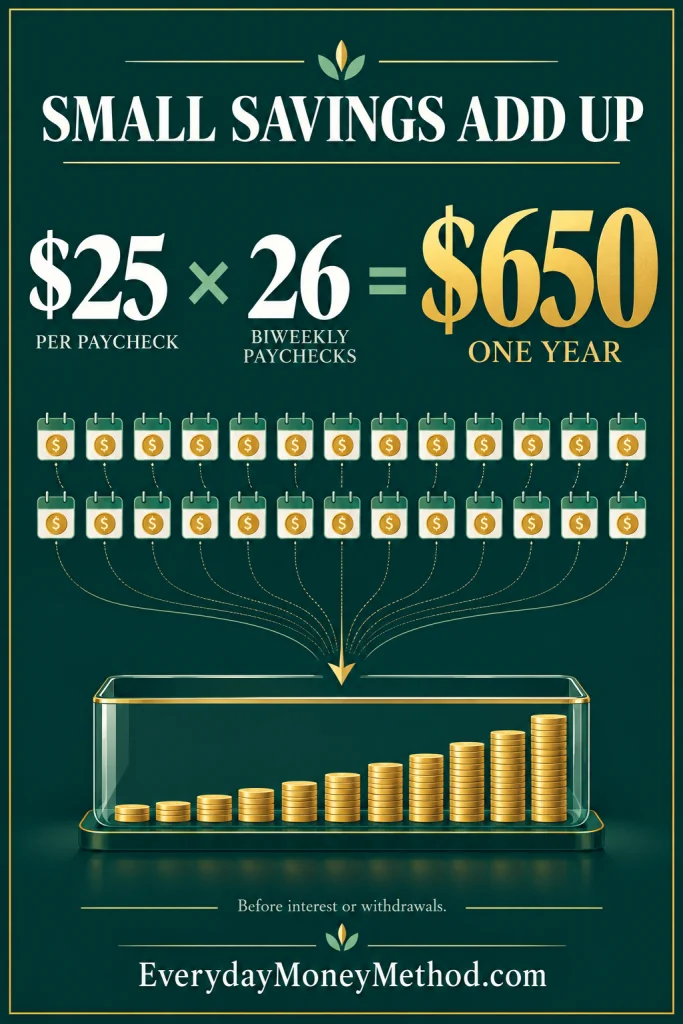
For example, $25 from each of 26 biweekly paychecks equals $650 over one year, before any withdrawals. That’s not a prediction of your outcome. It’s a way to make a large goal feel like a repeatable decision.
With inconsistent income, a fixed automatic amount may not work. You could instead transfer a small percentage of a payment after that money clears and after your immediate obligations are covered.
4. Automate it carefully
You can set up a recurring transfer from checking to savings or, if your employer permits it, split your paycheck between the two accounts.
Automation can help you save without making the decision again every payday. But check your due dates first. A transfer scheduled before a rent payment clears could create an overdraft fee and undo some of your progress. The CFPB specifically warns savers to monitor checking balances when setting up automatic transfers. [1]
If you prefer not to automate yet, a recurring calendar reminder works, too. The method should fit your cash flow rather than create another financial problem.
5. Use occasional extra money without depending on it
A tax refund, bonus, gift, or extra freelance payment can move your emergency fund forward. You don’t have to save every dollar of a windfall, especially when other urgent needs are waiting. Choose a portion intentionally.
For example, if you receive an unexpected $300 and can safely save $200, add that amount to your emergency fund. Your planned payday transfers can continue as usual.
One practical detail: Eligible U.S. taxpayers can use IRS Form 8888 to split a federal income tax refund by direct deposit among up to three accounts. That can help you move part of a refund into savings before it mixes with everyday spending.
6. Check progress, then increase the goal
After you’ve built your first $100, keep going toward $500. When you reach $500, decide whether the next milestone is $1,000, one month of necessities, or another amount suited to your situation.
Check the balance monthly. If an expense category becomes more expensive, update your larger goal. If your income grows and your bills stay manageable, consider increasing the automatic transfer slightly.
An emergency fund isn’t a savings challenge you finish once and never revisit. It’s a financial cushion you maintain.
What If You’re Living Paycheck to Paycheck?
This is where a lot of emergency fund advice becomes frustrating. It tells you to stop buying coffee when the real problem is that groceries, housing, transportation, and required payments already use nearly every dollar.
If your essential expenses exceed your income, a savings goal alone cannot fix that shortfall. Prioritize keeping your housing, food, necessary transportation, medicine, and critical services covered. Review what bills are negotiable and whether assistance, additional income, or changes to debt payments are available. A nonprofit credit counselor can help assess options when debt is part of the squeeze.
If you do have a little breathing room, start smaller than the standard advice suggests. A hypothetical $5 saved each week would become $100 after 20 weeks, provided you don’t need to withdraw it. That’s still money available for a future surprise.
Don’t create a savings transfer that forces you to pay an overdraft fee, miss a minimum debt payment, or buy necessities with expensive credit. It may be better to save irregularly at first than to automate an amount your account can’t support.
What if your income changes every month?
Suppose your take-home pay fluctuates between $2,400 and $3,600. Building your normal spending around the $3,600 months could leave you short when a quieter month arrives.
Instead, plan essential spending against a conservative income estimate based on your records. When a stronger month comes along, cover near-term bills first and put part of the remaining money into your fund. If you work for yourself, keep business tax money and business operating expenses separate from personal emergency savings.
You may eventually want a larger cushion because income uncertainty itself is one of the emergencies you’re planning for. The goal is to smooth the uneven months, not to pretend every month will be your best one.
Should You Build an Emergency Fund or Pay Off Debt First?
Imagine you have $400 available this month, an outstanding credit card balance, and no emergency savings. You could put the entire $400 toward paying down debt. But if your car needs a $250 repair tomorrow, you might have to borrow again or delay an essential repair.
That is the challenge. Paying down debt reduces your outstanding balance and moves you closer to financial stability. At the same time, having emergency savings can help you handle unexpected expenses without taking on additional debt.
A practical starting approach is to keep required debt payments current while gradually building a small emergency fund. Once you have a basic financial cushion, you can decide how much additional money to direct toward debt repayment and how much to continue saving.
If you are behind on essential bills, facing collection activity, or at risk of losing access to housing or necessary transportation, those immediate obligations may need attention first. Your financial priorities should reflect your actual circumstances.
Avoid using every available dollar to reach a large savings goal while important bills remain unpaid. At the same time, do not assume you must eliminate every outstanding debt before starting an emergency fund.
Consider your upcoming expenses, income stability, required payments, and access to emergency cash.
The goal is to make steady progress on debt repayment while maintaining enough savings to handle unexpected expenses without creating new financial problems.
What Counts as an Emergency Fund Expense?
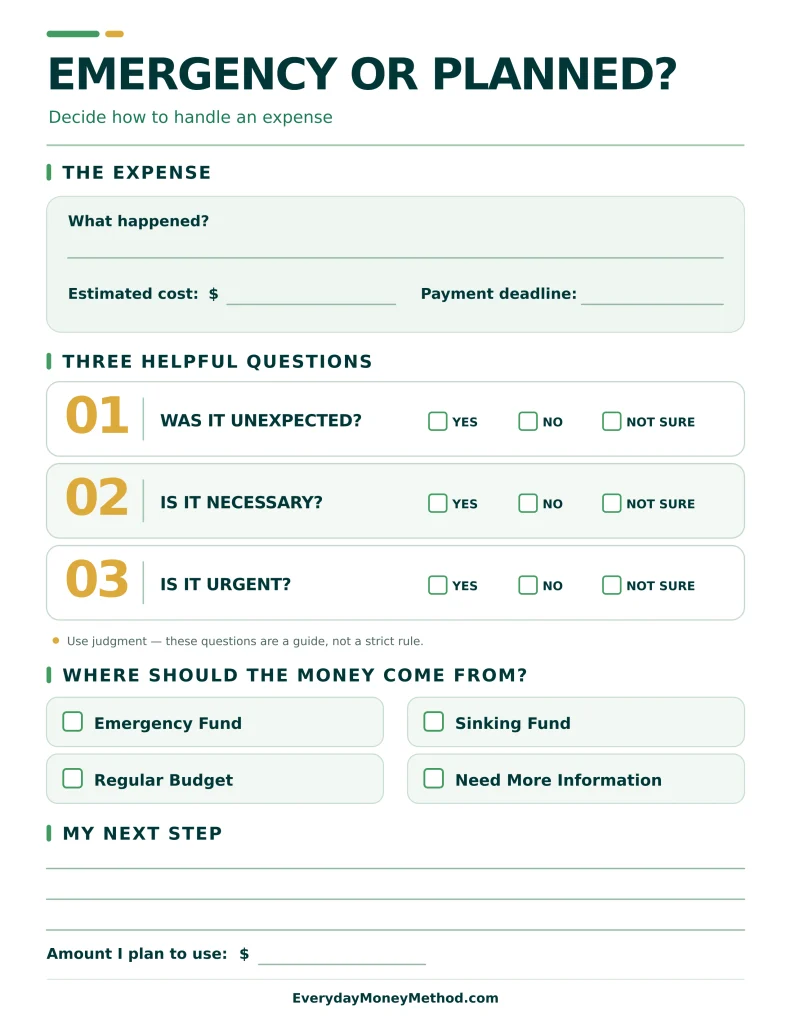
Not every unexpected purchase is an emergency, and not every expense you knew was coming needs to come out of the fund.
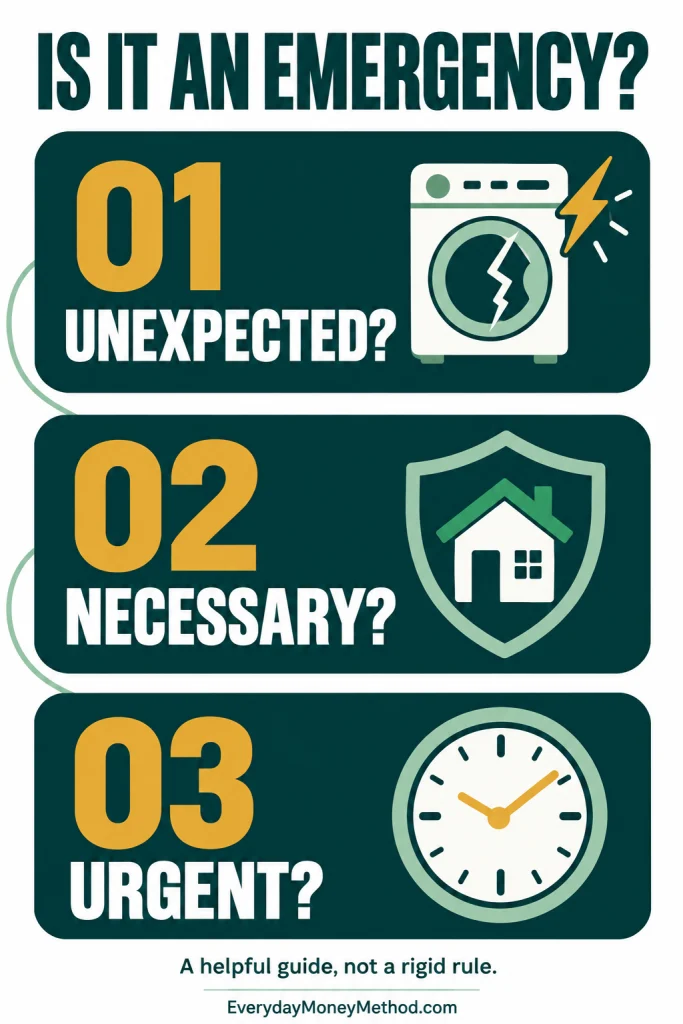
When you’re unsure, ask yourself three things:
- Was it unexpected? You didn’t know exactly when this expense would happen.
- Is it necessary? It affects your health, safety, ability to work, or basic needs.
- Does it need attention soon? Waiting could cause a larger problem or isn’t reasonably possible.
This is a helpful decision guide, not a rigid test for every household. Losing income may qualify even though there isn’t a single surprise bill.
| Situation | Usually an emergency fund expense? | Why |
|---|---|---|
| Your car breaks down and you need it to get to work | Yes | Urgent, necessary transportation |
| You lose your job and still need to pay rent | Yes | Unexpected loss of income |
| You need an urgent medical treatment with an out-of-pocket cost | Yes | Necessary health expense |
| Your annual car insurance premium comes due | Usually no | Predictable, even if it feels expensive |
| Holiday gifts or a planned vacation | No | Discretionary, foreseeable spending |
| Your refrigerator fails and food cannot be kept safe | Usually yes | Essential appliance replacement or repair |
| Your phone works, but a newer model is on sale | No | Optional upgrade |
Emergency fund vs. sinking fund: Know the difference
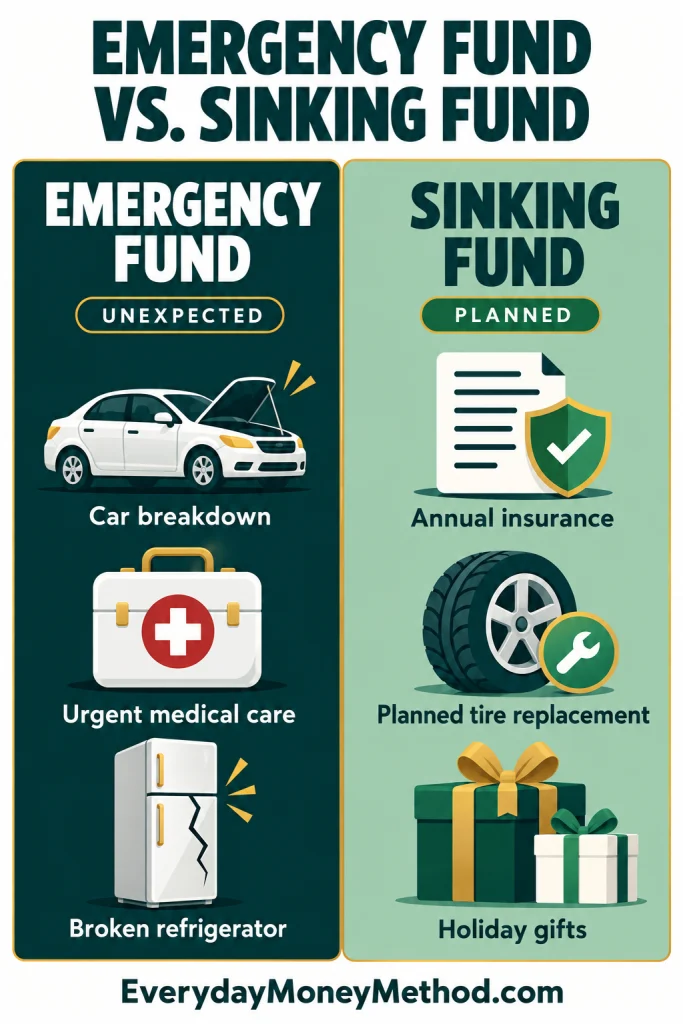
A sinking fund is savings for an expense you can anticipate, even if it doesn’t happen every month. That might be tires, holiday travel, annual insurance, or routine home maintenance. An emergency fund is for surprises and interruptions.
For example, suppose you expect an annual $600 insurance bill. Setting aside $50 per month in a sinking fund prepares you for it. If you leave that expense out of the budget, you’ll end up treating a predictable bill like an emergency.
These two types of savings can live at the same bank, but label them separately. Doing that makes your true emergency balance easier to see.
What If You Have to Use Your Emergency Fund?
Use it for the emergency. That’s what you built it for.
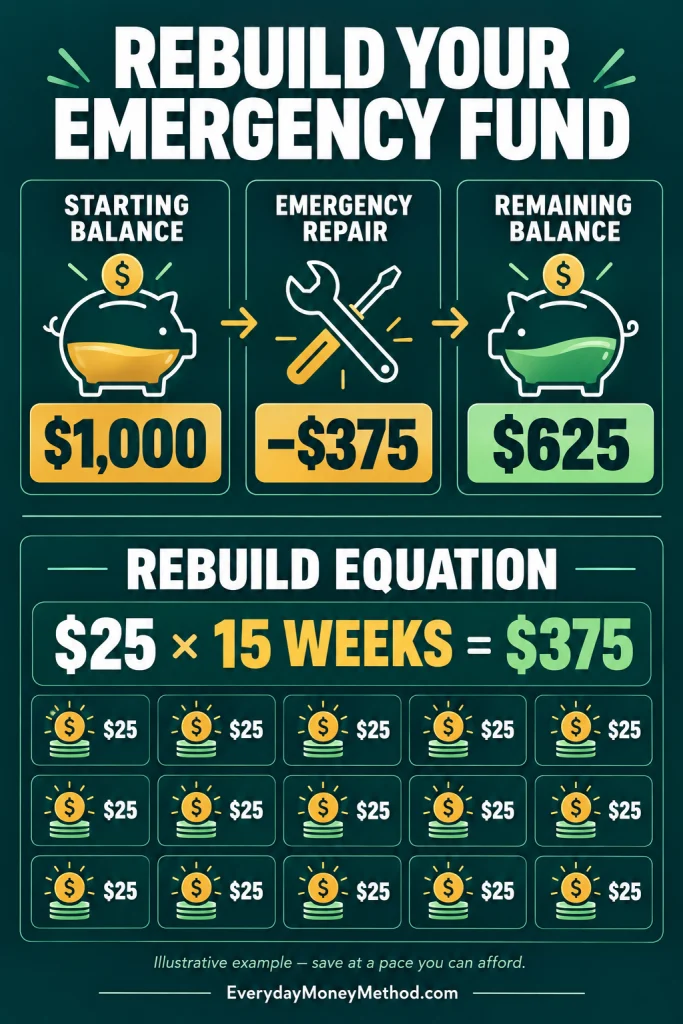
Suppose you saved $1,000 and then paid $375 for an urgent repair. Your balance is now $625. You haven’t failed your savings plan. You used the fund for its intended purpose.
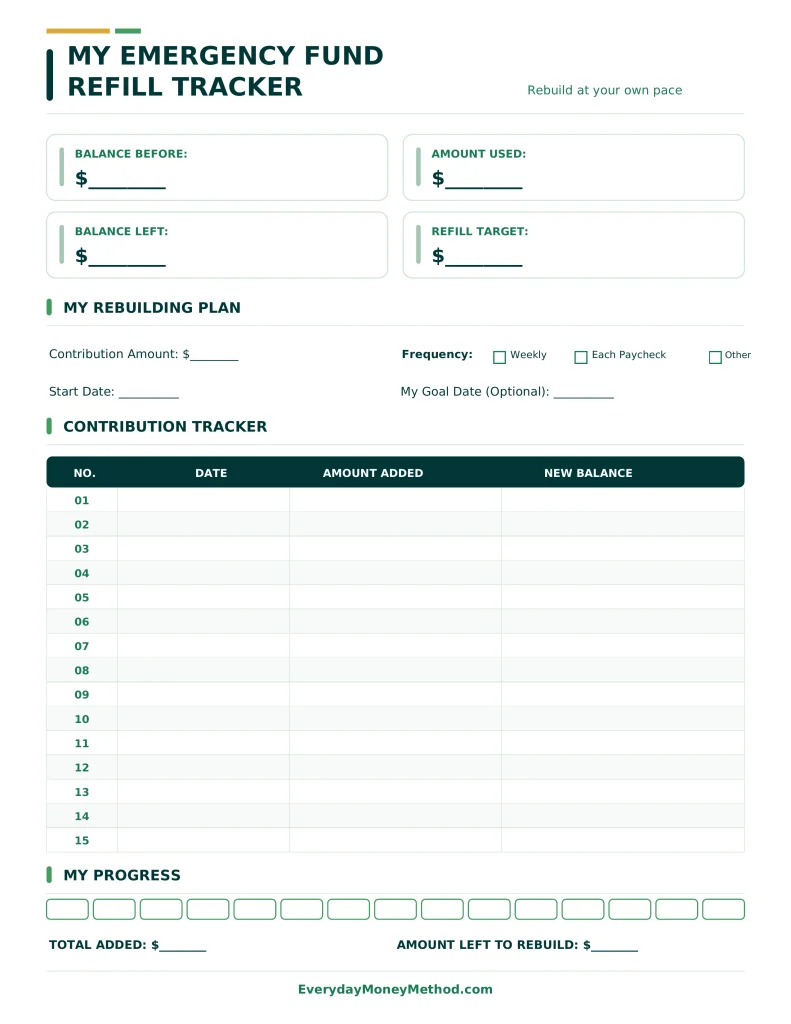
Once the immediate problem has passed, make a simple rebuilding plan. If $25 a week is affordable, replacing that $375 would take 15 weeks, assuming no further withdrawals. If it’s a tight season, rebuild more slowly.
Then return to your original longer-term goal. The CFPB recommends setting guidelines for when the money is used and working to replenish it afterward.
Emergency Fund Mistakes That Make Saving Harder
One mistake is aiming for the full six months before celebrating any progress. A five-figure target can look impossible when you’re starting with $20. Use smaller milestones so you can see the fund doing its job.
Another is counting money that’s already committed elsewhere. If your account shows $1,200 but your rent is due tomorrow, that $1,200 isn’t all emergency savings. Separate balances by purpose.
A third is chasing returns instead of keeping the money available. If your emergency money is invested in assets that can drop in value, you may need to sell at a loss when you can least afford it. A safe, accessible deposit account is often better suited to this particular job.
And finally, forgetting to update the goal. Three months of expenses based on rent from two years ago might not cover three months today. Review the number when you move, change jobs, add dependents, or take on major new obligations.
Frequently Asked Questions About Emergency Funds
Can I start an emergency fund with only $10?
Yes. The first useful step is setting money aside for emergencies, even if it’s $10. Follow it with a contribution schedule you can maintain. The goal is to build an accessible reserve over time, not to meet a minimum starting balance set by a rule.
Should I keep my emergency fund in cash at home?
Keeping a small amount of cash at home can be useful during power outages, banking disruptions, or situations when electronic payments are unavailable.
However, storing your entire emergency fund at home comes with risks, including theft, fire, accidental damage, or loss.
For most U.S. beginners, keeping the majority of emergency savings in a secure, easily accessible bank or credit union account with appropriate deposit insurance is generally more practical. Review the account’s terms and conditions to make sure they align with your financial preferences.
You can keep a small amount of physical cash for immediate needs while maintaining the rest of your emergency fund in a safer location.
Is a credit card an emergency fund?
No. A credit card provides access to borrowed money, not savings you already own.
Although it may allow you to cover an unexpected expense, relying on a credit card can increase your outstanding debt and create additional repayment obligations. Your available credit limit can also change.
An emergency fund gives you access to money you have already saved, allowing you to handle unexpected expenses without depending on additional borrowing.
Building accessible cash savings is a more reliable foundation for emergency preparedness than relying on credit cards.
Can I use the fund for emergency pet care?
Yes, if the care is urgent and necessary for an animal you’re responsible for. If you have regular veterinary costs, try to budget separately for checkups, prescriptions, and other predictable care.
How long does it take to build an emergency fund?
It depends on your savings goal and how much you can consistently set aside. Divide your target amount by your planned contribution to estimate the time needed.
For example, $500 ÷ $25 per week = 20 weeks, assuming you make every contribution and do not withdraw money during that period.
If you increase your weekly savings, you can reach your goal sooner. If you need to reduce contributions or use part of your emergency fund, it may take longer.
The key is to choose a realistic savings amount, contribute regularly, and track your progress toward your goal.
Do I need separate emergency funds for everyone in my household?
Not necessarily. A shared household can use one clearly designated fund if the people involved agree on what it’s for and who can access it. If finances are kept separate, each person may prefer their own reserve. What matters is that essential expenses and access during an actual emergency are covered.
Start With the Next Payday, Not the Perfect Budget
If the refrigerator breaks next month, a $100 emergency fund won’t cover everything. But it will give you $100 more than you otherwise had, and possibly $100 less to borrow.
Building an emergency fund begins with one practical decision: check your next payday, choose an amount that won’t interfere with essential bills, and move it into a separate, accessible savings account. Then repeat when you can.
The larger three-to-six-month target can come later. Right now, your job is to give the next unexpected expense a place to land.
References and further reading
These resources support the general educational topics discussed; individual circumstances and current rules may differ.
Continue learning
monthly budget guide · saving money quickly · paycheck budgeting guide · debt payoff guide

Personal finance writer and content creator at Everyday Money Method.
Editorial Policy · Report a correction