
Editorial voice: Monem · Published 2026-09-28 · Article resources updated November 18, 2026
Key takeaways
- Base your plan on take-home income and actual bills.
- Include irregular expenses and savings before assigning discretionary money.
- Check the dates of deposits and payments, and adjust as you learn.
General educational information, not personalized financial advice. Read our Financial Disclaimer.
You check your bank balance, see a few hundred dollars, and think you’re doing okay. Then you remember the insurance payment coming out tomorrow. Suddenly, that balance means something very different.
A useful budget answers more than “How much money do I have?” It answers “What does this money still need to cover?”
To make a simple monthly budget, list your take-home income, plan for your expenses and savings, and compare the totals. Track what actually happens and adjust the next month’s plan. That’s the basic process recommended by consumer.gov.
Then add one practical check: will the money arrive before the bills are due?
You don’t need to get every estimate right today. Start with a plan you can understand, then make it more accurate as you use it.
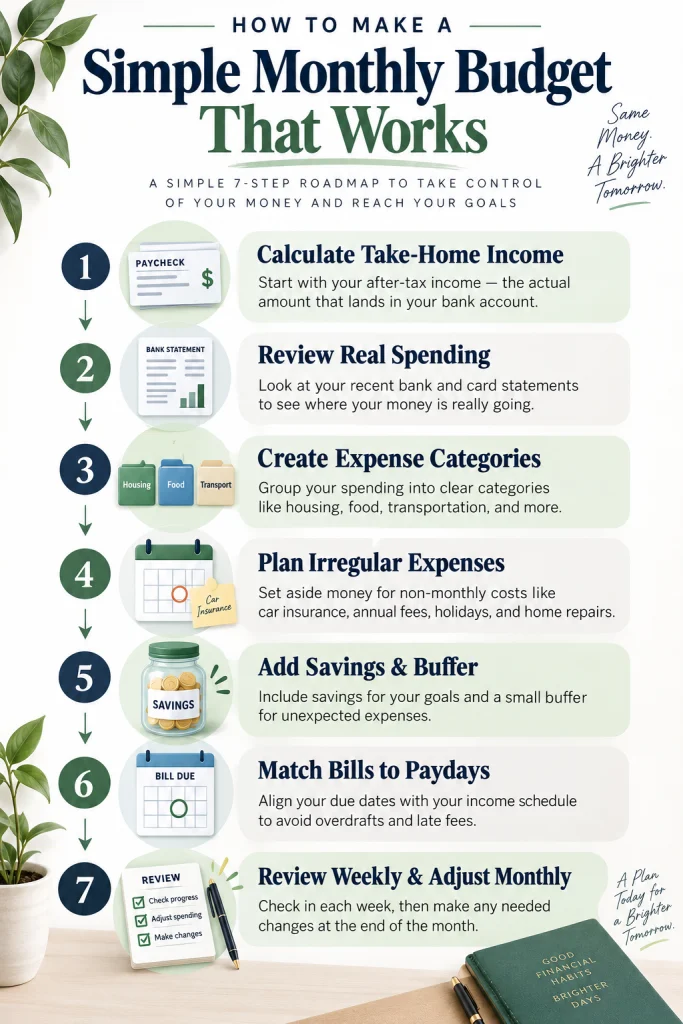
How to Make a Simple Monthly Budget in 7 Steps
Related reading: Explore our paycheck budgeting guide for a complementary approach.
1. Start with the income you’ll actually receive
For a basic household spending plan, use your take-home pay, meaning the amount left after payroll deductions such as taxes, health insurance, and retirement contributions. This is the money deposited into your account, not the larger salary figure on your employment agreement.
Write down each expected deposit and its date. Include other dependable income that is available for the expenses you’re planning. Leave uncertain overtime, bonuses, and unpaid client invoices out of the amount you treat as spendable.
Keep the accounting consistent. If insurance or retirement contributions were already deducted before your paycheck reached your bank, don’t subtract them from that deposit again. You can note those contributions separately to keep the bigger picture visible.
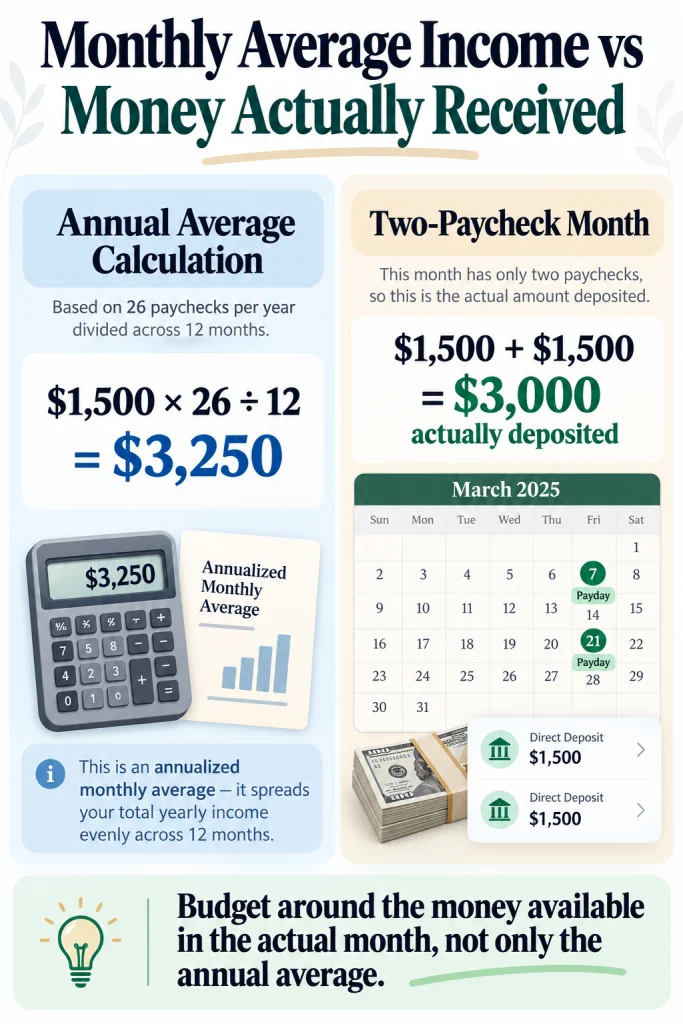
Paid every two weeks? Look at the actual month’s paydays.
For example, suppose you receive $1,500 per paycheck and have 26 paychecks in a particular year. Your monthly average is:
$1,500 × 26 ÷ 12 = $3,250.
But a month with two deposits brings in $3,000, not $3,250. Unless you have money carried forward to cover the difference, the average does not tell you what you can spend that month.
For variable income, a conservative estimate based on the lower end of your recent earnings can be a useful starting point. Fidelity recommends this approach rather than assuming every month will be a strong one. Self-employed readers also need to account for taxes that have not been withheld.
Build your essential spending around that cautious estimate where possible, and decide how to use additional income after it arrives. A lower estimate still won’t solve a gap when essentials exceed what you earn. We’ll address that situation below.
2. Look at your real spending before setting limits
Related reading: Explore our emergency fund guide for a complementary approach.
Start with your recent bank and credit card statements, bills, and records of cash purchases. Check several recent months when possible, then look further back for annual payments and seasonal costs. The point is to include both your regular expenses and costs that don’t appear every month.
Choose a recording method you’ll keep using. A notebook, spreadsheet, or simple budget worksheet is enough. Create a row for each category, with space for the amount planned and the amount actually spent.
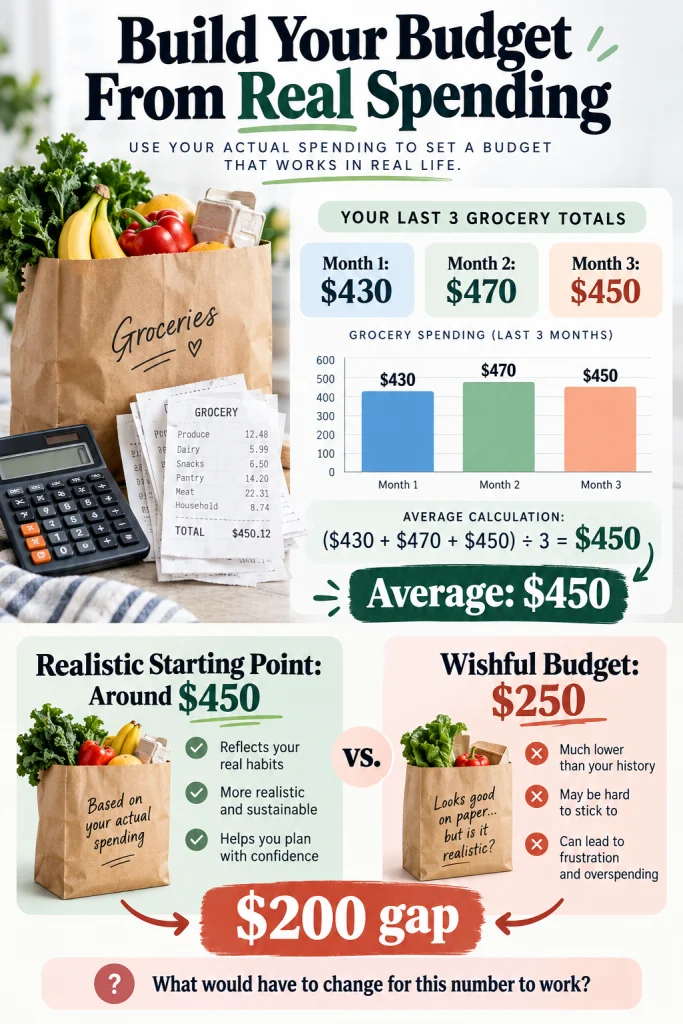
Before choosing your targets, ask: What would have to change for this number to work?
Suppose your last three grocery totals were $430, $470, and $450. Their average is $450. Writing down $250 for next month creates a $200 reduction that needs a real plan. A smaller adjustment may be a more useful first experiment.
Also look for transactions that are easy to misunderstand. In this spending plan, a $60 grocery purchase paid by credit card belongs in groceries. Reserving $60 to pay that purchase doesn’t create a second $60 grocery expense. Keep payments toward older card debt separate from the money reserved for newly recorded purchases.
That distinction lets you track spending without counting the same purchase twice.
3. Give your expenses clear, useful categories
Start with the categories you actually need: housing, utilities, food, transportation, medical costs, insurance, debt payments, and personal spending. Add childcare, pet care, education, or other responsibilities when they apply to you.
Keep two different questions in mind:
Does the amount stay similar? Fixed expenses are generally predictable in amount and frequency. Variable expenses change. A flat-rate subscription can be fixed, while groceries and usage-based electricity bills are variable.
How necessary is the expense? Needs and wants describe priority, not price consistency. Groceries can be a variable need. A streaming subscription can be a fixed want. Your circumstances matter, too: transportation that is optional for one person may be essential for another.
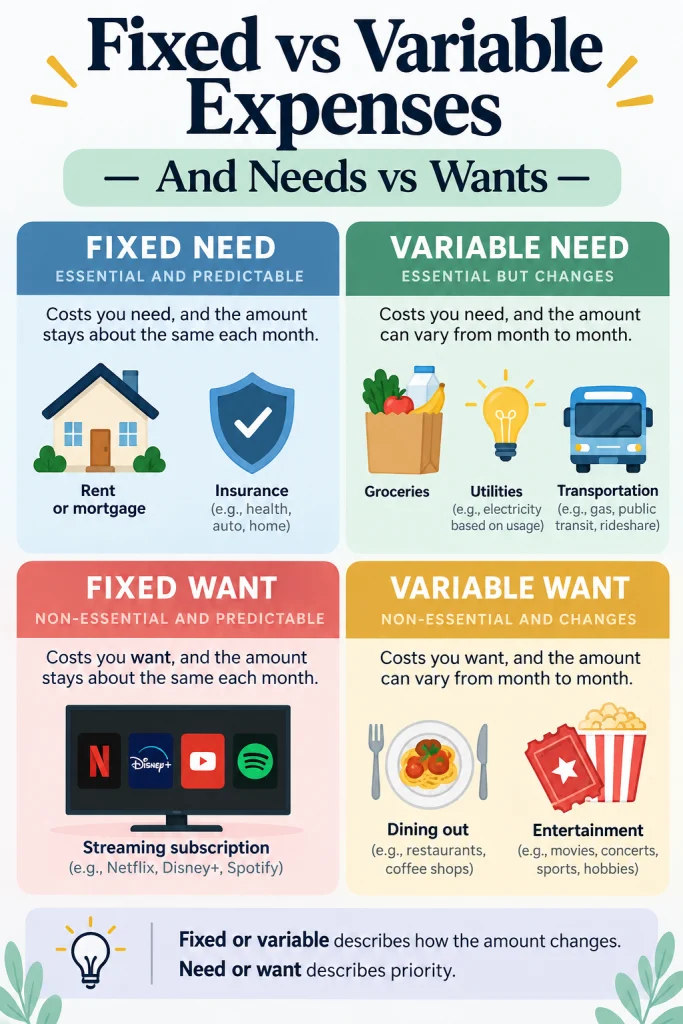
This helps you avoid cutting the wrong things just because one category looks easier to change.
For debt, write down the required payment and due date for each account. Keep extra debt payments on a separate line so you can see what is required and what you’ve chosen to pay above that amount. Include any installment payments already committed.
There’s no prize for having the most categories. Separate a category when the extra detail will help you make a decision. Combine it when the detail only creates work.
4. Plan for bills that don’t happen every month
Related reading: Explore our grocery savings guide for a complementary approach.
Annual insurance, holiday spending, and a planned dental appointment may not appear on this month’s statement. They still need a place in the plan.
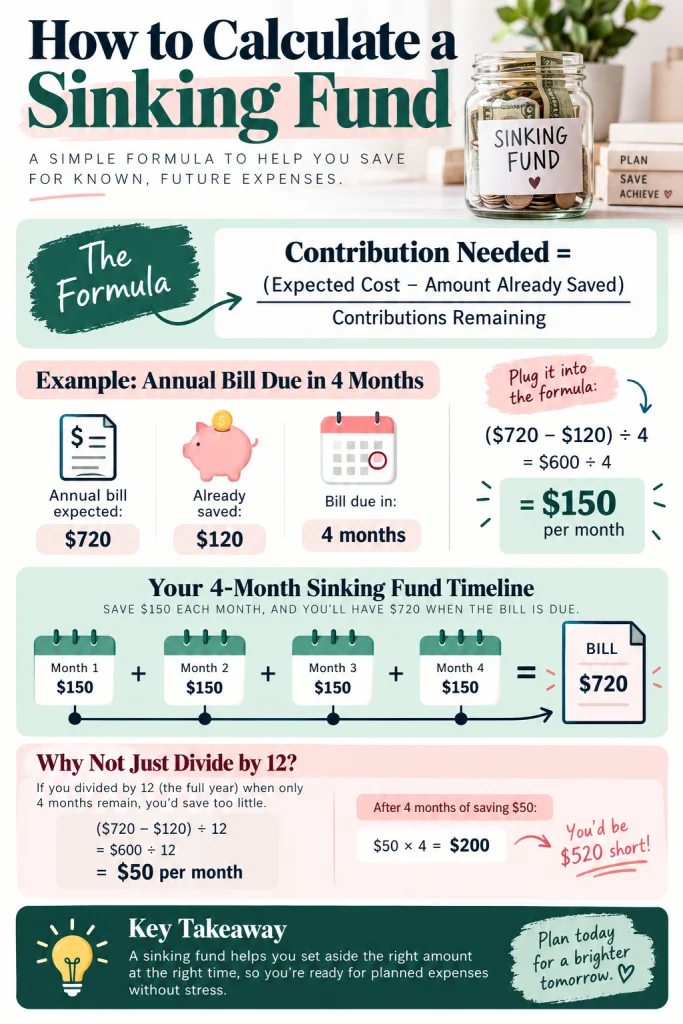
A sinking fund is money you set aside gradually for a known future expense. An emergency fund has a different job: covering unexpected costs or income disruption. MoneyHelper makes this distinction and recommends using the amount needed and the number of paydays remaining to calculate your contributions.
Here is an original example:
Suppose an annual bill is expected to be $720. With a full year to prepare, $60 a month would cover it.
But suppose the bill is due in four months and you already have $120 saved. Your calculation becomes:
($720 − $120) ÷ 4 = $150 per month.
Dividing by 12 at that point would leave you short. Use the saving opportunities that remain before the due date.
For your own plan, use:
Contribution needed = (expected cost − amount already saved) ÷ contributions remaining.
Keep a simple record of each fund’s balance. When the bill is paid, record the expense and the use of that reserved money. Don’t ask the current month’s paycheck to fund the full bill again if previous contributions already cover it.
Start with the next few significant costs you can identify. You can add more detail later.
5. Add savings, a little flexibility, and a balanced total
Now give your savings goals a specific amount instead of treating savings as whatever happens to remain. A monthly budget can include money you save as well as money you spend.
For emergency savings, start with an amount your situation can support. The Consumer Financial Protection Bureau says the appropriate emergency fund size depends on your circumstances, and even a small reserve can help. Keep emergency money somewhere safe and accessible.
For example, saving $50 a month would build a $300 starter reserve in six months, assuming no withdrawals. That is an illustration, not a universal target.
Consider leaving a small checking-account cushion for minor differences between estimated and actual costs. Label it buffer rather than quietly treating it as spending money. Choose the amount based on your available income and the gaps you’re trying to manage.
Room for enjoyable spending can belong in the plan, too. Give it a deliberate limit that fits after your obligations and priorities, rather than pretending it will never happen.
Then compare everything you’ve allocated with your expected income. A positive difference means money remains to assign. A negative difference means the plan needs lower allocations, more available income, or both.
A simple monthly budget example
This hypothetical person expects $3,200 in take-home pay. Payroll deductions have already been taken out, and the insurance line below covers only premiums paid separately.
| Category | Planned amount |
|---|---|
| Housing | $1,100 |
| Utilities, phone, and internet | $220 |
| Groceries | $400 |
| Transportation | $250 |
| Insurance paid outside payroll | $120 |
| Medical and personal essentials | $100 |
| Minimum debt payments | $180 |
| Dining out and entertainment | $200 |
| Subscriptions | $30 |
| Sinking funds for upcoming costs | $180 |
| Emergency savings | $150 |
| Additional debt payment | $100 |
| Checking-account buffer | $170 |
| Total assigned | $3,200 |
| Income left unassigned | $0 |
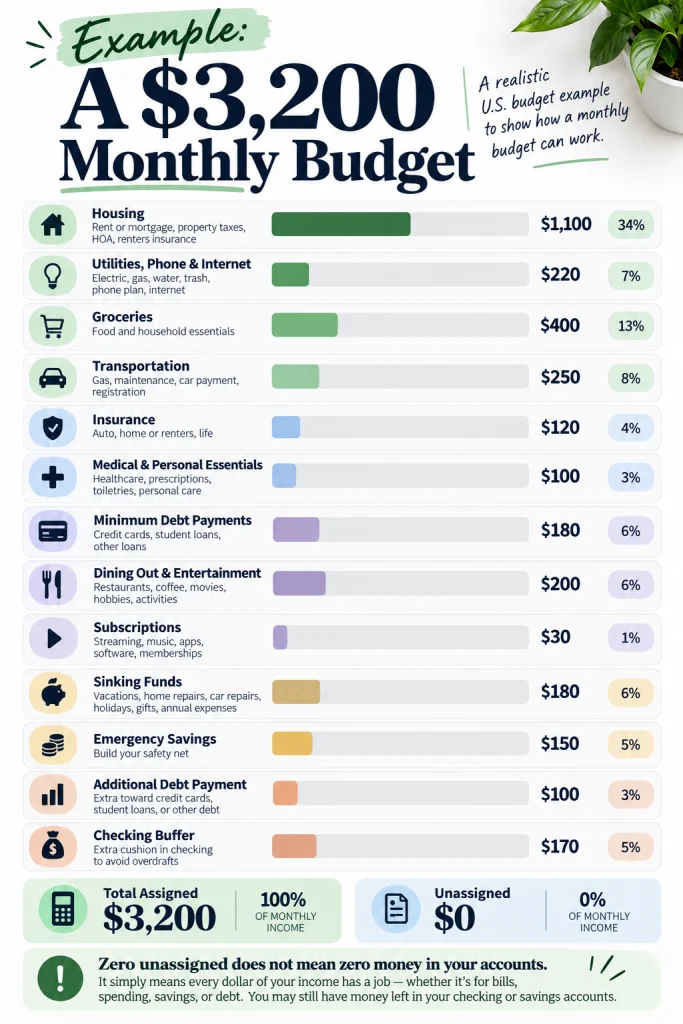
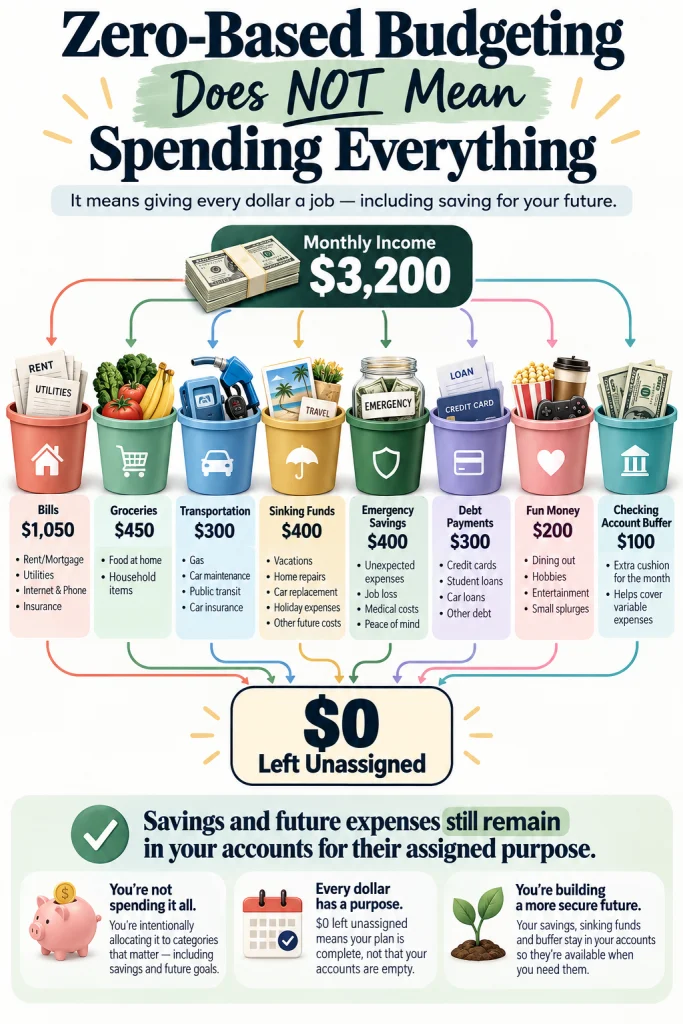
The $180 sinking-fund contribution, $150 emergency contribution, and $170 buffer remain available for their assigned purposes unless used. They are not instructions to spend those amounts during the month.
That is the important distinction behind zero-based budgeting: zero dollars left unassigned does not mean zero dollars left in your accounts. Savings and future expenses receive allocations too.
This example isn’t a budget you should copy dollar for dollar. Replace its categories and amounts with your own. The buffer contribution may also change once you’ve built the cushion you need.
6. Match your bills to your paydays
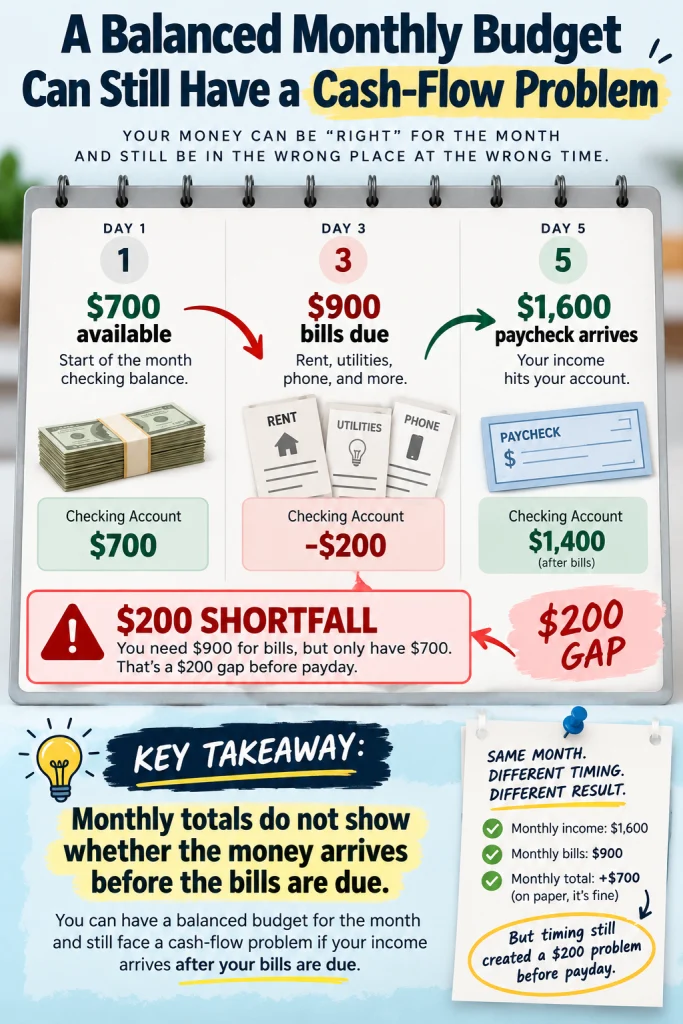
A monthly total doesn’t show whether money arrives in time. A bill calendar adds the missing dates: when income comes in, when payments go out, and what must be covered between paydays.
For a separate hypothetical example, imagine you have $700 available on the first day of the month. Bills totaling $900 are due on the third, but your $1,600 paycheck arrives on the fifth.
You’re short $200 before payday. The later deposit doesn’t remove that earlier shortfall.
Walk through your month in date order. Start with money already available, subtract upcoming payments and everyday spending, then add income only on the date you expect it to become available. Money carried forward from last month is an opening balance, not another paycheck.
Where timing is the problem, possible adjustments include reserving part of a previous paycheck or asking a bill provider whether an approved due-date change is available. Don’t assume that you can simply delay a payment without consequences.
Before you move money into savings or make an extra debt payment, check what still needs to be paid before your next deposit. Automatic transfers can support regular saving, but the CFPB cautions that you still need to monitor balances to avoid overdraft fees.
7. Check the plan weekly and improve it monthly
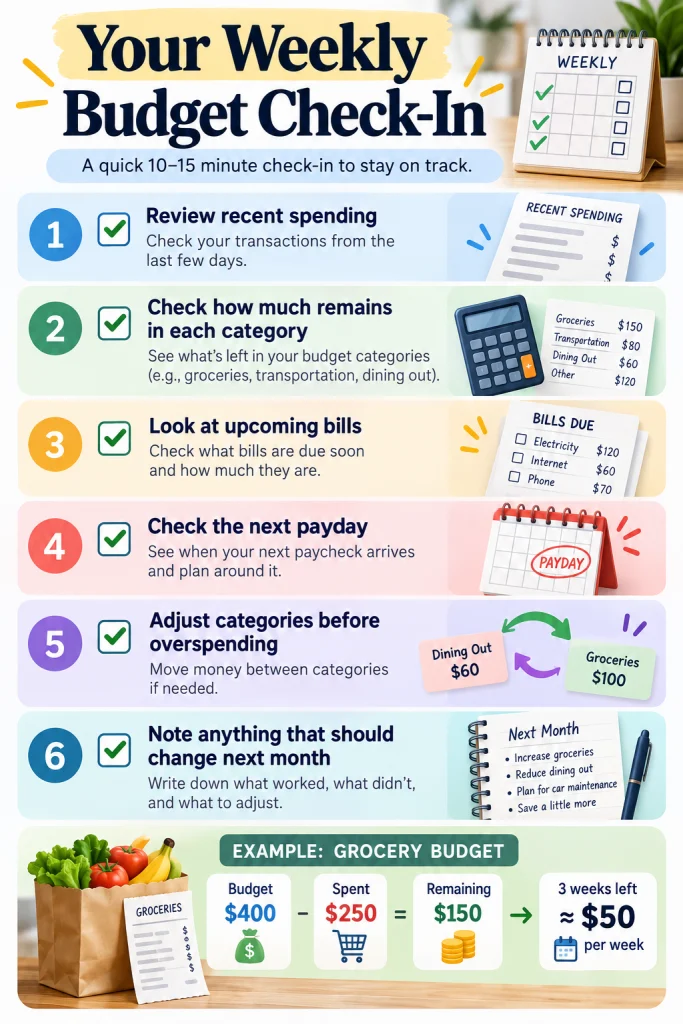
Try a brief weekly check-in rather than waiting until the month ends. The CFPB’s bill-calendar guidance recommends checking upcoming bills weekly.
During that check, compare your recent spending with the amount remaining in each category. Look ahead to the next payday and bill dates, not just backward at what you’ve already spent.
Suppose your grocery budget is $400, you’ve spent $250, and you have three weeks left. The remaining $150 gives you an average of $50 per week. If that won’t realistically cover your needs, decide where an adjustment will come from now.
At the end of the month, compare planned and actual amounts. Look for differences that will probably repeat, not just one unusual purchase. The Financial Consumer Agency of Canada recommends revising your figures when actual spending regularly differs from your plan.
For example, if groceries are $40 over and entertainment is $40 under, you could move that unused allocation. If groceries are over every month, revise the grocery estimate and make a corresponding change elsewhere.
Do not erase an actual expense to make the budget look balanced. Change the plan you use next.
Do You Need to Follow the 50/30/20 Rule?
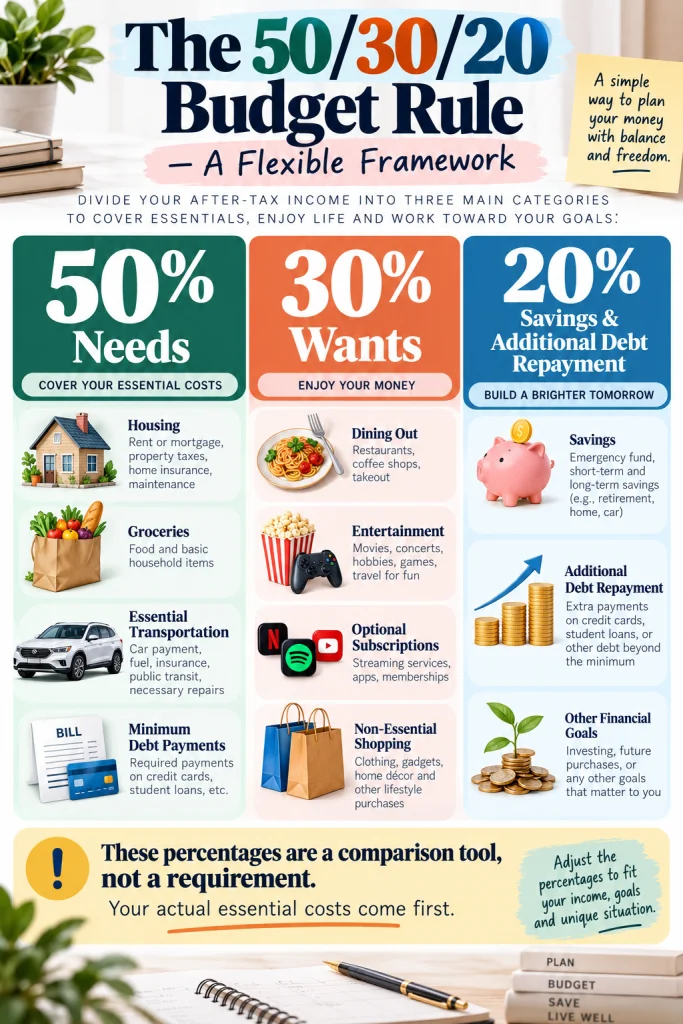
No. You can use the category-based plan above without fitting your life into a percentage formula.
The 50/30/20 rule is one optional framework: roughly 50% of after-tax income for needs, 30% for wants, and 20% for savings and additional debt repayment. Under the UN Federal Credit Union’s explanation, minimum debt payments belong with needs; amounts paid above the minimum belong with financial goals.
Be careful about what “income” means in a calculator. Some versions add payroll retirement contributions and health insurance deductions back to take-home pay so those amounts can be assigned to the appropriate categories. That is different from the bank-deposit spending plan used in this article. Don’t mix the two approaches halfway through your calculation.
The percentages are adjustable. ANZ’s guide explicitly notes that some households currently have no room for saving or discretionary spending. Your actual essential costs matter more than whether your budget matches a preset ratio.
Use the rule as a comparison when useful, not as a reason to invent lower rent, grocery, or medical costs on paper.
What If Your Income Doesn’t Cover the Basics?
First, identify what kind of problem you have. An overlooked annual bill, a payday mismatch, and a recurring income shortfall need different responses.
Suppose essential costs and required payments total $2,650, but income is $2,400. That’s a $250 gap before entertainment or optional savings. Removing a $15 subscription would reduce the gap, not eliminate it.
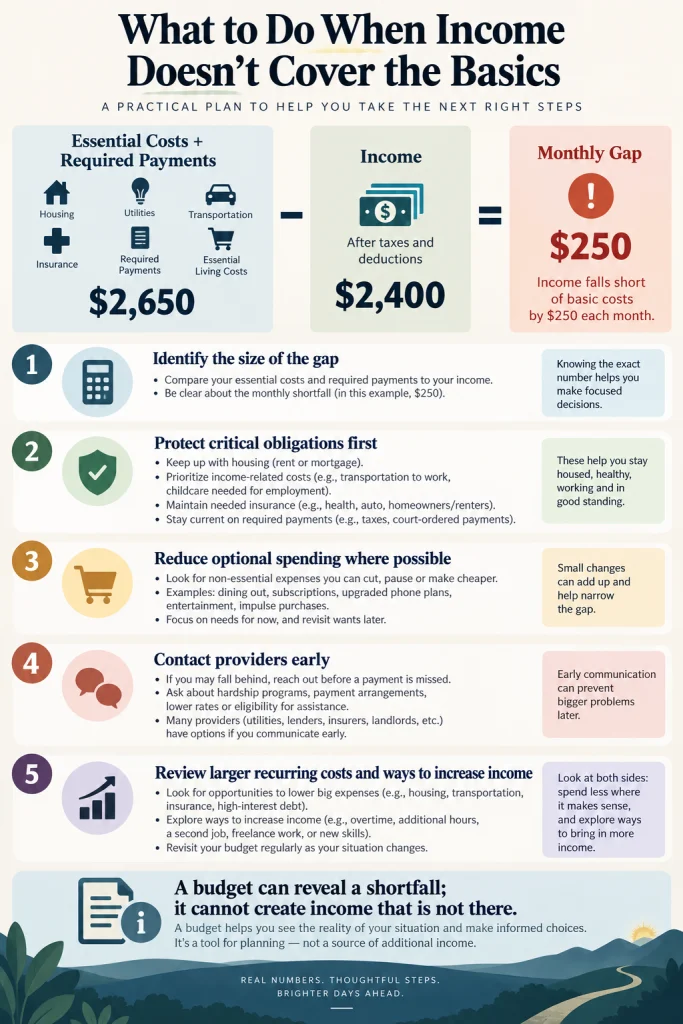
When you cannot pay everything, consider the consequences of each unpaid bill. CFPB guidance emphasizes protecting housing and income, keeping needed insurance, and addressing court-ordered obligations. It also recommends contacting the people or companies you owe rather than ignoring bills you cannot pay.
Make a short-term plan around your essential needs and the most consequential obligations. Contact providers early about hardship options or payment arrangements, and confirm what any agreement changes. A qualified credit or housing counselor may help with a plan when the situation is difficult to manage alone.
Don’t force an extra savings transfer or accelerated debt payment into a month that cannot support it. Longer-term changes may require looking at larger recurring costs, available assistance, or ways to increase income, not just small purchases.
A budget can make the shortfall visible. It cannot turn insufficient income into sufficient income by itself.
Start with the Next Month You Need to Manage
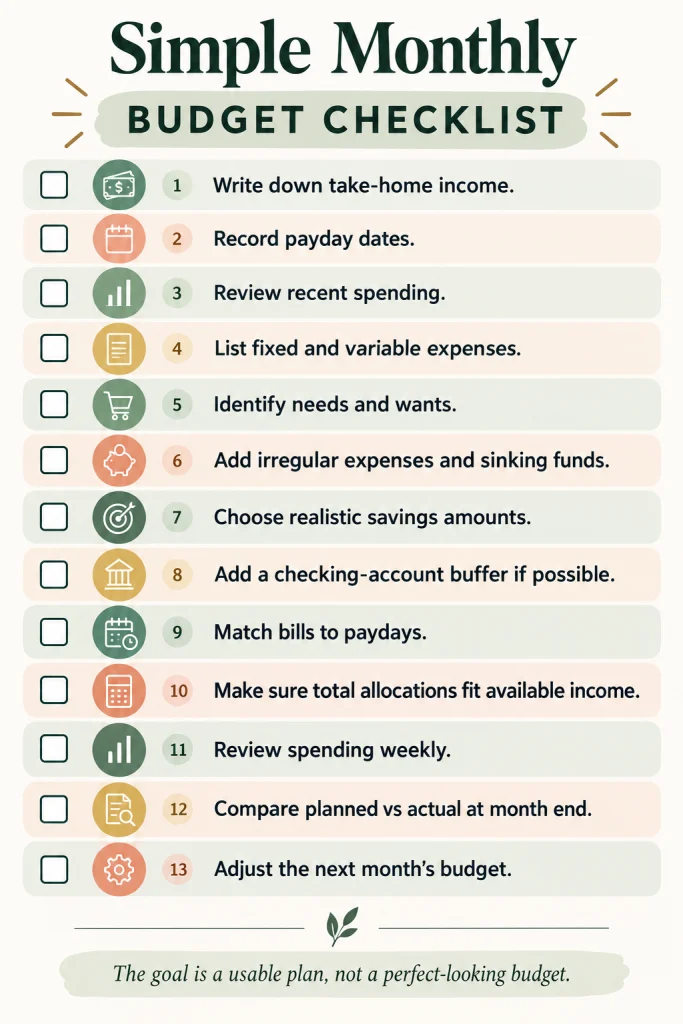
Open your latest statement and write down your next payday. Then list the bills and everyday costs that money must cover.
Build from there: include the upcoming irregular costs, choose realistic savings amounts where possible, and check the payment dates. After a week, come back to see what needs adjusting.
The goal of a simple monthly budget that works is a usable plan, not a perfect-looking page. You should be able to see what is covered, what still needs money, and which decision comes next.
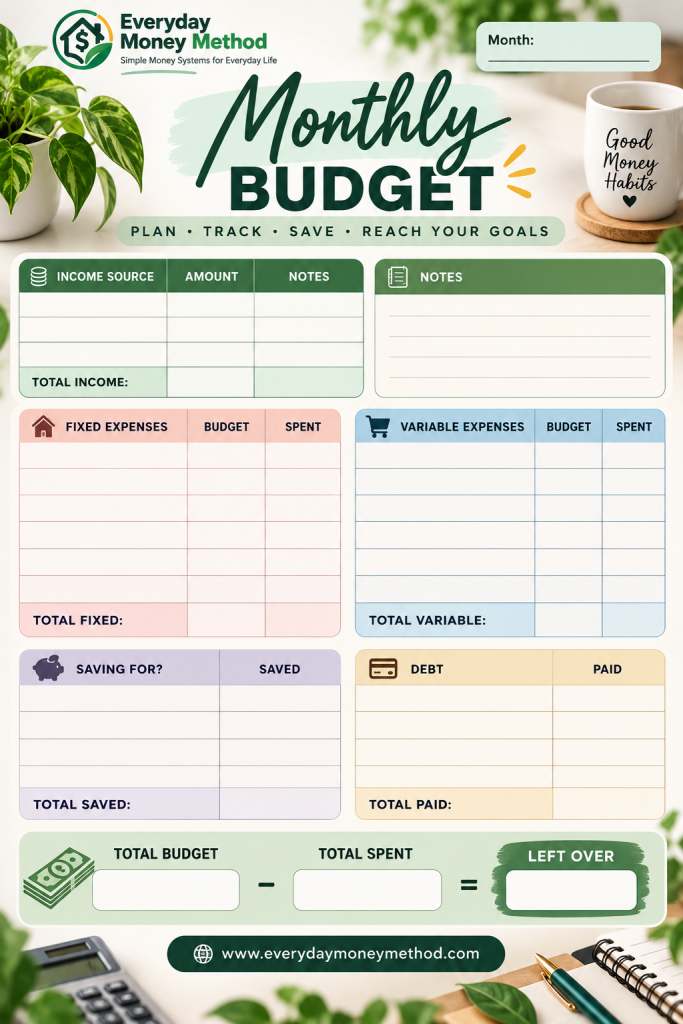
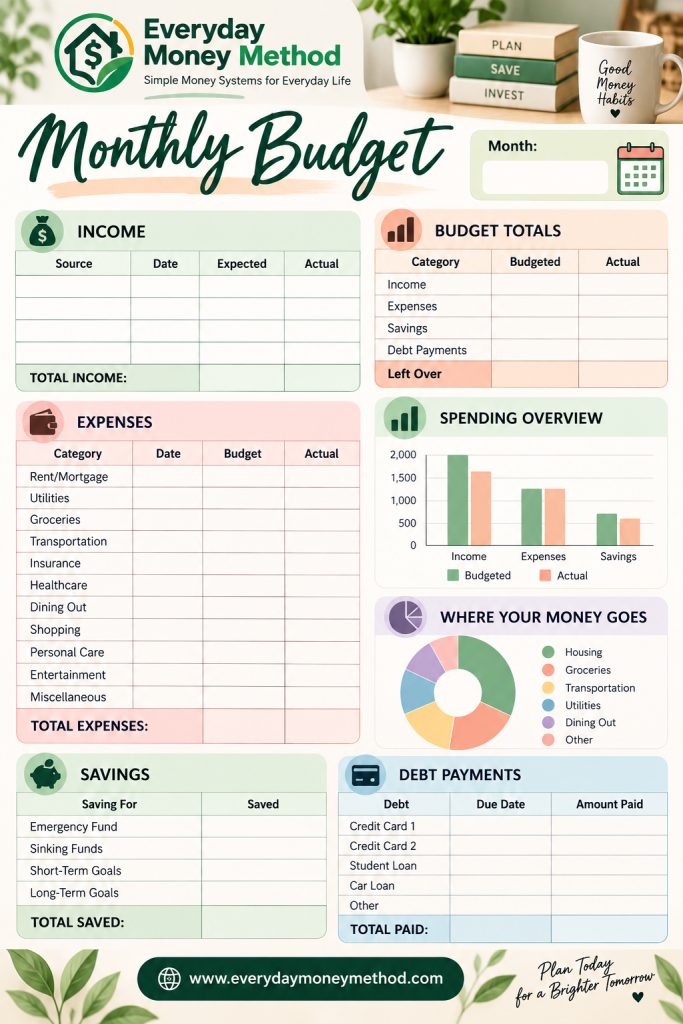
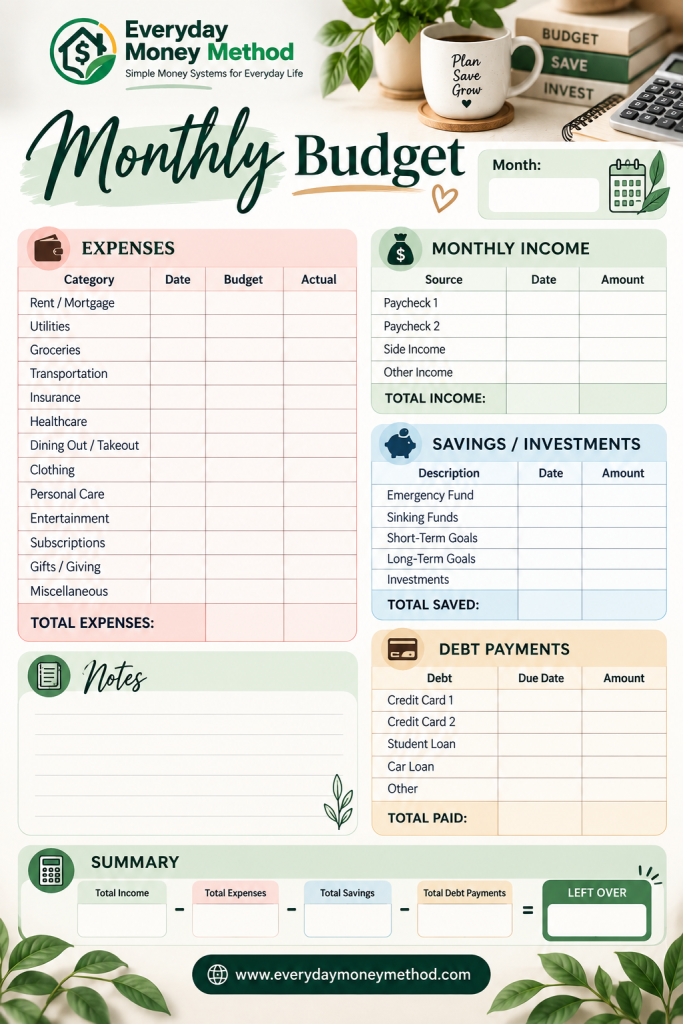
Free Monthly Budget Worksheet
Use this worksheet to plan your income, expenses, savings, and debt payments for the month. Save or print the image and use it alongside the steps in this guide.
References and further reading
These resources support the general educational topics discussed; individual circumstances and current rules may differ.
Continue learning
paycheck budgeting guide · emergency fund guide · grocery savings guide · debt payoff guide

Personal finance writer and content creator at Everyday Money Method.
Editorial Policy · Report a correction