
Editorial voice: Monem · Published 2026-10-29 · Article resources updated November 18, 2026
Key takeaways
- Choose work based on available time, skills, costs and local demand.
- Measure net earnings after expenses rather than gross revenue.
- Check tax obligations and avoid offers that require payment to get paid.
General educational information, not personalized financial advice. Read our Financial Disclaimer.
The laundry is done, tomorrow’s lunch is packed, and you finally have two free hours. You could scroll through another list promising $500 a day from your phone. Or you could use those two hours to do something a real person is willing to pay for.
That’s the difference between an interesting side hustle idea and a useful one.
Some of the best side hustles in 2026 are surprisingly ordinary: selling things you no longer use, cleaning homes, walking dogs, doing small jobs for neighbors, tutoring, or helping a business with work it doesn’t have time to finish. Freelance and digital work can fit around a busy schedule, too. The right choice depends less on a headline earning estimate and more on what you can actually do, when you can do it, and what remains after expenses.
To keep expectations grounded, Bankrate’s 2025 survey found that 27% of U.S. adults had a side hustle. The median side-hustle income was $200 per month, compared with an average of $885. The higher average reflects the influence of bigger earners; it is not what a typical beginner should expect.
Below are practical options for different schedules, with the less glamorous details included.

How to Choose a Side Hustle That Fits Your Actual Life
Related reading: Explore our side hustles for women for a complementary approach.
Before signing up for anything, answer three questions: Do you need money this month or are you building something for later? How many hours can you repeat each week? What would you have to spend to get started?
| If you have… | Start by considering… | Main thing to watch |
|---|---|---|
| A few things to sell and almost no free cash | Selling unused belongings | This produces one-time income, not a steady paycheck |
| Two or three predictable evening hours | Tutoring, freelance editing, virtual assistance | Time spent finding clients and preparing work |
| Free weekends and willingness to work locally | Cleaning, yard work, pet care, furniture assembly | Travel, supplies, insurance, and physical effort |
| A vehicle and an unpredictable schedule | Grocery, food, or package delivery | Mileage, idle time, repairs, and insurance |
| A laptop but no fixed hours | Website testing, research studies, simple freelance projects | Work may be sporadic and screening is often unpaid |
| Patience to create something before it sells | Digital downloads, books, content | Slow or nonexistent initial sales |
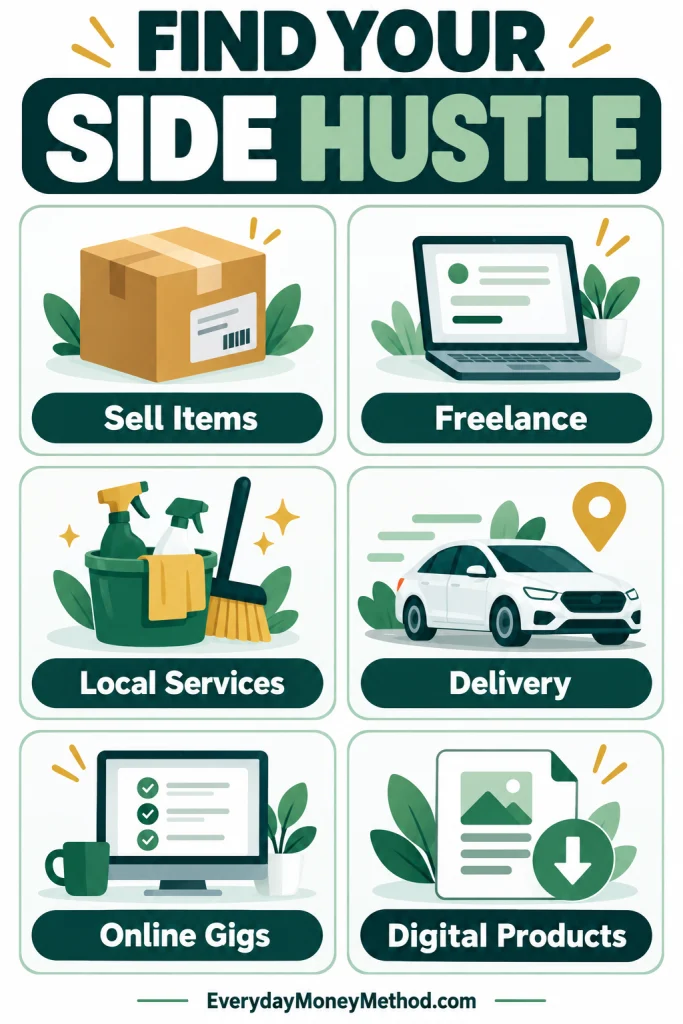
Here’s a useful rule: If the goal is extra cash for next month’s bills, favor a service someone already needs over a business that requires you to build an audience first.
Best Side Hustles for Beginners Who Want to Earn Sooner
1. Sell Things You Already Own
Related reading: Explore our monthly budget guide for a complementary approach.
A jacket that doesn’t fit, a phone you upgraded, an unused kitchen appliance: those may be better starting points than buying a course about making money.
Take clear photos in daylight, describe wear honestly, and compare sold prices for similar items instead of assuming every asking price reflects what buyers pay. You can try local marketplaces for bulky things or eBay and Poshmark for items that are practical to ship. Fees matter: eBay’s final value fee varies by category, and Poshmark generally takes $2.95 on sales under $15 or 20% on sales of $15 or more.
Try this: List five things this weekend. Record the amount you actually receive after platform fees, packaging, and shipping. Treat it as a cash boost, not recurring earnings.
2. Resell Used Items, but Learn One Category First
Reselling becomes a business when you deliberately buy something for less than you can sell it for. That’s also when you can lose money on items nobody wants.
Start in a category you understand, perhaps used tools, sports equipment, books, or particular clothing brands. Check actual sold listings, item condition, shipping weight, and likely fees before spending money.
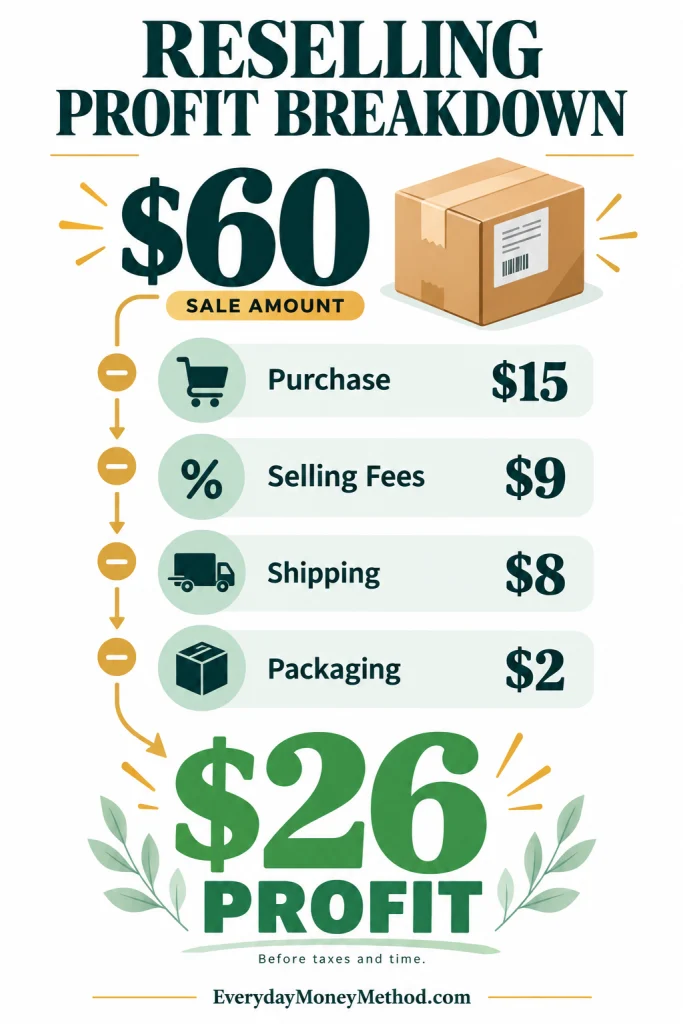
Hypothetical example: You buy a used item for $15 and sell it for $60. If selling fees cost $9, shipping costs $8, and packaging costs $2, your profit before taxes and the value of your time is $26, not $60.
One May 2026 Reddit poster reported making about $350 in profit reselling small room-decor products, while earning only about $40 over three weeks using microtask apps. Those figures are the poster’s own account, not verified earnings or a result anyone can expect. Their experience illustrates both the potential of finding actual buyers and the risk of putting money into inventory first.
3. Offer Yard Work and Seasonal Outdoor Help
Related reading: Explore our saving money quickly for a complementary approach.
People need weeds pulled, leaves bagged, garden beds tidied, lawns mowed, and outdoor furniture moved. You don’t need to turn all of those into one enormous landscaping business.
A 2025 Reddit user described making $500 in a week from light weeding and yard work after leaving 30 handwritten cards with specific prices for visible work. They reported three callbacks. That’s an anecdote, not a tested customer-conversion rate, but the useful detail is how specific the offer was: a defined task, a local customer, and a clear price.
Start with work you can do safely with equipment you already own. Give written estimates and confirm who supplies tools or handles green-waste disposal. Check local rules, licensing, insurance, and whether the task involves hazardous equipment or chemicals.
4. Clean Homes or Small Offices
Cleaning is less flashy than launching an online store, but a satisfied customer may want help again next week or next month. That possibility of repeat bookings makes it worth considering.
A simple starting offer could be a standard kitchen, bathroom, and floor clean for a home in your area. Estimate the actual time, include travel and materials in your price, and agree on what is not included, such as deep oven cleaning or heavy lifting.
Hypothetical example: Two clients book $90 cleanings every other week. Four jobs generate $360 in a four-week period before supplies, travel, insurance, and taxes. The goal is not to promise $360. It is to see whether the price makes sense for the hours involved.
If you’re entering a client’s home, reliability, references, clear communication, and appropriate insurance can matter as much as a polished flyer.
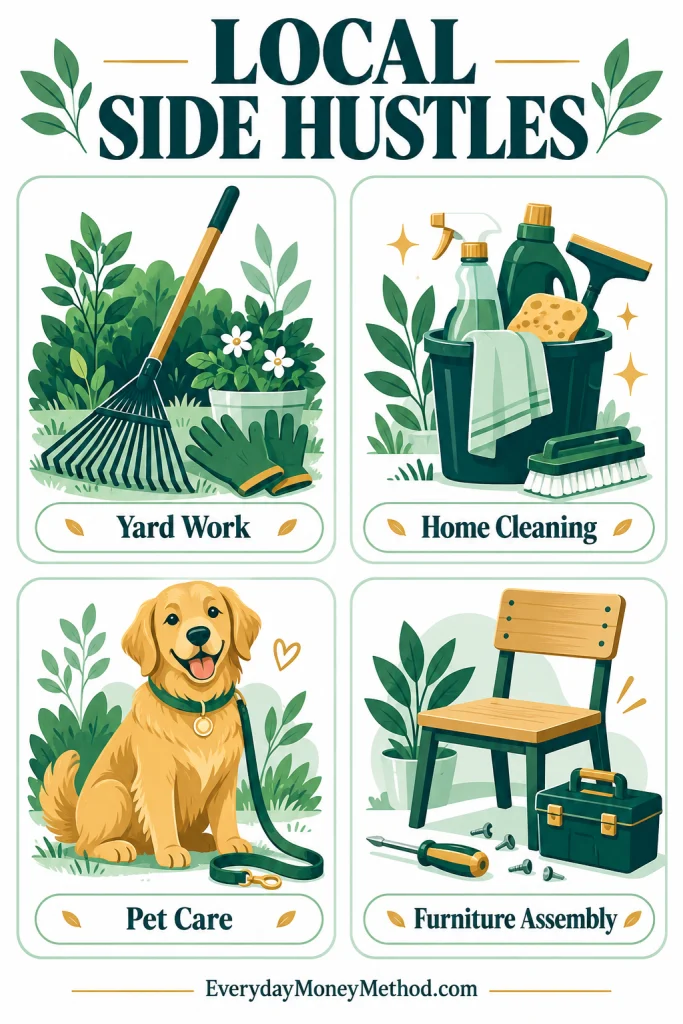
5. Walk Dogs or Offer Pet Sitting
If you already have experience caring for animals, dog walking and pet sitting may fit around classes, remote work, or some weekends. Rover can help connect sitters with owners, but you can also start with trusted personal referrals.
Rover’s general service-fee page says pet-care providers receive 80% of booking earnings after a 20% service fee. It also identifies exceptions, including different rules in California and some U.S. pilot arrangements, so check the terms shown in your own account.
Hypothetical example: Two $40 bookings would be $80 gross, or $64 after a 20% platform fee, before travel, supplies, and taxes. Meet owners and pets beforehand, clarify emergency instructions, and only accept animals you can safely handle.
6. Babysit or Provide Nonmedical Family Support
Parents sometimes need a date-night sitter, school pickup help, or a few hours of supervised care. Other households need help with errands, shopping, or companionship for an older adult.
The biggest asset here isn’t an app. It’s trust. Relevant experience, references, first-aid training, background checks, and a reliable schedule matter. Care.com says individual caregivers on its platform must complete its background-check process to interact with families, although that check has limitations and is not a guarantee of safety.
Be clear about which work you are qualified to do. Nonmedical companionship is not the same thing as providing medical or personal-care services that require training or licensing.
7. Assemble Furniture or Handle Small Household Tasks
Not everyone wants to assemble a dresser, hang curtains, organize a garage, or move boxes. For someone comfortable with tools, these can be sensible weekend jobs.
Taskrabbit is one place to find local work. Its current U.S. support page lists a $25 one-time, nonrefundable registration fee if registration is successfully processed and warns that paying it does not guarantee acceptance.
Choose tasks within your skills and legal scope. Don’t market electrical, gas, structural, or specialized repair work as a beginner project. A focused offer such as furniture assembly may be safer and easier for customers to understand than “I can fix anything.”
8. Deliver Food During Times You’re Actually Free
Food delivery can fit an irregular schedule because you can choose when to work. But the amount shown in an app is not the amount you get to keep.
DoorDash describes its pay as base pay plus tips and applicable promotions. Its “Earn by Time” option pays for active delivery time, not necessarily every minute you’re logged into the app.
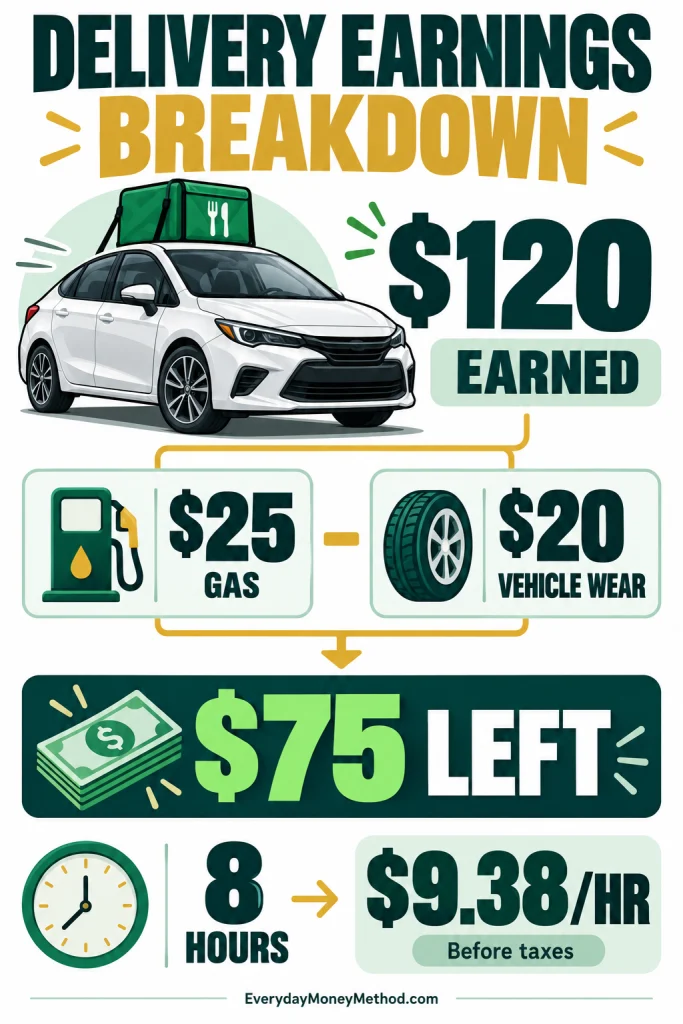
Hypothetical weekly check: Suppose an app shows $120 earned. You spend $25 on gas and set aside $20 toward vehicle wear and future maintenance. That leaves $75 before taxes and any other costs. If you were out for eight hours, that is about $9.38 per hour before taxes, not $15. Your actual vehicle costs will vary.
Track total time online, all business miles, parking, tolls, and expenses for a full week. DoorDash itself says earnings depend on the local market and when you work, so a good shift in one neighborhood is not a national pay benchmark.
9. Shop and Deliver Groceries
Grocery delivery adds shopping, substitutions, and communication to driving. It’s a fit if you know your local stores and can work efficiently without rushing or mishandling someone’s order.
Instacart says shopper pay includes batch pay, applicable promotions, and tips. The batch-pay calculation considers factors such as travel, number and weight of items, and expected shopping time. It states shoppers receive 100% of customer tips.
Don’t accept a large order simply because its payout looks attractive. Estimate shopping time, driving distance, parking, and whether you will need to carry heavy bags upstairs.
10. Deliver Packages with Amazon Flex
Amazon Flex offers prearranged delivery blocks rather than the same flow of restaurant orders. You see information about the block and its expected earnings before accepting.
Amazon’s published Flex FAQ says many delivery partners earn $18 to $25 an hour, but explicitly says availability and earnings depend on location and other factors. It also says delivery blocks aren’t guaranteed from week to week. This is the company’s stated figure, not an independently verified net hourly wage after fuel, wear, taxes, or time between available blocks.
If you already own a suitable vehicle, compare one actual week of Flex opportunities with other local work instead of buying a vehicle to pursue uncertain blocks.
Best Online Side Hustles You Can Do from Home
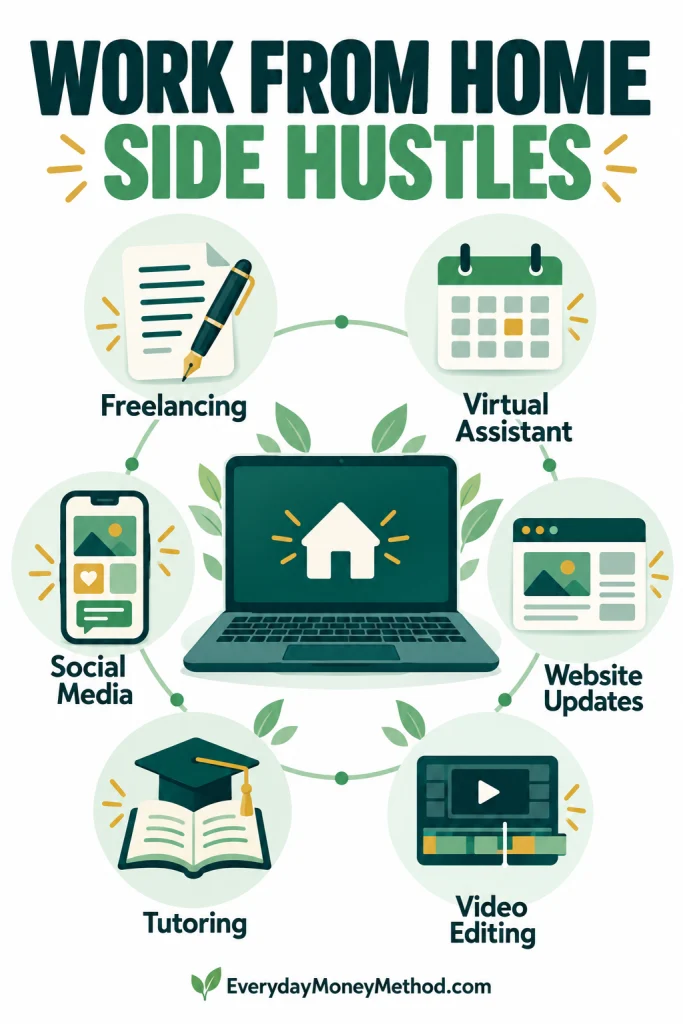
11. Freelance One Skill You Already Use
Writing, proofreading, spreadsheet cleanup, design, transcription, and presentation formatting are all services a client can purchase without hiring someone full time.
The first move is to make the offer smaller. “I do freelance writing” is vague. “I’ll edit three product descriptions so they sound clear and consistent” is something a store owner can decide whether to buy.
Create two or three honest work samples. If you don’t have client projects, label your samples as practice work. You can contact businesses directly or try a marketplace. Upwork’s freelancer fee varies by contract, while Fiverr says freelancers earn 80% of completed orders, including extras and tips.
Hypothetical example: Four $75 editing assignments would generate $300 before platform fees, taxes, and the time spent winning those clients. Don’t count unbooked jobs as income.
12. Become a Virtual Assistant for a Specific Task
A virtual assistant might organize an inbox, enter information into a spreadsheet, prepare meeting notes, schedule appointments, or follow up on customer requests.
Upwork’s 2026 guidance recommends defining a clear service, building samples, and customizing proposals instead of relying on a vague generalist profile.
Choose work you can repeat well. An example offer might be “two hours every Friday to format invoices and update a client tracker.” It is easier to price, deliver, and explain than a promise to handle an entire business for a few dollars.
13. Manage a Small Business’s Social Media Content
A local bakery may take good photos but never post them. A salon might have events that need simple graphics. You could organize a monthly content calendar, write captions, format images, and schedule approved posts.
One Reddit user in 2026 described managing content for a cafe for a flat $200 a month, while finding low-performing posts stressful. That is one unverified person’s account, but it highlights an important issue: agree on deliverables and expectations rather than promising views, followers, or sales you cannot control.
Start with an offer like eight scheduled posts per month using client-supplied photos. Set a revision limit and get approval before publishing.
14. Help Businesses With Simple Website Updates
A restaurant has an outdated menu. A contractor needs to update photos. A local store wants product descriptions added to its website. These are often smaller jobs than a complete redesign.
If you know WordPress, Shopify, or another platform, offer a narrowly defined maintenance service such as uploading products, fixing formatting, or updating business hours. Use staging and backups when appropriate, and never request access beyond what the job requires.
This works particularly well when you can show a real before-and-after example. Remember that a two-hour task may also involve estimates, communication, revisions, and invoicing.
15. Tutor a Subject You Know Well
You don’t have to be able to teach every subject. If you understand algebra, conversational English, test preparation, or a specific software tool, start with one learner need.
Wyzant’s published fee policy says tutors typically retain 75% of their listed hourly rate for platform-arranged lessons, before taxes. For a hypothetical $40 lesson, that would be $30 after the 25% platform fee, before lesson preparation and other expenses.
Offer a clear lesson goal, such as explaining fractions to a middle-school student or preparing for a particular exam topic. First confirm whether you need credentials, screening, or local permits for the age group and service.
16. Offer Basic Bookkeeping or Administrative Support
Businesses often need receipts organized, invoices tracked, expense categories reviewed, and documents prepared for their bookkeeper or accountant.
If you’re detail-oriented and already know spreadsheets or accounting software, this can be a recurring service. But don’t advertise tax preparation or professional accounting advice unless you have the necessary qualifications. Protect client data, use secure systems, and be clear about what you’re responsible for.
A simple package could be a weekly review of receipts and invoice statuses. Confirm the process with the client before handling financial records.
17. Create Short Videos for Local Businesses
Businesses sometimes need short videos showing a product, a work process, or their space. You don’t need to be famous on social media to provide a video production service.
Make two or three original samples with products or places you have permission to film. Offer a specific deliverable: one edited 20-second vertical video with captions and one round of revisions. Discuss usage rights, music licensing, consent, and who owns the finished footage.
Avoid paying for a large camera kit before someone has agreed to pay for your work. A phone you already own may be enough for a first sample.
18. Evaluate or Label Data for AI Projects
Some companies hire contractors to review model responses, label images, assess search results, or work on specialized coding and writing tasks. Projects can require assessments and may have gaps between assignments.
This is one reason to treat AI-related contracting as a possible project source, not an automatic paycheck. You still need to evaluate the offered rate, task time, payment terms, and your own expertise. Never pay a recruiter to unlock AI tasks.
Small Online Gigs for Irregular Spare Time
19. Join Paid Research Studies on Prolific
Prolific hosts studies for researchers who need participants with particular characteristics. It can be useful for shorter gaps in your schedule, but it isn’t a dependable substitute for a part-time job.
Its participant guidance states researchers must offer at least $8 per hour, with $12 per hour recommended. That’s a minimum rate for qualifying study time, not a guarantee that studies will be available for an hour whenever you log in.
Complete your profile accurately. Don’t misrepresent demographics or rush through questions just to receive a payment.
20. Test Websites and Apps
Website testing usually involves trying an interface and explaining what you see, where you get confused, and how you would complete a task. Clear spoken feedback may matter more than technical expertise.
UserTesting says payment varies by test type, duration, and customer demand, and that the payout is shown before you take a test.
A Reddit contributor posting in July 2026 said their user-testing and microtask income had fallen substantially compared with earlier years, even though one testing platform still worked reasonably well for them. Their unusually high earlier results should not be used as an income estimate for a beginner. Their main lesson is that availability changes.
21. Apply for Paid Research Interviews
If you work in a specific industry or regularly use a product, you may qualify for a research interview or focus group. The compensation can look attractive, but selection isn’t guaranteed.
Respondent’s help center gives illustrative payouts of roughly $40 to $150 for a 30- to 90-minute remote interview and lower amounts for short unmoderated tasks. It says screening is unpaid and participants should not treat the service as dependable daily income.
Apply to studies that genuinely fit your experience. Keep the time spent completing unsuccessful screeners in mind when assessing your actual hourly return.
Side Hustles That Can Grow but Usually Take Longer
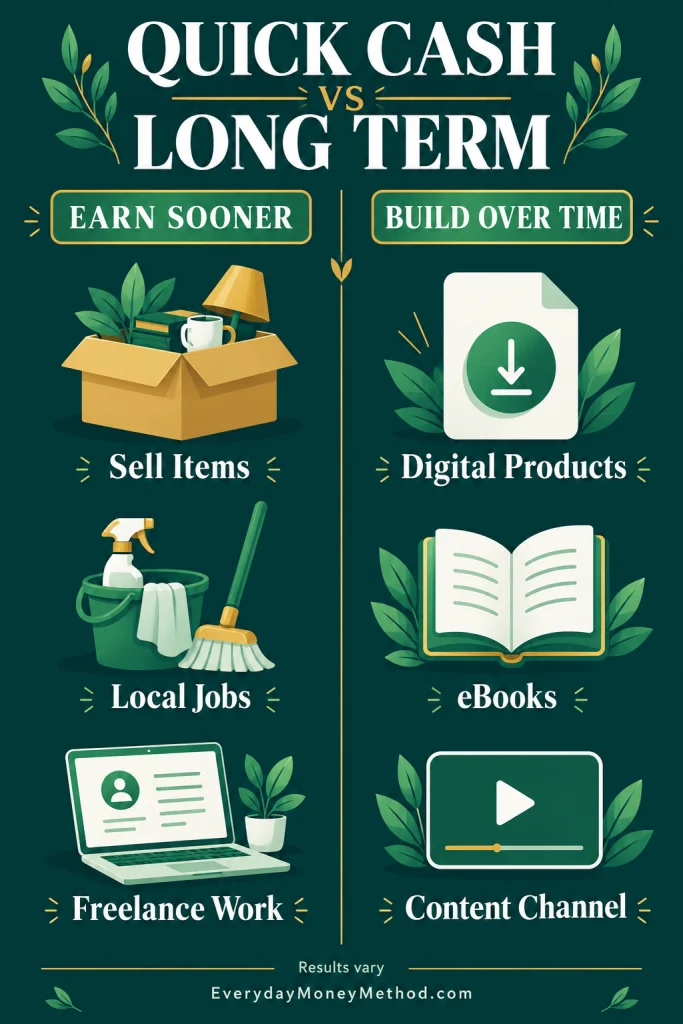
22. Sell a Useful Digital Download
A meal-planning sheet, a simple invoice template, a pet-care checklist, or an original printable could become a product people buy more than once. But the “make it once, sell it forever” version skips the difficult part: getting buyers to notice it.
Etsy’s published fee structure includes a $0.20 listing fee, a 6.5% transaction fee, and payment-processing costs that vary by country; some sellers also face setup or advertising fees.
Begin with one product solving a specific problem, show how to use it, and test whether anyone buys it before producing a hundred variations. Check licensing and don’t resell someone else’s template as your original work.
23. Publish a Short, Useful eBook
If you have genuine knowledge about a narrow subject, a short, practical guide might work better than an enormous book written to sound impressive.
Amazon Kindle Direct Publishing offers 35% and 70% ebook royalty options subject to eligibility and other conditions. In July 2026, the U.S. list-price ceiling for the 70% option increased to $12.99.
Those royalty percentages are not sales forecasts. Editing, formatting, cover design, and getting readers take time. Start by answering a specific question your intended readers actually ask.
24. Rent Out Space You Already Control
A spare driveway, garage space, or legal parking spot can be useful to someone else. Neighbor offers a marketplace for some types of storage and parking rentals. Its host page says listing is free and cites a processing fee of 4.9% plus $0.30 for paying renters.
Before listing, check your lease, homeowners association rules, zoning, insurance coverage, security, and what items tenants may store. This is not a good option if you do not have permission to rent the space or can put household safety at risk.
25. Build a Blog, Newsletter, or Video Channel
Creating content can lead to advertising, sponsorships, affiliate income, or your own products. But it is one of the least suitable options if you need a reliable payment next week.
YouTube, for example, has specific eligibility and review requirements before creators can receive advertising revenue through the Partner Program. Reaching view or subscriber thresholds doesn’t automatically guarantee approval.
Choose a subject you can keep explaining even when nobody is watching yet. Think of content as a longer-term experiment and let faster, more dependable work handle urgent expenses.
What Real Side Hustlers Say That Most Idea Lists Leave Out
The most useful firsthand discussions aren’t always the ones with the biggest income numbers.
The Reddit user who did local weeding didn’t begin with a logo or an expensive website. They gave neighbors a clear price for a visible job. Another person who tried several income streams said small online tasks were frustrating, while product reselling worked better for their circumstances. A third reported that user-testing income declined sharply in 2026 despite previous success.
These stories can’t tell you the odds of success. We don’t know all their costs, backgrounds, markets, or whether their stated figures are complete. But they point to three practical questions: Who will pay you? What will you deliver? What will you keep?
There is no shame in choosing a straightforward local job over an internet trend. And there is nothing wrong with trying a digital option, provided you understand that “flexible” often means “not guaranteed.”
How to Start a Side Hustle This Week Without Overspending
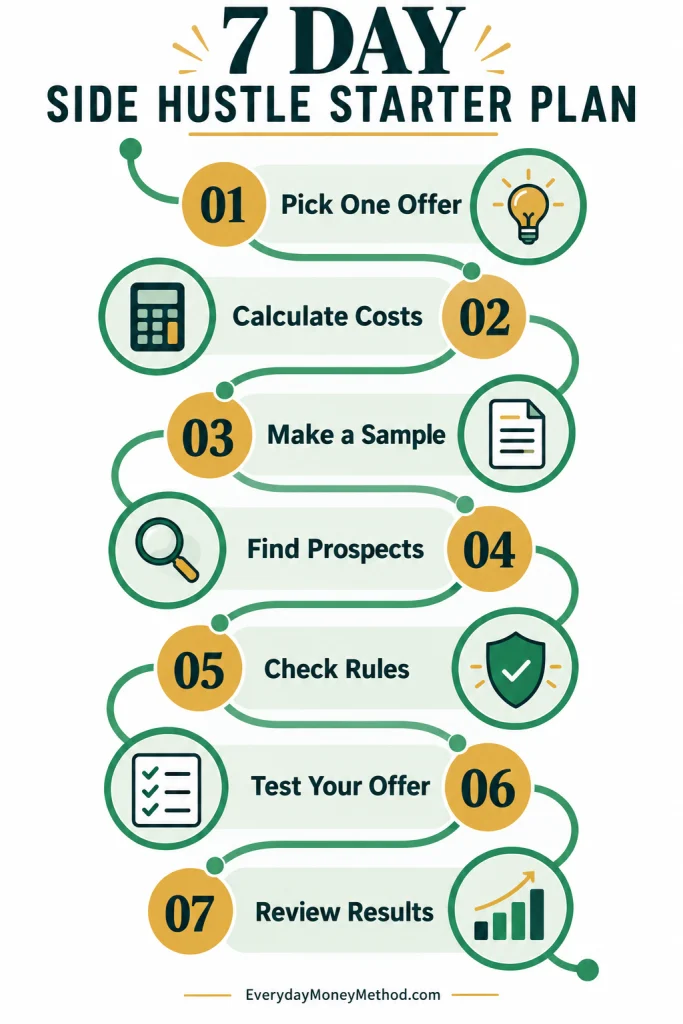
Day 1: Pick one offer. Don’t sign up for seven platforms. Choose a service you can complete with tools or skills you already have.
Day 2: Work out the numbers. Estimate customer price, materials, platform fees, travel, and time. Include an allowance for future expenses. Decide what would make the work worth doing.
Day 3: Make one example. List one item, prepare a sample edited document, create a simple video, or describe a clear local service. A real sample is more useful than an elaborate brand identity.
Day 4: Find a few real prospects. Ask people who already know your work, contact relevant businesses politely, or use a legitimate marketplace. Personalize your offer and don’t spam strangers.
Day 5: Check the rules. Review local permits, insurance, employer restrictions, platform fees, safety requirements, and tax obligations before accepting work.
Days 6 and 7: Run a small test. Complete one real job or list a few real products. Track total time, cash received, and expenses. If nobody buys, improve the offer before investing more.
A hypothetical 30-day target of $200 could come from four $50 jobs or ten $20 net sales. That’s a way to break down a goal, not an assurance those jobs or sales will appear.
Don’t Confuse Revenue With the Money You Keep
For a U.S. side hustler, the simple calculation is:
Cash collected − platform fees − supplies − delivery/travel costs − other business expenses = estimated profit before taxes.
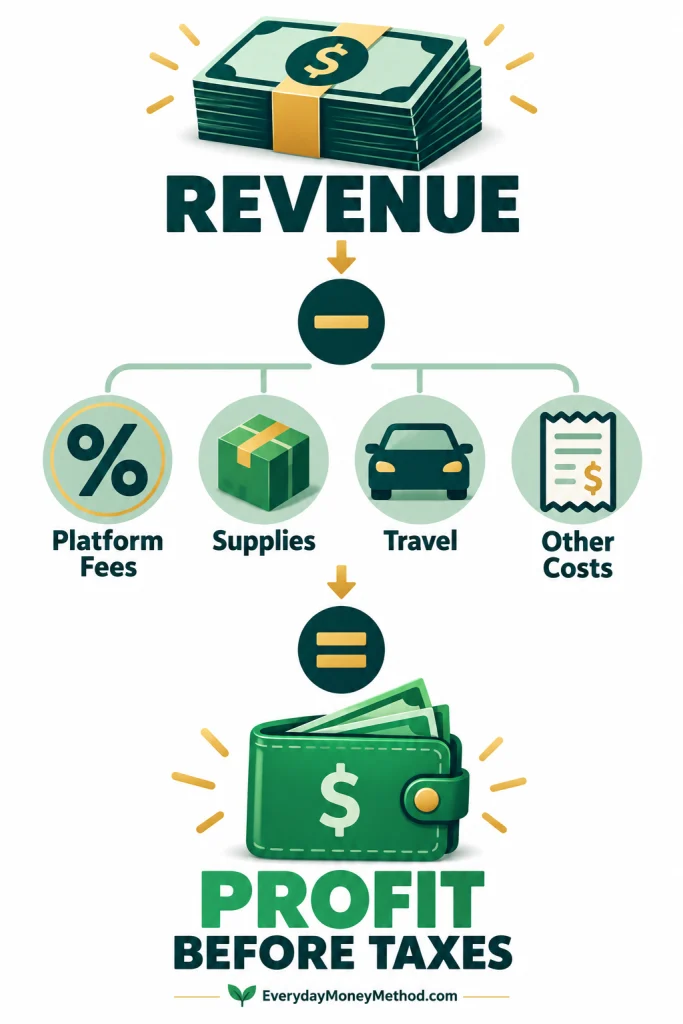
Then track the time spent getting the job, doing the work, communicating, and getting paid. A “two-hour job” that takes another hour of driving and messaging is really three hours of your time.
The IRS says gig income must generally be reported even if it comes from part-time work, cash payments, or work with no tax form. It also states that self-employed people with $400 or more in net earnings generally have a federal filing obligation, even when the work is temporary. Estimated taxes may apply.
If you drive for work, keep a mileage log. The IRS lists a 76-cent-per-mile optional business standard mileage rate for July 1 through December 31, 2026, up from 72.5 cents for the first half of 2026. That rate is a tax-deduction method, not the amount of cash your car actually costs per mile and not a reimbursement paid to every driver. Eligibility and deduction methods vary.
Side Hustle Scams Worth Skipping in 2026

Be especially careful with unsolicited messages about “product boosting,” “optimization tasks,” easy data entry, or jobs that pay large amounts for little work. The FTC warned in 2026 that fake side-hustle offers often ask for money or personal information. Its task-scam guidance explains how fake app balances can be used to pressure people to deposit cryptocurrency before they supposedly withdraw earnings.
A legitimate platform may have disclosed fees, reasonable equipment costs, or qualification requirements. But a stranger demanding that you send money to unlock pay you’ve supposedly earned is a major warning sign. Independently verify the company and use its official website, not a recruitment link from an unexpected text.
Also be cautious of exaggerated claims about passive income, expensive coaching programs, fake reviews, and “guaranteed” earnings screenshots. Your best protection is to insist on a clearly defined task, a real customer, written terms, and a way to calculate what you keep.
Frequently Asked Questions
What is the best side hustle for someone with no experience?
Selling things you already own or offering a small, safe neighborhood service is often a reasonable first experiment. Neither requires pretending to be an expert. Choose work you can do reliably and check local requirements before taking paid jobs.
Which side hustles can I do from home?
Freelance editing, virtual assistance, tutoring, website updates, product listings, online research participation, and usability testing can be done remotely when the client and platform allow it. Access and eligibility differ by location.
Can I make $500 a month from a side hustle?
It’s possible, but not promised. At $25 profit per completed job, you would need 20 jobs to reach $500 before personal income taxes. At $100 profit per job, you’d need five. Whether those jobs exist is the harder question. Compare the required hours with your real calendar.
What side hustle pays fastest?
Selling an item to a legitimate local buyer can produce cash quickly. A nearby service job may pay as soon as it is completed. Online platforms often require verification, approval, and payout processing, so check timing before counting on the money.
Are online surveys a good side hustle?
They can provide occasional extra cash, but many people find the pay and availability too inconsistent for regular bills. Specialized research studies may pay more for selected participants, while unpaid screening and limited invitations reduce the predictability.
The Best Side Hustle Is the One You Can Test
If you have two spare hours this weekend, you don’t need 25 new plans. You need one reasonable experiment: list a few unused belongings, offer a neighbor a defined service, or send a small freelance proposal backed by a real sample.
A side hustle can help you make extra money in your spare time, but it should fit your life rather than consume every free moment of it. Start with the smallest version you can do well. Record what it truly pays. Then decide whether it’s worth doing again.
References and further reading
These resources support the general educational topics discussed; individual circumstances and current rules may differ.
Continue learning
side hustles for women · monthly budget guide · saving money quickly · emergency fund guide

Personal finance writer and content creator at Everyday Money Method.
Editorial Policy · Report a correction